

Is It Normal to Hate Your Body?
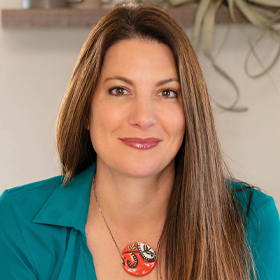 By Leslie Schilling
Do you remember the moment when you first questioned whether or not your body was good? The moment you wondered if eating this or that food was good or bad?
Think back to your childhood or early teen years. Think back to the early influences in your life—parents, grandparents, teachers, Sunday school leaders, Uncle Bob, siblings, friends, maybe even a pastor or pediatrician. Think about all of the people in your circle of trust. People you loved. People who loved you. People who, deep down, only wanted what was best for you.
Not all of our moments look stark and overt. Some are much subtler, building significant distress and doubt over months and years until we’re swimming in self-doubt. Either way, most of us living in this body-obsessed culture have a moment like this.
Are you sure you want to eat that? Won’t that mess up your diet? Is that really the size you want? Aren’t you trying to lose weight? It would be best if you didn’t eat that snack. Maybe you should try Weight Watchers.
These were the words of caution my mother, sister, and I regularly heard from my grandmother growing up. Many adored and looked up to my God-fearing, strong-willed, wartime turned polio-epidemic nurse of a grandmother. What an amazing woman she was! Oh, how I loved Mabel. But my early distrust of the body I was living in came from her. I had no idea body hatred was a legacy I didn’t have to accept, and you don’t have to accept it either.
None of This Was Nanny’s Fault
For generations, humans (not a loving God) attempting to earn God’s grace set a bar of earthly purity so high that we were doomed to fail. It makes sense that we’re here—at the crossroad between a legacy that was and a legacy that no longer has to be.
The struggle dates back to the Garden of Eden and Adam and Eve’s first family. After the fall, Adam and Eve covered their nakedness and felt shame for the first time (see Genesis 3). They had concerns about their bodies and food that they’d never had before.
The early Christian church was profoundly influenced by Roman culture. Rome (around the time of the apostle Paul’s letters) was a culture driven by patriarchy. In those times, if you weren’t a man, you were the property of one. We still see various shades of this in our culture.
The idea of the objectification of women didn’t end in the first century. Some churches even today suggest that keeping a trim body and maintaining attractiveness for the husband’s benefit is a godly activity, maybe even a calling. Need a little help being obedient? Never fear; diet schemes wrapped in a Bible verse with a side of extra prayer can help you get there. It’s no wonder Kate’s mom and Nanny felt the way they did—the church family in which they’d spent their whole life preached it.
It’s Not Only an Anti-Grace Message; It’s a Dangerous One
Years ago, a newly married couple walked into my office. Having just been diagnosed with a life-threatening eating disorder, the young woman sat silently. She had very little energy, not even enough to speak. On the other hand, her husband was concerned that she might not be able to continue the highly restrictive diet their congregation was doing together. He didn’t yet understand that this churchwide diet could kill her.
It wasn’t my first experience with a patient suffering from an eating disorder, but it was my first experience of a church that practiced and promoted one.
Dieting, which is a common and seemingly benign practice, is disordered eating. Our diet-crazed and body-obsessed culture has become intertwined with the church—it’s a dangerous pairing of the secular and the sacred. How can we hate a body divinely designed for our unique walk in life? We aren’t born with body hatred; as I said earlier, we learn it, even in “safe” places such as the church.
It’s not a new thing for places of worship to promote particular ways of eating. You can find food rules, body shaming, and diet plans wrapped in an out-of-context Bible verse in almost every congregation in America. I get it. I used to think of dietary purity as my Christian duty as well. It seemed like a legitimate way to depend on God more and even grow stronger in my faith.
I even believed it until I saw how this approach was wrecking believers—their lives, health, relationships, and families. I saw believers look down on one another because of the food they ate or didn’t eat. I watched as church members praised my friend for her weight loss as she was dying from cancer.
After years of witnessing this hurt and harm, I experienced another very different moment—the moment I realized, as both a lifelong Christian and a longtime nutrition professional, that dieting to gain worth and offering pretend grace for one another were nothing but lies.
Christian values such as “love your neighbor,” “don’t judge one another,” “don’t covet,” and “care for the least of these” have collided with a culture profoundly strung out on appearances, healthism, and perfectionism. Given this culture’s false definition of health, the value of thinness falls seamlessly into the purity culture of many churches. After all, this is what the medical field deems healthy, right?
The “thin ideal,” or the thought that everyone can just work hard enough and be thin, is the Western world’s ideal. Not only is it untrue (much more on that in my book); it’s also incongruent with our divine design.
When we deny our bodies, aren’t we also denying that we are made in the image of God—the God who knows each one of us? I believe that just as we have different colors of skin, speak various languages, and have vastly diverse shoe sizes, we are also meant to live in bodies of all shapes, sizes, and abilities. Not one human of any color, tongue, size, or range of ability is a mistake.
The belief that it’s normal to hate your body is manufactured—a lie handed down from generation to generation. It becomes a cyclical trauma. The experience of being at war with our bodies doesn’t have to be passed down like a family heirloom. There’s a truth you can claim instead—namely, that your body was made just for you by the God of love, no matter what the world says.
________
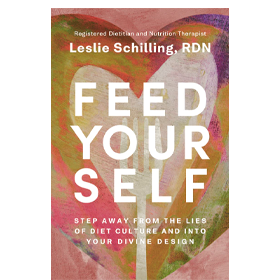 Adapted from Feed Yourself: Step Away from the Lies of Diet Culture and into Your Divine Design by Leslie Schilling. Click here to learn more about this book.
Break the chains of diet culture once and for all.
Christian dietitian and nutrition therapist Leslie Schilling counsels hundreds of people every year who are struggling with food, body concerns, chronic dieting, and disordered eating. She helps them understand diet-culture myths, fight the lies we've been told (and sold), and discover the truth about health, well-being, and how God sees us.
In Feed Yourself, you'll learn how to:
- Pinpoint the lies of diet culture all around you, even in our places of worship
- Understand that health is far more than what we eat or how we move
- Step away from the shame and guilt you may feel about your body
- Trust your body and recognize the cues your body gives you Identify what your body really needs
- Find freedom in food and learn to define health for yourself
It's time to accept that you are fearfully and wonderfully made—a truth unrelated to your body size or what's on your plate. Cheers to freedom!
Leslie Schilling is a registered dietitian, sports nutritionist, and nutrition therapist. She owns a coaching practice specializing in nutrition counseling for families, people with disordered eating concerns, professional athletes, and performers. In addition to running her practice, Leslie has served as a performance nutrition consultant for Cirque du Soleil® and as an expert contributor to U.S. News & World Report, sharing advice on parenting and health.
Leslie has been featured in media outlets like Health, Women's Health, Self, Pregnancy Magazine, the Yoga Journal, the Huffington Post, and on HGTV. When she's not spending time with her family, you can find her sharing anti-diet messages through media and on speaking platforms across the nation. Leslie is the creator of the Born To Eat® approach and coauthor of the award-winning book Born to Eat: A Baby-Led Weaning Guide That Supports Intuitive Eating for the Whole Family. She and her family live in Las Vegas, NV.
________
 Looking for More?
Sign up today for the Zondervan Books Faith in Action monthly email newsletter and receive the PDF eBook Three Principles of and Three Guidelines for Encouragement by Dr. Larry Crabb and Dr. Dan Allender, adapted from Encouragement: The Unexpected Power of Building Others Up.
Each month you’ll receive an email with a deal, a feature article, and book samples designed to help you find more life-changing books for your reading and listening lists.

