

Ways to Help You Avoid the Comparison Trap

By Sarah Bragg
I hit my personal breaking point.
I wanted to lessen whatever was driving comparison and pulling me away from connection and creativity. I wanted to remove the source of my negative feelings like self-righteousness, jealousy, and angst.
I didn’t want to feel those negative thoughts every time I opened my social media accounts. I wanted to see if there was a way to feel creative again, to see if there was a way to enjoy my life and create something—even if nobody else saw it or gave it a like.
Can I tell you the final straw that made me take a break from social media? It was a parade.
Not just any parade, though. It was the parade that celebrated the Atlanta Braves World Series victory.
We lived about fifteen minutes from the Braves stadium, and when we moved to Tennessee, leaving the Braves was at the top of the con list. Attending games was a big part of our family’s life. I knew we couldn’t attend the parade now that we lived in a different state, and I felt intense jealousy toward all the people I knew who would attend.
Even though that was a petty, childish reason to avoid social media, it was motivation to take a break.
I knew that nothing good would rise up in my heart by being online during that time. I committed to not checking social media for forty-eight hours. Two days turned into a week, and before I knew it, I was on a break from social media. The Braves parade (petty or not) was the motivation I needed to start.
Initially, it was shocking how many times I went to open that app. Without me even thinking about it, my fingers would magically return to where it once lived on my phone.
After some time, I opened the app again so I could check my messages. I hated the thought of people feeling like I was ghosting them if they contacted me.
I put the app in a folder on the farthest screen from my home screen. I allowed myself to check messages once a day. I would open the app and then literally use my left hand to cover all the images and stories so that I could see only my messages. I didn’t want to get back on the comparison-and-competition ride.
I lived social media free for four months.
Let me tell you. Those were some great months. I had more time on my hands. Instead of endlessly scrolling, I played solitaire on my phone when I got bored. (It’s not lost on me that I was going to Instagram because of boredom.) Doing something like that helped me take a baby step away from social media. Sure, I was still on a screen, but solitaire didn’t cause me to compare and compete.
I leaned into creativity. I purchased a guitar. I played the ukulele. I bought a hand-lettering guidebook. Not only that, but I got active. I started walking again. I started reading more fiction. I reached out to a friend, and we started going for coffee every week, talking face-to-face instead of typing words on a screen, and wandering around antique stores.
All of these things were beneficial.
All of these things inspired me.
All of these things left me feeling better instead of worse.
Cultivate Your Creativity to Help Combat Comparison
Cultivating creativity can go a long way in countering the tendency to compare. Brené Brown said, “Creativity, which is the expression of our originality, helps us stay mindful that what we bring to the world is completely original and cannot be compared. And, without comparison, concepts like ahead or behind or best or worst lose their meaning.”
So much creativity is packed inside you. It’s what makes you original—what makes you, you. And tapping into that creativity can be integral to your happiness.
Until recently, I had never made the connection that creativity helps combat comparison. Maybe that’s a new revelation to you too.
Think about it in regard to children and what they create. A healthy childhood is nearly defined by creativity, from the art they make to how they dress themselves to what they play. We encourage kids’ creativity. We see it as essential to their well-being.
Creativity can be shared publicly or not, but if you share online, share with some level of caution. Wanting your art to be seen isn’t a bad thing. My girls used to jump up and down to show me what they created. Even now they are excited to see my smile when they present any work of their own hands and imagination. I feel the same about what I create. I want to share what I create with others, much like my girls do. But I do so carefully, knowing I will have to fight hard against comparison.
Creativity is about being unique, while comparison is about competition. Comparison is about conforming to what other people are doing and trying to do it better.
When I stepped back from social media, I gave myself space to be creative without feeling the pressure to share my content online. Creativity without competition allowed me to be inspired again. I was able to stop worrying about how my art was received. It gave me space to stop obsessing over what others were doing, hitting the numbers, measuring up, or whether I was “winning.”
Stepping away from social media allowed me to do something that was just for me. It allowed me to connect to myself—to what I found inspiring, interesting, fun. And I was able to connect with others from a place of happiness for them because I wasn’t focused on how I compared.
Choose Compassion and Drop the Measuring Stick
In our letting go of comparison, we also need to develop self-compassion and self-acceptance.
Comparison does not cultivate self-acceptance, belonging, or authenticity. Instead, it makes us judge our creative selves and feel like we don’t measure up. We try to copy what someone else is doing because what they’re doing is “working.” We conform and settle for fitting in instead of being truly known for who we are.
And listen, I get it. Being honest about who we are is scary, especially online, where people we don’t even know feel that they can comment on and critique everything we say, do, or post.
To stay online yet free from comparison, we have to put away the measuring stick. Resist the urge to compare. Show compassion and acceptance toward yourself with what you create.
When I was struggling, I found it hard to show up online in a way that felt authentic. Posting about ideas I was thinking about or stories about our life seemed too vulnerable at the time. I felt like if I shared, it would only be because I was staring at a measuring stick between me and someone else in the same field of work.
So instead, I shared pictures of our horses. No commentary. Just what my eyes saw daily. And when I shared, I would remind myself that what I do or don’t do is okay. I worked to show myself compassion and acceptance.
The more we practice dropping the comparison stick, the less we will succumb to the pressure to compare and compete.
So when you feel the urge to doom-scroll through your social feeds during those sleepless hours of the night, I challenge you to choose a better way.
Choose to cultivate creativity.
Choose to be compassionate toward yourself.
Choose to drop the measuring stick.
________
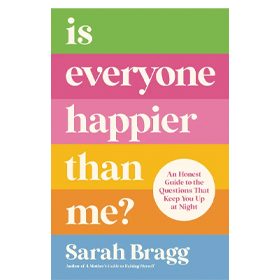 Adapted from Is Everyone Happier Than Me? An Honest Guide to the Questions That Keep You Up at Night, by Sarah Bragg. Click here to learn more about his book.
The point where you feel like your life is unraveling can actually be a place of unimaginable growth—an awakening—if you're willing to ask yourself a few simple questions.
In an age where everyone else's successes are flaunted in front of you on social media, it can be a struggle to feel true happiness and contentment exactly where you are. Throw in difficult circumstances—loss, heartbreak, change, midlife—and it's easy to understand why you feel lonely, lost, unsure of yourself, stuck, and, if you're honest with yourself, flat-out unhappy.
Is Everyone Happier Than Me? provides practical and relatable answers to the questions you've probably already been asking about your life, and poses a few more, to help you figure out what's standing in the way of your happiness, peace, and connection. Author, podcaster, and midlife mom Sarah Bragg is a trustworthy comrade for the journey as she shares the valuable lessons she's learned in her own hard seasons to help you:
- Identify the unhealthy habits you do when you feel unhappy and how to overcome them
- Discover simple ways to find peace even in the murky middle of hard seasons
- Find new ways to connect with others and yourself
- Embrace exactly where you are even as you try to move forward
It's time to let go of the ideal of a perfect life and allow yourself to be a work in progress. And there's no better time to find happiness than right here in the middle.
Sarah Bragg is a well-loved communicator and author, and you can find her hosting the popular podcast Surviving Sarah. She is also the author of A Mother's Guide to Raising Herself: What Parenting Taught Me About Life, Faith, and Myself. She is a wife, mother of girls, and creative entrepreneur. Sarah is a master at brewing coffee and helping others survive well right where they are. Sarah and her family reside in Tennessee. You can find more from her at SarahBragg.com and at @sarahwbragg.

