

Is God Real?

By Lee Strobel
Among those who are convinced that God doesn’t exist is British comedian and armchair philosopher Ricky Gervais. In an essay titled “Why I’m an Atheist,” he explained that when he was about eight years old, Jesus was his hero. One day, he was at the kitchen table drawing a picture of Christ when his older brother Bob came in and asked, “Why do you believe in God?”
Said Gervais, “Just a simple question. But my mum panicked. ‘Bob,’ she said in a tone that I knew meant, ‘Shut up!’ Why was that a bad thing to ask? If there was a God and my faith was strong it didn’t matter what people said. Oh . . . hang on. There is no God. He knows it, and she knows it deep down. It was as simple as that. I started thinking about it and asking more questions, and within an hour, I was an atheist.”
Others have reached a similar conclusion for varying reasons. The founding publisher of Skeptic magazine, Michael Shermer, told me he was led to Christ by his friend George when they were in high school, though Shermer admits he had mixed motives because he thought a conversion might help his odds of dating George’s sister. Shermer lived as an evangelical Christian until he gradually lost his faith in college, where a professor attacked his beliefs and Shermer didn’t find satisfying answers to some of his nettlesome theological questions.
Then his college sweetheart became paralyzed in a motor vehicle accident. Shermer asked God to heal her, and yet she remained disabled. I asked Shermer, “Was this the final nail in the coffin of your faith?” He replied, “Yeah, that pretty much did it. I was like, ‘Ah, the heck with it.’”
Can you relate to that? Has there been a time when you called out to God during a crisis but felt like you were only talking to yourself? For some people, God seems too hidden to be real.
Charles Templeton was the pastor of a burgeoning church in Toronto and pulpit partner of renowned evangelist Billy Graham before morphing into Canada’s best-known spiritual skeptic. When I asked Templeton if there had been one thing in particular that caused him to lose his faith in God, he said it was a photograph in Life magazine many years earlier.
“It was a picture of a Black woman in northern Africa,” he told me. “They were experiencing a devastating drought. And she was holding her dead baby in her arms and looking up to heaven with the most forlorn expression. I looked at it and I thought, Is it possible to believe there is a loving or caring creator when all this woman needed was rain?”
He shook his head. “I immediately knew it is not possible for this to happen and for there to be a loving God. There was no way.”
Interestingly, though, Templeton broke down in tears during our interview because he said he missed Jesus—and there’s reason to believe he did ultimately return to faith in God on his deathbed a few years later.
Scholar Bart Ehrman said he left Christianity to become an agnostic partly because his research on the text of the New Testament cast doubt on the Bible’s reliability—ironic because he dedicated his book on the topic to his mentor, Bruce Metzger, who told me that his own study of the matter only served to deepen his faith.
Like Templeton, Ehrman also attributed his abandonment of Christianity to his inability to reconcile the existence of pain and anguish with a loving God. “For many people who inhabit this planet, life is a cesspool of misery and suffering,” he wrote. “I came to a point where I simply could not believe that there is a good and kindly disposed Ruler who is in charge of it.”
Among evangelical Christians, a phenomenon called deconstruction has been gaining notoriety in recent years. Some people have found that this systematic dissecting and reexamining of their beliefs has led to a stronger and more secure faith in the end. But Alisa Childers, author of Another Gospel?, has warned that “sometimes the Christian will deconstruct all the way into atheism.” In many instances, she said, the deconstructed faith fails to retain “any vestiges of actual Christianity.”
The size of the trend is uncertain, but by 2023, there were already nearly 350,000 posts on Instagram using the hashtag #deconstruction. Said Sean McDowell and John Marriott in their book Set Adrift: Deconstructing What You Believe without Sinking Your Faith, “College students and young adults are finding it increasingly difficult to retain their faith and, as a result, are deconverting from it.”
As for me, however, I went in a far different direction. I deconstructed my atheism.
From Skepticism to Belief
For years, I was a happy spiritual skeptic, with degrees in journalism and law and enjoying my career as a legal editor at the Chicago Tribune. Then my agnostic wife’s conversion to Christianity prompted me to spend nearly two years investigating whether God is real, focusing largely on the resurrection of Jesus.
Reluctantly, I became convinced that Jesus not only claimed to be the unique Son of God, but he also proved it by rising from the dead. I put my trust in Christ in 1981, and my life has never been the same—in a good way!
In fact, I’ve seen that kind of story again and again among people I’ve encountered down through the years. For example, just from within my sphere of relationships are these stories:
- J. Warner Wallace, a cold-case homicide detective, used his well-honed investigative skills to painstakingly analyze the historical reliability of the Gospels. He concluded that these written accounts “reliably and accurately described the resurrection of Jesus without ulterior motive.” When he realized this, “everything changed for me.” He renounced his atheism and wrote the bestselling book Cold-Case Christianity.
- Sarah Salviander, an astrophysicist raised by atheists, believed that Christianity was “philosophically trivial.” But as she was studying deuterium abundances in relation to the big bang, she became “ ‘completely and utterly awed’ by the underlying order of the universe and the fact it could be explored scientifically”—and she became a Christian. “I was awakened,” she said, “to what Psalm 19 tells us so clearly: ‘The heavens declare the glory of God, the skies proclaim the work of his hands.’”
- Stephen McWhirter, a musician, was a methamphetamine addict. The troubled son of a pastor, he hated Christianity and yet he inexplicably accepted a book from a friend about Jesus. As he read it at 3:00 a.m. amidst his drug paraphernalia, he encountered the presence of the living God. “I went from addiction to redemption,” he said, “because God’s real.” Today he writes Christian worship songs.
- Guillaume Bignon, a cynical software engineer, became a Christian after studying, among other topics, the nature of morality. Concerning his exploration of faith, he said, “I had to force myself to be open-minded because I really wanted everything to be false.” But his skepticism withered the more he explored the evidence. He not only became a Christian, but he went on to earn his doctorate in philosophical theology and write the memoir Confessions of a French Atheist.
- Louis Lapides, a spiritually skeptical Vietnam veteran, examined the ancient messianic prophecies, prompting him to conclude that Jesus, and Jesus alone, is the divine Messiah sent to save Israel and the world. Lapides, raised Jewish, became a Christian and later a minister. “My friends knew my life had changed, and they couldn’t understand it,” he said. “I would say, ‘Well, I can’t explain what happened. All I know is that there’s someone in my life, and it’s someone who’s holy, who’s righteous, who’s a source of positive thoughts about life—and I just feel whole.’”
- Holly Ordway, an atheist professor of English literature, started to ask herself, What if God is real? Christian fiction planted seeds in her imagination; Christian philosophers provided a counterpoint to her naturalistic worldview; and her fencing coach turned out to be a Christian. “I realized that I could ask my coach questions and feel safe and respected while having a dialogue about these issues,” she said. She ultimately found that the evidence of history “was best explained by concluding that the resurrection really happened.” She became a Christian, a professor of apologetics, and author of the book Not God’s Type: A Rational Academic Finds a Radical Faith.
- Cody Huff, a drug addict and convicted burglar, was living on the streets of Las Vegas when he went to get a free shower at a church. A volunteer offered a hug and the words “Jesus loves you”—and it was the pivotal moment of his life. “Right away something was different,” he told me. “The more I heard about Jesus, the more I wanted to hear. I couldn’t get enough of the Bible.” He came to faith, was ordained as a Baptist minister, and devoted the rest of his life to helping the homeless.
- Michael Brown, a Jewish hippie with an insatiable appetite for illicit drugs, went to rescue two friends who were attending church in pursuit of girls. Brown got into discussions with Christians about why they believed that God is real. He became a follower of Christ, and now, with a doctorate in Near Eastern Languages, he is among the foremost defenders of Jesus being the Messiah.
- Thomas Tarrants, a Ku Klux Klan terrorist, was wounded in a shoot-out with the FBI when he went to firebomb the home of a civil rights leader in Mississippi. Sentenced to prison, he escaped and survived another shoot-out in which an accomplice was killed. He then spent three years by himself in a six-by-nine-foot cell—with a Bible. He delved deeply into the Scriptures, eventually coming to a profound faith in Christ that liberated him from his racial hatred. Finally released, he earned his doctorate, was named president of the C. S. Lewis Institute, and became a champion of racial reconciliation.
Again, these are just a few of the people I have personally known, and I could have added many others. All of them had some things in common. Despite their initial doubts about God, they kept an open mind and pursued the evidence and arguments wherever it took them. In the end, they were willing to reach an informed verdict in the case for God.
Yearning for the Transcendent
Let’s face it, the question of whether God is real resonates deep inside all of us. Who doesn’t want to know where we come from and where we’re going after we die? Staring into the darkness in the middle of the night, we tend to wonder about the purpose of life.
Are we accidents of nature, destined to flourish for a brief moment and then wither and decay forever? Or are we the creation of a beneficent God who loves us and imbues meaning into our existence? Is there really hope after the grave, or is that merely wishful thinking from the only species that is able to recognize the horror of its inevitable demise?
From time to time, we feel an innate longing for God—which might actually be evidence that he is real. “One argument for God’s existence regards the aching absence of God in human experience,” said philosopher Douglas Groothuis. “There is, on the one hand, the pained longing for the transcendent and, on the other, the sense of the inadequacy of merely earthly goods to satisfy that longing.... We all experience a deep sense of yearning or longing for something that the present natural world cannot fulfill—something transcendently glorious.”
He pointed out that C. S. Lewis talked about several instances in which he sensed something wonderful beyond his grasp. “These were fleeting but invaluable moments, which he called the experience of ‘joy,’ ” Groothuis said. “They were indicators that the everyday world was not a self-enclosed system; a light from beyond would sometimes peek through the ‘shadow lands.’ This thirst, which is intensified by small tastes of transcendence, indicates the possibility of fulfillment.”
Wrote Lewis in Mere Christianity, “Creatures are not born with desires unless satisfaction for those desires exists. A baby feels hunger: well, there is such a thing as food. A duckling wants to swim: well, there is such a thing as water. Men feel sexual desire: well, there is such a thing as sex. If I find in myself a desire which no experience in this world can satisfy, the most probable explanation is that I was made for another world. If none of my earthly pleasures satisfy it, that does not prove that the universe is a fraud. Probably earthly pleasures were never meant to satisfy it, but only to arouse it, to suggest the real thing.”
So perhaps our longing for the transcendent is a clue that it actually does exist. And yet there could be another explanation. Maybe our imagination conjures up the idea of God because we desperately want to be rescued from our fear of death. Could it be that we are so frightened by our own mortality that we subconsciously manufacture false ideas about a loving deity and eternity in heaven in order to ease our death anxiety?
One way or the other, our beliefs have very real consequences. How we live our lives and what we value the most inevitably flow from our convictions. The paramount question becomes whether our beliefs are based on fact or fantasy.
My motive has been to discover truth, regardless of what the implications might be. Maybe that’s fueled by my investigative reporting at the Chicago Tribune, where I relentlessly followed the facts to make sure I was exposing the news as accurately as I could. Or maybe it’s rooted in my law training, where I came to admire the beauty of a legal system designed to ferret out the truth. Regardless, I became obsessed with getting to the bottom of whether or not there’s a God and then living with the consequences, one way or the other.
If he was real, I wanted to know him personally. And if he wasn’t, then I wasn’t interested in playing any religious games.
Because truth matters.
________
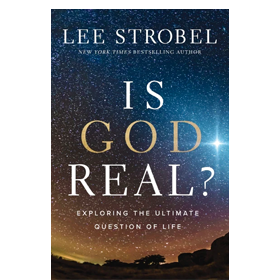 Taken from Is God Real? Exploring the Ultimate Question of Life by Lee Strobel. Click here to learn more about this book.
It's no coincidence that one of the most asked questions on any search engine is: "Is God real?"
When life feels overwhelming, we want to know if there really is a deity who loves us, knows us, and cares about what happens to us. Join investigative journalist and former atheist Lee Strobel on a quest to determine whether we can know with confidence that God is real.
Lee Strobel's landmark book, The Case for Christ, is one of the most respected defenses of Christianity of all time. Now in Is God Real? Lee weaves together material from his previous books with the latest evidence from the most brilliant scientific and philosophical minds to answer the pressing questions on our hearts and minds.
In this rational exploration of the proof of God's existence, Lee investigates:
- If God is real, why is there so much suffering?
- How do we know which God is real?
- If God is real, why does he seem so hidden?
- How do recent scientific findings support the claim that God is real?
- If God is real, what difference does it make?
Written for skeptics and believers alike, Is God Real? is a life-changing exploration of the question that matters most.
Lee Strobel, former award-winning legal editor of the Chicago Tribune, is a New York Times bestselling author whose books have sold millions of copies worldwide. Lee earned a journalism degree at the University of Missouri and was awarded a Ford Foundation fellowship to study at Yale Law School, where he received a Master of Studies in Law degree.
He was a journalist for fourteen years at the Chicago Tribune and other newspapers, winning Illinois’ top honors for investigative reporting (which he shared with a team he led) and public service journalism from United Press International. Lee also taught First Amendment Law at Roosevelt University.
A former atheist, he served as a teaching pastor at three of America’s largest churches. Lee and his wife, Leslie, have been married for more than fifty years and live in Texas. Their daughter, Alison, and son, Kyle, are also authors. Website: www.leestrobel.com.

