

Build a Bible Study About Love and Charity Using the TCR
February 1, 2024
The Thompson Chain-Reference Bible features many studies on how to treat others and live by the Golden Rule (Mt 7:12). There are many topics we can explore that provide insights and examples of how to treat others in a loving way because of who God is and who he created us to be. The topics of Love and Charity, both of which are featured in the TCR stand out as a starting point for this path of study since they often come to mind when discussing how to treat others.
The rationale for this article is simple: at different points in our lives, we all need a refresher in how to build other people up and how to show love to one another. Jesus said it all when he told his disciples, “By this everyone will know that you are my disciples, if you love one another” (John 13:35). So we see that this course of study should be required reading for anyone who wants to either become a disciple of Jesus or be identified as one.
Love is an essential factor in the Christian life. Showing charity toward one another confirms our mutual identity as followers of Jesus and fellow individuals who possess the inward Holy Spirit.
So let’s get started. In this post, we’ll demonstrate how one can build a Bible study about love and charity for either personal or small-group use using the many features of the TCR.
Choosing Our Topics to Study
To find our topics, we simply look to the Alphabetical Index of Topics for the topics called Charity and Love. We can then choose the specific topic we want to study and follow their topic numbers to the Numerical Index of Topics.
When we combine the two topics in the Alphabetical Index, we see there are 42 topics about love and charity that we can explore. That’s a lot of information on this critically important subject, nuanced in many different ways. And reviewing the surrounding topics and additional suggested topics gives us many other options of study for personal devotions, group study, classroom preparation, and sermon preparation..
Charity
When we look at the topics Charitableness and Charity, we see that the subtopic of Charitableness called Duty of, and the major topic called Charity, both use topic number 659. We also see that Charitableness – Uncharitableness covers topics 659-662. Turning to the Numerical Index leads us to all the places we can find all of the topics dealing with charity.
Since this topic includes both charitableness and uncharitableness, we’ll see both sides of charity in these topics. This is great for exploring the contrast between them and for searching out a well-rounded study.
Charitableness, 659
Topic number 659 is labeled as Charitableness in the margins. It’s part one of the major topic’s outline, which is Duty of. It includes six primary references and 18 references in total. At the end of the list, it recommends the topic Mercy (2), 2298, for further study. These studies give the reader reminders of how and why we should be charitable toward other people. These practical passages inform our daily practice; following the advice in these passages will serve us well.
Charitableness, 660
Topic number 660 is labeled Judgement Forbidden (1) in the margins. This is part two of the outline and is titled Judge Not. It includes seven primary references and 15 references in total. This topic is part of Uncharitableness, showing how the two contrast. This part of the study gets into the area of judging others, which Jesus also spoke about in Matthew 7:1: “Do not judge, or you too will be judged.”
Again, this study is as practical as it can be. The TCR pulls together in one convenient place all the relevant verses on this subject to inform and edify our daily practice. Studying each one in context will prove very beneficial from the minute we walk out the door in the morning to the minute we get home—and beyond.
Uncharitableness and Faultfinding, 661-662
Topic 661 is named Uncharitableness in the margins. This is part one of the next portion of the outline and it’s titled Of Others. It includes 10 primary references and 24 references in total. At the end of the list is the suggested topic Rejoicing (4), 1935, for further study. This study provides examples of when characters in the Bible found fault in others, and how we can respond when others find fault in us.
Love
Love in the Alphabetical Index of Topics includes 26 subtopics with 35 topic numbers. This is a large topic with many different interesting subtopics to study. As we consider how God has loved us, this topic will help us to consider how to show love to others as well.
The subtopics cover every aspect of love in the Bible. This includes topics such as brotherly love, family, Christ’s love, God’s love, love of sin, love of God’s Word, spiritual love, and many more. Some of the topic numbers are not found in groups under a larger main topic as we saw with Charitableness–Uncharitableness. This means they are found under multiple major topics throughout the Numerical Index. Some of these topics include multiple topic numbers, so in the rest of this article we’ll sort through various options for study available under this subject.
Brotherly (1)-(3)
Brotherly Love covers three topics from 2200-2202. They are part of the major topic Love–Hatred. Simply reviewing the texts associated with these topic numbers gives a good overview and many references for finding examples of and instruction in how to love one another. As we explore the various topics in this section, we’ll find dozens of verse references, suggested topics of study, and many other ideas for expanding our study, including Friendship, Human Compassion, Sympathy, and Family of Humanity. Exploring these many topics and subtopics gives one a renewed sense of what it means to be loving toward others in a way that reflects our gratitude for God’s love for us.
Love
Topic 2202 is labeled Godly Love (3) in the margins. This one includes part 1b of the outline, labeled Examples. This is the part of our study on Love where we get to see how to manifest godly love as we influence others. This section includes nine primary topics, 35 total topics, and five suggested topics, and points to multiple other areas: Family, 2a, Married, 2b, Maternal, and 2c, Paternal.
Of Enemies
Now here’s one that deserves more study. Who in this world doesn’t need some training in this area? Here Jesus told us, “You have heard that it was said, ‘Love your neighbor and hate your enemy.’ But I tell you, love your enemies and pray for those who persecute you, that you may be children of your Father in heaven” (Matthew 5:43-45). This study includes three subtopics: 3395, 1436, and 1437. Let’s look at each one.
Social Duties
Topic 3395 is labeled Enemies in the margin. This is part three of a larger topic outline and is titled To Enemies. It includes eight primary references with 11 references in total. The list also includes two suggested topics for further study. These passages and topics point to the upside-down world of the kingdom of God. Reading through the lists of instructions in these passages is almost jarring, as it so completely goes against what many in this world would assume to be true.
Good for Evil
This study describes the response of returning kindness when we’re mistreated. It’s labeled Good for Evil (1) in the margin. It’s part one of an outline and is labeled Examples. There are 10 primary references, 18 total references, six people with references, and two suggested topics. As you study these passages, think about how you might integrate these principles into your life right now, today.
Good for Evil
Topic 1437 is labeled Good for Evil (2) in the margins. This is part two of the outline and is labeled Prescribed. It includes eight primary references, 12 total references, and four suggested topics. Interesting in this study are the suggestions for further study called Forbearance, Enemies, Humble Submission and Retaliation Forbidden. Just these very words sum up this course of study.
Spiritual
Topic 2209 is part three of a larger outline on Love and is titled Spiritual. This is part 3g, labeled The Preeminence of Love. It includes 11 primary references and 27 total references. These references detail how the idea of Love is to be lived out in the lives of those who know and follow God.
Universal Love
Topic 4124 includes four primary references, five total references, and one suggested topic. This study leads us to understand and explore how God’s universal love was brought to the world and suggests a rationale that underpins all of the study we’ve looked at to this point.
Ending Thoughts on How to Build a Bible Study About Love
That’s our look at how to build a Bible study about love and charity using the Thompson Chain-Reference Bible. While we couldn’t address every nuance of these two critical aspects to the Christian life in this short post, we hope we at least gave you a jumping-off point. The TCR extensively covers the topics of Love and Charity, so take your time walking through both the Alphabetical and Numerical Indexes found in the back of the TCR. Any or all of the topics you’ll find there will work great for building a Bible study for personal use, study groups, classroom material, and sermon material.
Purchase your Thompson Chain-Reference Bible today in the Zondervan TCR shop.

Using the Thompson Chain-Reference Bible to Create the Reading Plan
December 18, 2023
There are many ways to approach reading the Bible, but following a daily or weekly plan to read the Bible throughout the year is one of the most popular methods. Many Bible readers choose a plan to follow that they find online or through a Christian organization, but another option for studying the Bible is to find and follow a topical reading plan. This is where the TCR can be a big help: it can help you build a topical reading plan that will support your reading goals. In this post, we’ll look at how to use the TCR to create a reading plan to help as you read the Bible throughout the year.
Using the TCR to Set a Yearly Reading Plan
The potential approaches to reading the Bible through the year are many and varied. One option, of course, is to start in Genesis and end in Revelation. Using the TCR for this exercise has the added benefit of offering a consistent topical study found within the margins of every text page. To figure out how much to read per day, simply divide the number of pages of the Bible text in the TCR by the number of days you want to read.
You can also follow other methods, such as reading a little in the OT and a little in the NT, reading multiple books start to finish, reading chronologically, and the like.
Of course, the TCR works great with any readily available reading plan, whether it be yearly, weekly, monthly, bi-monthly, quarterly, semi-annually, or whatever you choose. While you’re studying the text, the TCR identifies topics and offers tools to make it easy to read different topics throughout the year.
Using the TCR to Set a Topical Reading Plan
Why choose a topical reading or study plan? There are thousands of topics in the Bible. We see them in general reading, but focusing on a single topic, or even a range of topics, can strengthen our understanding and equip us to face issues around that topic from a biblical perspective. For example, we can focus on our finances, relationships, work ethic, evangelism, studying God’s love for us, or any of thousands of other topics.
Find a Topic to Read
There are several tools to help you find a topic that interests you in the back reference section of the TCR. You can:
- Search the Alphabetical Index of Topics
- Browse the Numerical Index of Topics
- Browse the Character Studies
- Search the Bible Harmonies and Illustrated Studies
- Use the Topical Treasury
All of these tools provide topic names and numbers that will lead you to the Numerical Index of Topics. The Numerical Index itself includes topic names and related topics that you can browse to see what areas of study will pique your interest. Once you’ve decided on which topic to study, turn to that topic number in the Numerical Index.
The Numerical Index lists all the references for that topic that the editors of the TCR have highlighted as being most impactful. The major verses are often printed in full. It’s possible to read them from this list in the index; however, to follow a reading plan it’s best to read each of the verses in context.
Read in Context
Rather than reading only the verse that’s found in the Numerical Index, turn to the verse in the Bible and read the passages surrounding the verse to gain a wider perspective on the topic. Also consider the book and its place in the Bible, its author, its audience, and the like. You’ll find this information in the book introductions that are placed at the beginning of every Bible book.
Reading the Bigger Topic
Virtually every topic in the Numerical Index is part of a larger topic. Rather than reading a single topic, look through the Numerical Index to explore the surrounding topics. You’ll find that these are interestingly, and sometimes surprisingly, related to your current topic and are great for expanding your reading. Start with the topic you’re interested in or start at the beginning of the major topic and read all of the subtopics. Again, be sure to read them in context.
Related Topics
At the end of many lists in the Numerical Index is a short list of related topics that directs readers to other interesting courses of study, providing the appropriate topic names and numbers. Just like the related surrounding topics, these are great for expanding your Bible reading and study.
Creating a Topical Reading Schedule
The topics found in the Numerical Index vary in size. Some have a few verses, while others have many verses associated with them. Choosing to read them in context will provide you with one larger passage per day of reading. Once you’ve decided on the topics, surrounding topics, and related topics you’d like to read, decide on the number of passages per day you want to read. Count the number of references and consider each reference a passage. This will determine the number of readings you want to pursue per day, allowing you to build your reading schedule.
Continue this process to add more topics and build a reading schedule based on themes. Plan as far ahead as you want, or choose the topics as you progress through the schedule. Don’t be surprised if your topical study takes you outside the bounds of what you initially were interested in! The TCR helps draw out many fascinating areas of study, and the potential for learning more about God’s goodness, his love, and his plan for this world is virtually endless.
Sample Reading Schedule
Let’s look at one potential topic for study.
If you were to decide to read on the topic of Stewardship, you’d find the major theme titled “Stewardship-Ownership” in the Alphabetical index. Stewardship covers topic numbers 3451-3461 and includes multiple sub-topics and dozens of passages, as well as five related topics. Reading one major passage per day in context could provide well over a month of daily Bible reading on the topic of Stewardship. Adding the secondary passages (the references printed in black in the Numerical Index) and related topics would add more depth and context to each daily reading.
You could also expand the reading by studying the rest of the related topics in the major topic, which is Ownership. This covers topic numbers 3455-3460 with lots of major references, secondary references, and related topics.
The last topic in the major theme is topic 3461, Stewardship of the Gospel. This includes another seven major references and lots of secondary references.
Combined, these passages could provide several weeks or months’ worth of Bible reading. For each chosen topic of study, when you’ve completed the reading, choose another topic and start the process again.
Ending Thoughts on Using the TCR to Set a Reading Plan
Studying the Bible is a worthwhile—even necessary—practice for every believer. Making a plan and sticking to it is the best way to reach your Bible reading goals, and using the TCR’s study tools makes it easy to build a reading plan based around themes.
Purchase your Thompson Chain-Reference Bible today in the Zondervan TCR shop.

Studying the Theme of Harvest in the Thompson Chain-Reference Bible
October 1, 2023
As the seasons change, studying the topical theme of harvest in the Bible is a great way to celebrate what God has done in providing, both physically and spiritually, for his people. And the Thompson Chain-Reference Bible is an excellent resource to assist a reader in their study of this important and interesting topic.
Looking up Harvest in the Alphabetical Index
The first place we’ll start in our study is in the Alphabetical Index, where we see five topics relating to the idea of harvest:
- Grape – 3757
- Natural – 64
- Promised – 59
- Spiritual – 3425
- Sin’s – 3423
Once you’ve decided which of these topics to pursue, turn to their topic numbers in the Numerical Index of Topics. For our examples, we’ll look at each of the topics on Harvest.
Turning to the Numerical Index
The categories in the list above reiterate the idea that this topic refers to both a physical and a spiritual harvest; both involve sowing and reaping. And the passages that cover physical harvests typically include spiritual teaching and application.
Grape
Grape harvest is topic 3757 in the Numerical Index. It includes seven prominent verses, all printed in red. The metaphor of the vineyard—whether in historical accounts or within the Bible’s other teachings—is very prominent in the Bible. Some of the key teachings that these verses refer to point to a physical harvest of grapes but are typically used as a metaphor for deeper teaching.
Natural
Natural harvest is topic number 64. The topic name for this course of study is Agriculture. It includes part four of the outline for the larger topic Agriculture-Horticulture (covering topics 57-100), which is Operations. This is part C under Operations and is called Harvesting. Even though the focus is on a natural harvest, there are spiritual applications.
This section of the Numerical Index includes 23 references, and 14 of those are printed in red to show they are the most prominent references for this topic. To begin this portion of your study, start by looking up all of the prominent references to see which provide the context and teachings you’re interested in studying.
Many of these references discuss harvesting on a farm and working in the fields. These verses give insights into the harvest and include the types of crops farmers in ancient times planted.
In the last one, John 4:35 (the full passage is John 4:31-38), the disciples discover Jesus talking to the Samaritan woman and urge him to eat something. Jesus used this as an opportunity to discuss spiritual food, which for Jesus was to do the will of him who sent him and to finish the work that he had been sent to do. As Jesus spoke these words, the fields were already ripe for harvest. Jesus was referring to the spiritual harvest he had come to prepare for, and was talking to the disciples about the future benefits of their labor for the kingdom.
Promised
The topic of harvest promised is topic number 59. This is also part of the larger topic of Agriculture-Horticulture. It’s part two of the outline and is titled Seedtime and the Harvest Promised. It only provides one verse, Genesis 8:22, where God promises Noah that there will be seedtime and harvest for as long as the earth endures. In this we can see the perpetual need for individuals to continue to sow spiritual seeds so that the Spirit can help them grow.
Spiritual
The topic of spiritual harvest is topic number 3425. This is part of the larger topic called Sowing and Reaping, which covers numbers 3422-3425. Topic 3425 is labeled Sowing in the index and Spiritual Harvest in the margin (of the NIV TCR).
This portion of the Sowing and Reaping section includes 10 references with seven printed in red to show they are the most prominent verses. This list also prints the most prominent verses in full, so you can peruse them from the index and select which verses to study more deeply. These verses strongly cover the spiritual aspect of harvest, which mostly involve studying the teachings of Jesus from the Gospels. It also includes teaching from David, Hosea, and Paul. The teachings use both sowing and reaping as a metaphor for doing God’s work in expanding the kingdom.
Sin’s
Sin’s harvest is topic number 3423. It’s called Sin’s Harvest in the margins and is part two of the outline of Sowing and Reaping. This part of the outline is called Harvest of Sin. It includes 14 references with the 11 most prominent printed in full.
The verses cover several warnings from Old Testament prophets, warnings from Paul, and a statement from an angel in the book of Revelation. This is the topic to study to discover what the prophets intended when they used this metaphor. The printed verses include several headings:
- Disappointing
- Profitless
- Reaped at the Judgement Day
- According to the Seed Sown
- Sure to Come in the Fullness of Time
At the end of this list of verses are two related topics, Sin’s Misery, 788, and Wages of Sin, 2874. Tracing these additional study topics will help round out your personal or small-group study of this aspect of harvest.
Festival of Tabernacles
One of the ancient Jewish harvest feasts, the Festival of Tabernacles, is held from October 15 through 22. This occurs in the seventh month (Ethanim) of the Jewish calendar. This is topic 1259 and can be found in the Numerical Index under Jewish Festivals. It includes a description of the festival, offers for study 21 verses with the 10 most prominent printed in red, and points to the suggested topic Tabernacles, 528.
This topic provides a good insight into how the Jews celebrated God’s goodness in the harvest in the Old Testament. We even see Jesus attending this festival in John chapter seven.
Ending Thoughts on Studying Harvest in the TCR
The tools that are present in the TCR allow readers to dig more deeply into the idea of harvest in the Bible. Using these tools, individuals can plan personal or small-group study around the concept, delve into what the Bible says about the physical and spiritual implications of this idea, and pursue a wide-ranging set of additional branches of study. All these passages provide insights and examples to show that we should be thankful to God for the bountiful harvest that he provides—both for our hearts and for our bodies.
Purchase your Thompson Chain-Reference Bible today in the Zondervan TCR shop.

How to Build a Study for a Small Group
September 25, 2023
Small groups are a popular and important way for Christians to interact with God’s Word and grow spiritually. They help members learn about important topics together and thereby grow closer to others in the group. The Thompson Chain-Reference Bible’s tools are great for building small-group studies. Using the TCR’s indexes, virtually anyone can lead a small group Bible study.
The Small Group Approach to Bible Study
Although the principles of Bible study are the same regardless of the person, or group participating in the study, small groups typically have a targeted approach to Bible study. The goal of a small group is to foster community while understanding a wide range of opinions and ideas based on the collective experience and learning of the group. These are typically led by one or more people who propose courses of study to the larger group. That makes the Thompson Chain-Reference Bible perfect for planning interactive studies.
Small Group Guidelines
The small group generally follows certain guidelines, such as determining:
- The purpose of the group. This may be people in the church wanting more fellowship or instruction in discipleship, wanting to study a certain topic such as marriage, or any other perceived need or topic of interest.
- Group members. While this is not always the case, the members of a small group often reflect the purpose of the group. For example, small groups can be designed for a certain demographic, such as retirees, singles, couples, parents, men, women, ministry teams, and the like. There are typically 10 or fewer members in a small group, but again that is not a hard and fast rule.
- Who will lead the group. The group can have one leader, a few leaders, or rotate between the members for each study.
- The study topic. The topic can be pre-selected, the group can choose the topic they’d like to study, or each leader might choose the topic within the guidelines of the group’s overall purpose.
- The study practices. This covers how the group will perform the study. For example, the leader can read the verses or have each person read a verse. The group can discuss the topic once all the verses are read, and the leader can ask questions for the group to answer. These studies should always be interactive, allowing everyone to participate fully by contributing to the discussion and by learning from others’ perspectives.
How the TCR Helps in Small Groups
The small group Bible study leader gathers the material either from a pre-determined study or by developing it themselves. The TCR is ideal for helping leaders develop studies on hundreds of themes, identifying the Scriptures to use in the study, and pointing to other related references. This allows the group leader to create a robust platform for learning and discussion. Additionally, group members who have access to the TCR can also use it to help find verses in answer to questions.
Use the TCR’s Tools to Choose the Small Group Topic
While the small group’s topic is often chosen before the group starts, that’s not always the case. For a group leader looking to build a specific study, the Thompson Chain-Reference Bible includes several indexes that are great for finding interesting and insightful topics to bring to their small group.
To find topics, leaders can turn to the Alphabetical Index of Topics, the Numerical Index of Topics, the Topical Treasury, or the many other tools in the back of the TCR. The Alphabetical Index is especially helpful in this regard. Leaders can browse these indexes and lists until they find the topic that speaks to them.
For example, the Topical Treasury (topic number 4305) contains several helpful lists for small-group studies.
Study ideas within the Topical Treasury include information specifically directed toward
- Prayer and Devotional Meetings
- Youth Meetings
- Men’s Meetings
- Women’s and Children’s Meetings
- Ministry Meetings
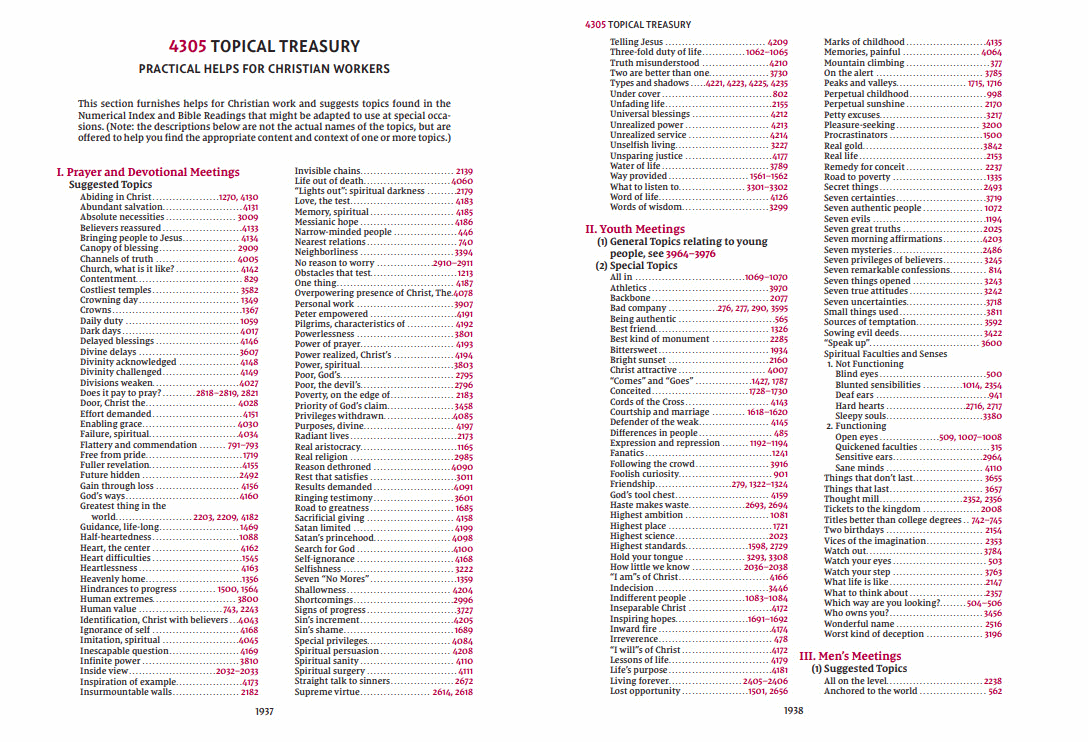
The numbers that are cited behind the topics indicated point to the corresponding numbers in the Numerical Index of Topics, which is where the details of those studies and the riches of the TCR’s study system come into play. As a group leader begins to search the depths of what’s available in the Numerical Index, he or she will find a wealth of excellent and highly organized information that points to cross-references and related topics for further study.
Use the TCR to Find the Scriptures for Your Small Group Topic
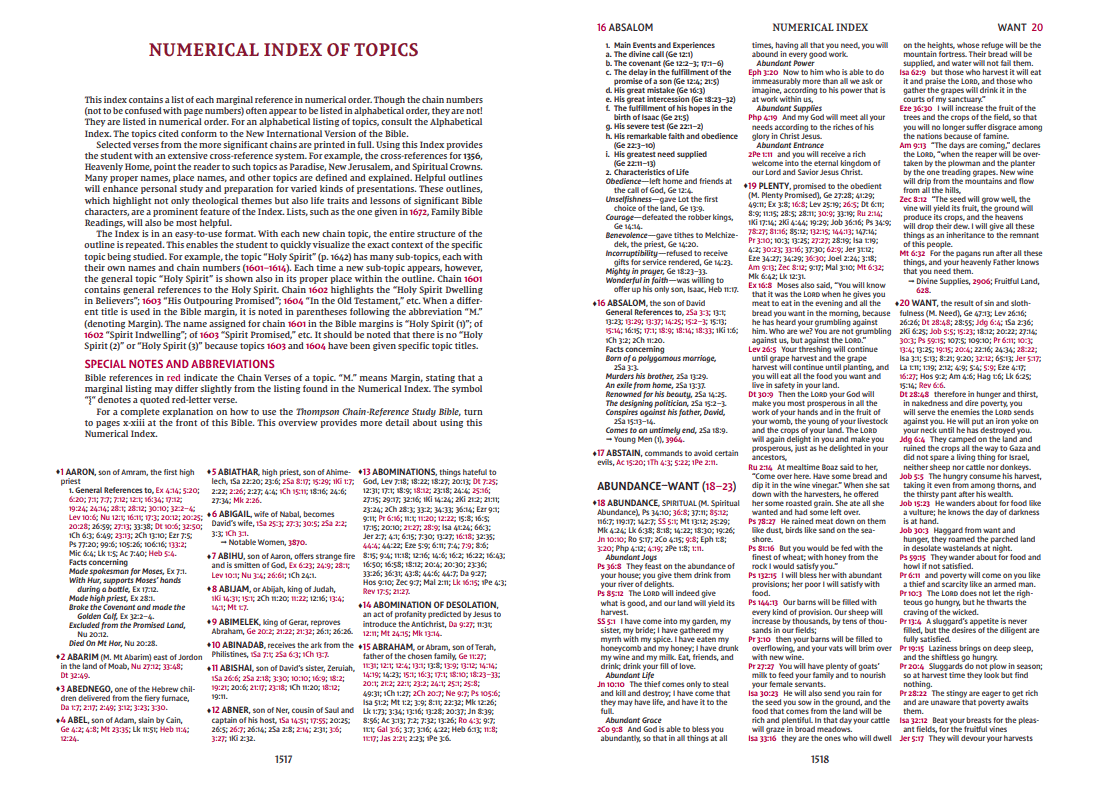
Turning to the topic number in the Numerical Index of Topics, they’ll see the topic name, a short description, a section of a larger outline, the list of related Scripture references (with the most prominent in red), the most prominent Scriptures printed in full, and a list of additional related or suggested topics.
Leaders can look through the topic that they’ve selected to see the verses available within that topic. The most prominent verses are the best verses to start a study. The less prominent verses are excellent for adding more information if needed. They can also look through the suggested topics to expand the study even further. As he or she plans a small-group session, the leader should be sure to read the verses in context to get the bigger picture.
Many of the study subjects are under the umbrella of larger topics. This means the surrounding topics are often related to the chosen topic, and the surrounding topics might also contribute to a deeper, more robust study for the small group. Leaders should look through all the surrounding topics as they plan their studies.
Building the Study
Once a leader has selected the verses for their small group Bible study, they should point to the references for the group to look up, making sure that they are read within their larger context. Having these available, the leader can create questions or write down observations that the group can use to kick off their conversation. A common rubric for approaching study is to ask the members of the group what the passage is about (given its subject matter and context), then encouraging them to think about what this passage tells them about who God is, and finally how they think they can apply this passage to their lives. Leaders who use examples from their personal experiences or other real-life stories often help the group members develop their own personal application from the text.
As they work with the wealth of material available to them in the TCR, group leaders can confidently lead discussions on literally thousands of topics using the excellent study tools and indexes in the Thompson Chain-Reference Bible.
Ending Thoughts on How to Build a Study for a Small Group Using the TCR
The TCR is an excellent tool for small-group study. Following the simple group study principles we’ve discussed, the TCR can help make your next small group study a success.
Purchase your Thompson Chain-Reference Bible today in the Zondervan TCR shop.
Getting the Most Out of the TCR's Indexes
September 12, 2023
The Thompson Chain-Reference Bible contains two major, extremely detailed indexes where any TCR reader can find a plethora of verses to study on a seemingly endless range of topics. These indexes have been carefully crafted and updated over decades to make it easy to find and study thousands of topics of interest in the TCR. While they are simple to use, the Alphabetical and Numerical Indexes also have a few features that we’ll point out in this article that can elevate the reader’s Bible study process so the Bible student, preacher, teacher, or pastor can get more out of them.
First Index: Alphabetical Index of Topics
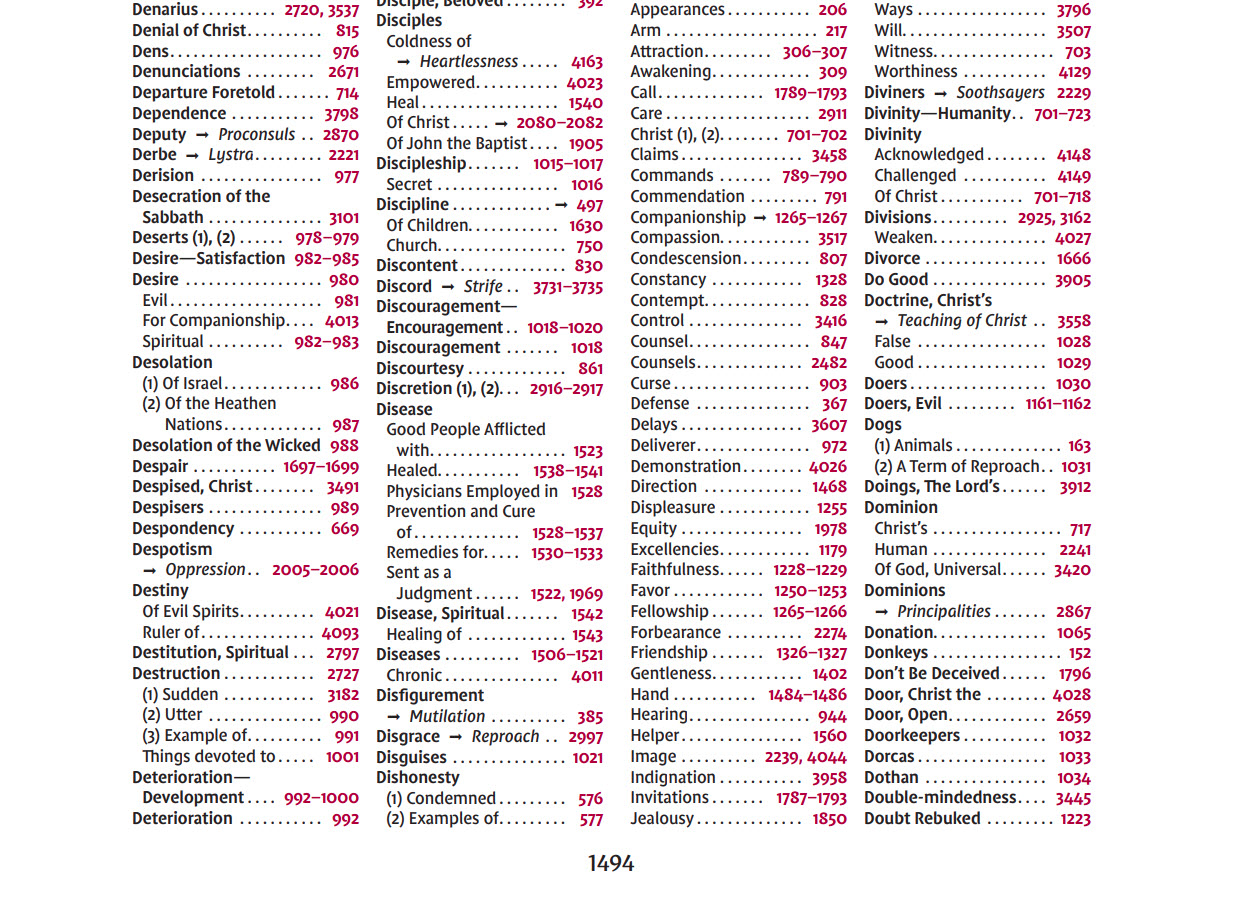
The Alphabetical Index of Topics has been designed to help readers easily find the topics that interest them most. This index includes the primary keywords to find any topic, but it also includes subtopics and multiple topic numbers which we’ll explain in this article. It also at times redirects the reader to a different, but related, keyword. Let’s look closer at how the Alphabetical Index of Topics works.
Topic Entries
Topic entries in this index are, of course, listed alphabetically for ease of scanning. In this index you’ll find hundreds of potential topics to study, along with topic numbers associated with those topics. From this index, you can flip to the Numerical Index to look up individual topic numbers to find all the verses that the TCR lists on any subject. A rule of thumb when using the Alphabetical Index is to look for related keywords rather than just the primary keyword, which will reveal more possibilities than you may have previously considered.
Subtopics
Some topics don’t show a topic number for the keyword (see Dominion, above). Instead, they show the main keyword and then break the topic down into subtopics, each with its own topic numbers. This helps the reader to narrow down their focus so they can study with more precision. It’s a good idea to focus on specific topics first, but then expand the study to include the other topics to gain more insights.
Multiple Topic Numbers
Some topics show several topic numbers. Some include numbers that are sequentially close, while others include numbers that are vastly different from each other, such as a lower number and a high number (see Denarius, above). As you scan the Alphabetical Index, you may wonder why this is the case. The reason for this is that Dr. Thompson, and many editors after him, expanded the existing topics by adding new insights, breaking them down into more detail and thereby building a greater range of study. Since the existing topic numbers were already established, many of these expanded studies were assigned higher numbers as they were added to the Numerical Index.
A Range of Topic Numbers
Some topics are broken out into different categories. For example, the topic “Confession of Sin” in the Alphabetical Index shows 3 such categories:
Confession of Sin
- Prescribed, 816
- Example of National, 817
- Example of Personal, 818
Note that while the main topic has no specific number, the three subtopics do. You will also see this reflected in the marginal notes, as this subject will appear as “Confession of Sin (1)” and the like. If you turn to the first number in the Numerical Index to begin studying the topic, you can then easily continue through all the related topics within the range of topic numbers to see all of the verses that the TCR points to on that subject.
Second Index: Numerical Index of Topics
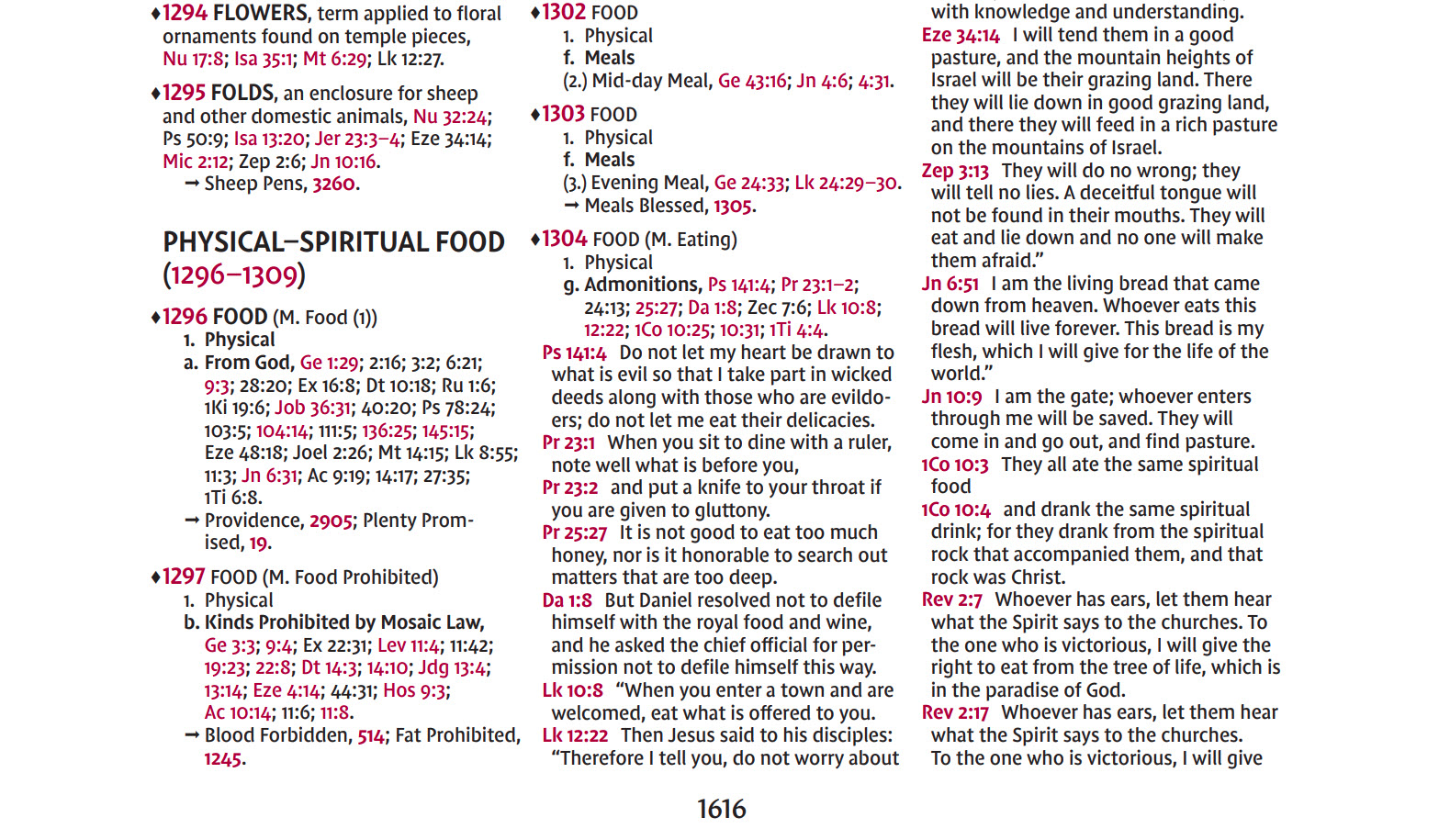
The Numerical Index of Topics is where the reader will turn once they’ve selected the topic numbers they want to pursue from the Alphabetical Index. This unique index provides Scripture references in various ways, prints the primary verses related to each topic in full, and includes additional information on each subject to help expand the reader’s study. Let’s look at the main elements of the Numerical Index.
Major Topic Divisions
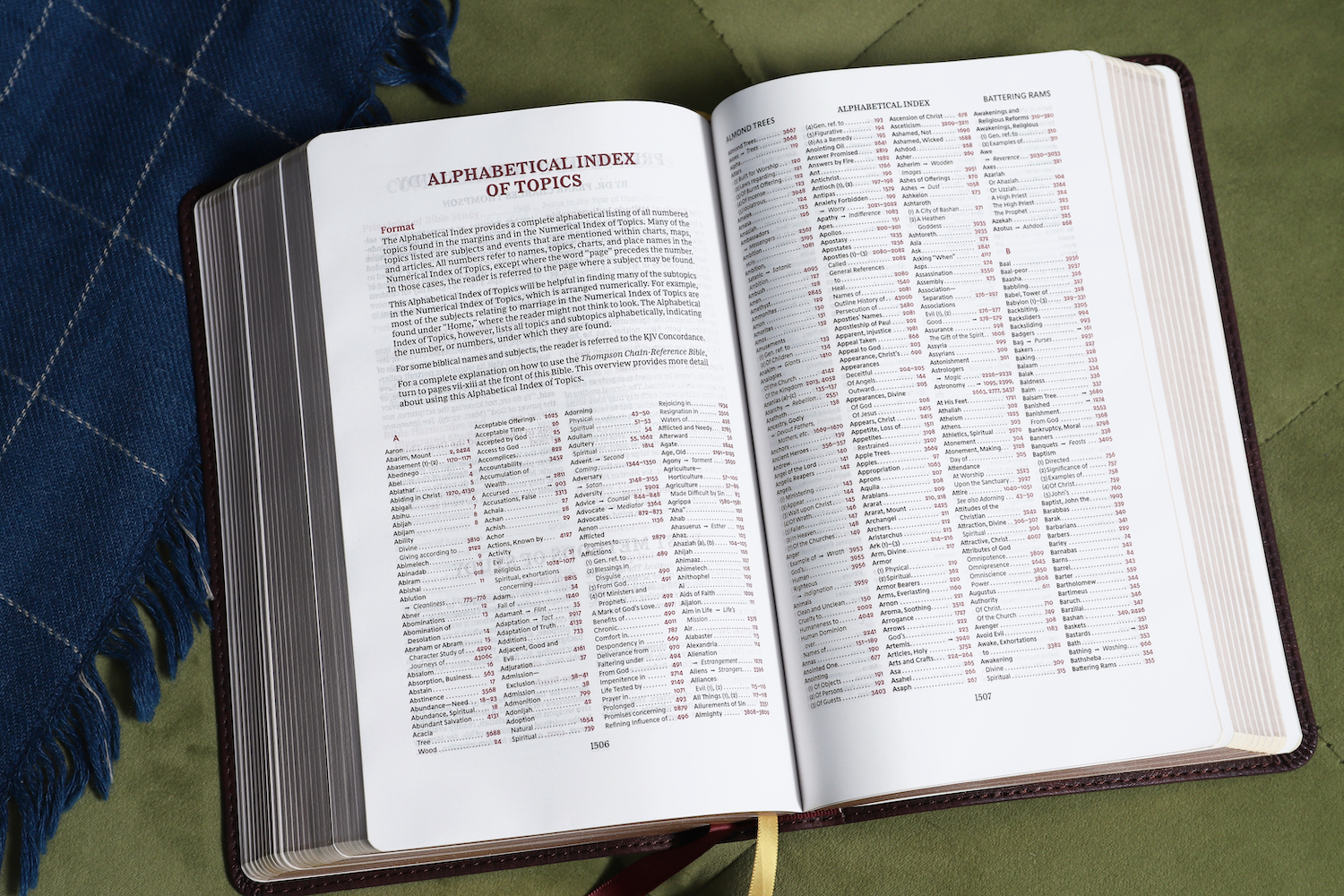
The major topic divisions in the Numerical Index are different from the numbered topics. They display a topic title with a range of topic numbers (see the large, boldfaced header above). These summary titles are descriptive and work well for skimming through the Numerical Index to find a subject of interest.
Numbered Topics
The topics themselves are numbered and are, of course, presented in numerical order to make each one easy to find. Many include a description of the course of study along with a list of Scriptures. Let’s take a closer look at each element.
List of References
The list of Scripture references under each topic typically includes two sets of references which are printed under the topic name in Scripture order. The scripture references printed in red are what the editors of the TCR consider the primary references to study under each topic. The rest are printed in black and also fit the topic, but they’re not as prominent as those in red. The reader can turn to any of these verses in the Bible and follow the topic chain in the margins to help see them in context.
Printed Scriptures
Many of the most prominent verses, those printed in red in the list of references, are printed in full so the reader can read them within the index. Some of the Scriptures include descriptive headings so the reader can quickly understand the context of the scriptures they’re reading. Reading these printed-out verses within the index is a great way to quickly discover if a verse is one the reader can use profitably in their study.
Outlines
Topics that are part of a larger umbrella topic include a portion of an outline to build the larger topic (see 1296-1304, above). These tie the surrounding topics together and provide a structured study on the topic, which can be used to help build a study, prepare a sermon, or plan a lesson to teach.
Suggested Topics
Many of the topics also include additional suggested topics of study at the end of the lists, including the topic name and number (see 1295, Folds, and the additional subject indicated by the arrow toward the end of the topic). As they pursue their selected course of study, readers can turn to those additional topic numbers to help expand their study.
Ending Thoughts on Getting the Most out of the TCRs Indexes
The TCR has intentionally built these two detailed indexes with an extremely robust amount of information along with a number of ways to use the study tools within the Bible. Following the tips we’ve mentioned here will help any TCR user dig deeper into Bible study for personal use and sermon or lesson-plan preparation.
Purchase your Thompson Chain-Reference Bible today in the Zondervan TCR shop.

How to Build a Bible Study for Couples
June 30, 2023
The Thompson Chain-Reference Bible has many helpful tools to study relationships, including topics that cover marriage, parenting, children, and more. These tools are great for personal study, teaching a class or counseling couples. In this post, we’ll examine how to use the TCR’s tools to build a Bible study for couples.
To begin building your study for couples, look through the Alphabetical Index of Topics for themes that correspond to couples. Such topics might include courtship, marriage, husbands, wives, parenting, and the types of responsibilities involved in being in godly relationships. Many of these relevant topics are grouped under larger topics. Once you find a topic to explore, browse through the surrounding topics in the Numerical Index of Topics for other subjects related to the topics you’ve chosen. I’ve used the Alphabetical Index and Numerical Index to gather the topics for this post.
Many of the topics that are important for couples to study are found within the major topic Home, which covers topic numbers 1615-1672. In this article, we’ll look at a few of the larger themes as well as a few more specific topics under this heading and others as we go through some of the main topics that relate to couples. There are many more in the TCR than I’ll cover here, but this will help the Bible student get started on building a Bible study for couples. For the purposes of this article I’ve grouped them in order of the natural progression of the relationship, from courtship to family.
Courtship
Topic 1618a covers courtship in the Bible. It covers two passages that discuss examples of courtships:
- Genesis 29:11-20
- Judges 14:1-10
Betrothals
Topic 1619 provides examples of betrothals in the Bible. The betrothal is the ancient Hebrew equivalent of an engagement, which was a more binding arrangement than what couples experience today. Although there are some differences, learning about ancient betrothals can help us understand the engagement relationship based on the lives of some very well-known Bible characters.
This topic includes:
- Jacob and Rachel
- Special privileges of the Betrothed
- David and Merab
- Joseph and Mary
Marriage
Topics 1620-1621 and 2255-2257 cover the topic of marriage. They show that God originated and ordained marriage and include the descriptions and portrayals of the privileges and obligations of marriage.
These topics include:
- Commended
- Solemn Obligations
- Forbidden with Heathen
Topics 1620-1621 under the major topic Home covers Marriage. Topic 1620 discusses Marriage Commended and includes 20 verses. Topic 1621 covers Solemn Obligations and includes 15 verses. Both of these topics help build a solid understanding of what the Bible says about marriage.
Family
The topic of Family in the Alphabetical Index of Topics covers 10 subtopics with 21 topic numbers. These cover a wide range of themes that are great for developing family relationships. The topics include:
- Cares
- Devotions
- Government
- Instruction
- Joys
- Love in
- Of God
- Prayer in
- Strife
- Trouble
Love, Family
The topic of Love, Family covers topic numbers 1623-1625. Topic 1623 includes 20 verses and covers conjugal love between husbands and wives. Topic 1624 covers maternal love with a focus on mothers and includes 23 verses. It also features several biblical examples, including:
- Hagar’s Love for Her Child
- The Mother of Moses
- The Mother of Samuel
- Rizpah’s Love for Her Sons
- The Mother in Solomon’s Kingdom
- The Shunammite Mother
- The Mother’s Unforgettable Love
- The Canaanite Mother
- The Mother of Jesus
Topic 1625 covers paternal love with a focus on fathers. It includes 35 verses and several biblical examples, such as:
- Laban
- Jacob
- David
- Jairus
- Father of the Prodigal
Husbands’ Duty
Topic 1626, Husband’s Duty, includes 17 verses that discuss the duty of the husband in marriage. The verses include examples, poetry, teachings of Jesus, teachings of Paul, and teachings of Peter.
Wives’ Duty
Topic 1627 covers verses about Wives’ Duty. It includes 16 verses with examples, poetry, and teachings from Paul and Peter.
Parental
The topic called Parental in the Alphabetical Index of Topics covers 15 sub-topics with 23 topic numbers. They include:
- Concern
- Duty
- Example
- Feelings and Emotions
- Gifts
- Indulgence
- Influence
- Joy
- Love
- Partiality
- Prayers
- Pride
- Sins
- Sorrow
- Weakness
Parents
The topic called Parents in the Alphabetical Index includes four topics with six topic numbers. They include:
- Dishonoring
- Duty to
- Love of, for Children
- Obedience to
Parental Duty
Topic 1629 covers Parental Duty, which includes 19 verses. It covers the special duties of parents. Topics include:
- To Teach
- To Train
- To Provide for
- To Nurture
- To Control
- To Love
Parental Duties
Topics 1630-1631 go further into the duties of parents and cover the correction of children. Topic 1630 includes 10 verses. Topic 1631 continues the topic of Parental Duties and covers the instruction of children; it includes 33 verses.
Parental Influence
Topics 1632-1633 cover the theme of Parental Influence. Topic 1632 focuses on evil influence and includes 26 verses, while topic 1633 covers good influences and includes six verses.
Children
Topics 1643-1657 cover children. They include many verses and sub-topics and build an outline that covers:
- The Gift of God
- Esteemed Highly
- Exhortations
- Present at Worship
- Ungrateful
- Helpful
- Vices
- Special Promises to
- Good Children of Good Parentage
- Good Children of Wicked
- Named
- Adoption
- Births Foretold
- Birthright
- Dishonoring Parents
Ending Thoughts on How to Build a Bible Study for Couples
That’s our look at how to build a Bible study for couples using the Thompson Chain-Reference Bible. This is just a sampling of what the TCR covers to help couples build stronger relationships. The TCR covers these topics extensively and much more could be included in these lists. Any or all of the topics work great for building a Bible study for couples.
Purchase your Thompson Chain Reference Bible today in the Zondervan TCR shop.
![Zondervan-1597[57]](https://s48920.pcdn.co/p/wp-content/uploads/sites/2/2023/06/26161136/Zondervan-159757-150x150.jpg "Zondervan-1597[57]")
Getting the Most Out of the Topical Treasury
June 28, 2023
The Topical Treasury is a unique tool in the back of the Thompson Chain-Reference Bible that provides a vast selection of topics for study. This study tool’s four pages and eight sections of references point to many subjects that will help the Christian worker. The various topics are great for personal study, developing class lessons, leading small groups, and preparing sermons. In this post, we’ll examine how to get the most out of the Topical Treasury for personal use and ministry.
4305 Topical Treasury
The Topical Treasury features several topics that address Christian work and various church-related occasions; these subjects for study are from the Numerical Index of Topics and include descriptions of the topic names to help the reader select the right topic for them. It also includes the appropriate topic numbers for quick reference.
The different study suggestions included in this treasury are excellent resources for anyone who has been called upon to teach a Bible study, take part in a group meeting, or organize various types of church and small-group meetings on special days. They’re also great for personal application and growth, as there are plenty of topics to examine regardless of where the reader is in their Christian walk.
To use them, the reader can simply turn to topic 4305, the Topical Treasury, and browse through the topics, looking at the larger divisions to help narrow down their search. Once the reader has found the topics they’re interested in studying further, they can turn to those topic numbers in the Numerical Index. Readers can study those topics plus the additional suggestions that surround their chosen topics in the Numerical Index, turning to the passages indicated to see them in context.
The topics vary in length and include different types of details. Let’s take a closer look at the sections and a few of the topics they include.
Prayer and Devotional Meetings
The first section is Prayer and Devotional Meetings. This is the largest section of the Topical Treasury. It contains a list of suggested topics that relate well to personal growth through prayer and devotion. It can be used for group studies as well as personal growth.
Some key topics include:
- Abiding in Christ, 1270, 4130
- Believers reassured, 4133
- Bringing people to Jesus, 4134
- Canopy of blessings, 2909
- Delayed blessings, 4146
- Divisions weaken, 4027
- Does it pay to pray?, 2818-2819, 2821
- Free from pride, 1719
- Greatest thing in the world, 2203, 2209, 4182
- Guidance, life-long, 1469
- Power of prayer, 4193
- Three-fold duty of life, 1062-1065
- Words of wisdom, 3299
Youth Meetings
Youth Meetings includes two sub-sections: the first covers general topics relating to young people, topic numbers 3964-3976, and the second is Special Topics. This section focuses on topics that are especially ideal for youth studies as they provide advice on the issues that young people face, and point them in the right direction as they live the Christian life.
Some key topics include:
- All in, 1069-1070
- Bad company, 276, 277, 290, 3595
- Being authentic, 565
- Following the crowd, 3916
- Hold your tongue, 3293, 3308
- Inspiring hopes, 1691-1692
- Lessons of life, 4179
- Things that don’t last, 3655
- Things that last, 3657
- Titles better than college degrees, 742-745
- What to think about, 2357
Men’s Meetings
This section covers topics that specifically relate to men. It has two subsections: the first is suggested topics; the second covers character studies and includes topic numbers 4286-4297. The topics focus on issues men face today and help them deal with those issues, whether they relate to relationships, family, work, or a number of other issues.
Some key topics include:
- Brotherhood, 3393
- Business success, 564-569
- Call to leadership, 1790
- Consistent living, 4014
- Extravagant living, 3202
- Generous givers, 2115
- Golden investments, 2812, 2814
- Men’s plans, 2774
- Personal responsibility, 3453
- Seven foolish men, 1723
Women’s and Children’s Meetings
This important section has four sub-topics that include general topics relating to women, 3859-3880, and special topics. It also includes general topics relating to home and children, 1615-1672, and two additional special topics. This section primarily focuses on the home and building a family.
Some key topics include:
- Appearances deceitful, 204-205
- Inward, 381
- Sin disfigures, 383-384
- Cares of motherhood, 4073
- Family cares, 4152
- How to have a happy home, 1623-1625
- Bible stories for children, 1672
Evangelistic Meetings
This section provides study resources that focus on evangelism, including topics for spiritual assets and liabilities, and several other more general topics. These study helps are excellent for any type of ministry or personal evangelism.
Some key topics include:
- Burden of sin, 1764, 1765
- Call to decision, 1793
- Danger of delay, 1501
- Eagerness for truth, 4150
- Seeking God, 3191
- Sword of the Spirit, 4114
Missionary Meetings
Covering the concept of missions, this section references the sub-topics of worldwide missions, 2379-2385, 1929, and the gospel, 1440-1442. This one is short, but the main topics do point to a large list in the Numerical Index.
Some key topics include:
- Messianic prophecies, 2890
- Salvation, 3116-3132
- Opportunity universal, 4189
Temperance Meetings
This one is also short and covers just the major topics for temperance. This section points to resources that are great for those who want to study about keeping themselves disciplined to live for God.
The topics include:
- Temperance–Intemperance, 3567-3576
- Restraining the Appetites, 3207
Special Days
The Special Days section covers topics for Christmas, Good Friday, and Easter. These resources are excellent for studying each of these major Christian holidays and to use in creating lessons or sermons.
Some key topics include:
- Incarnation, 720
- Christ’s mission, 684
- Christ’s death, 3367
- Cross of Christ, 892
- Sacrifice of (Jesus), 3366
- Christ conqueror of death, 4136
- Eternal life, 2156
- Meaning of the risen life, 4184
- Resurrection, 2407-2416
Ending Thoughts on Getting the Most Out of the Topical Treasury
The TCR’s Topical Treasury for Christian workers is an excellent list of topics that provide a treasure trove of insights into the life of a Christian. The examples here only scratch the surface of the topics included. The Topical Treasury covers a lot of topics that are useful for growing closer to God and setting a great example for others to do the same.
Purchase your Thompson Chain Reference Bible today in the Zondervan TCR shop.
How to Build a Study on Paul
May 30, 2023
The life of the apostle Paul is a great example of ministry and leadership. Those who have read his astounding treatises on the Christian faith in his letters to the churches may want to engage in further study of who Paul was and what his life was like.
The Thompson Chain-Reference Bible features many different kinds of beneficial material to help build a study on Paul, including lists of the events of his life, outlines of the books that he wrote, and maps that show where his missionary journeys took him. These tools are easy to use and provide all the information needed to build a study on Paul using only the Thompson Chain-Reference Bible.
Paul in the Alphabetical Index
The Alphabetical Index of Topics includes two entries for Paul. These entries cover a wide range of topics including his preaching, care for the Church, and his missionary journeys. Let’s take a closer look.
Paul 2697
The first entry in the Alphabetical Index is Paul. It includes four topics:
- Miracles of – 2371
- Persecution of – 3482
- Preaching of – 2087
- Overview of his life – 4304a
Paul’s
The second entry in the Alphabetical Index is Paul’s. It includes seven topics:
- Apostleship – 202
- Bonds – 3479
- Care for the Church – 732
- Example – 1178
- Missionary Journeys – 2382, 4304c-3
- Self-Support – 2097
- Thorn – 4080
Building a Study on Paul
We can use any or all of the topics listed in the Alphabetical Index to build our study on Paul. As we look at a few of the topics, we’ll see that the information gathered from them can be used to build a Bible study about Paul and his life in many different forms: as an outline, as bullet points, as a manuscript, as questions and answers, or in whatever form you or your group prefer.
Book Introductions
The various introductions to the letters Paul wrote to the churches (Romans, 1 and 2 Corinthians, Galatians, Ephesians, Philippians, Colossians, 1 and 2 Thessalonians, 1 and 2 Timothy, Titus, and Philemon—plus the introduction to Acts, which details his missionary journeys) provide all kinds of wonderful detail on the backgrounds and contexts of the letters as they were written. Studying them allows for different information to be summarized at points and expanded at points, allowing the reader to understand these different letters more completely.
Persecution of Paul
Topic 3482 provides a list of Scriptures that detail the accounts in the Bible where Paul suffers persecution. In that topic we can see the types of persecution he faced and the outcomes of that persecution. We can use these verses to show the types of problems Paul faced in his day, and we can contrast his sufferings with the types of persecution we face as the body of Christ and as individuals. This can help build a study on how to cope with the different situations we face as we talk to others about our faith.
Preaching of Paul
Topic 2087 covers the duty of ministers to preach. It includes examples of Paul’s preaching and the teachings of Paul on the topic of preaching. Paul discusses the importance of having a deep knowledge of Scripture and preaching it clearly and firmly. We can use these verses to build a study on how Paul approached his audiences based on their understanding of Scripture. We can also study the advice Paul gave to other ministers about preaching and teaching the Word of God.
Bonds
Topic 3479 covers the imprisonment of Paul. It includes verses about the different times he was imprisoned for his faith and his trial before the Roman authorities. It also details where Paul discusses in his letters his times of imprisonment. We can use these verses to learn more about Paul’s persecution in his life and ministry, which can help us build a study on how to help those in prison ministries or to assist individuals who are facing difficult situations in the mission field.
Care for the Church
Topic 732 covers Paul’s care for the Church. Paul teaches and guides the Church from a leadership position, warning against hardships, instructing the Church on devoting themselves to God’s work, advising on how to treat others in a Christ-honoring way in various situations, and reminding us of the importance of living for God every single day. These verses are great for building a study to show how Paul acted in his leadership role; they provide many examples for us to follow as we build strong relationships and as we do ministry to build the kingdom of God.
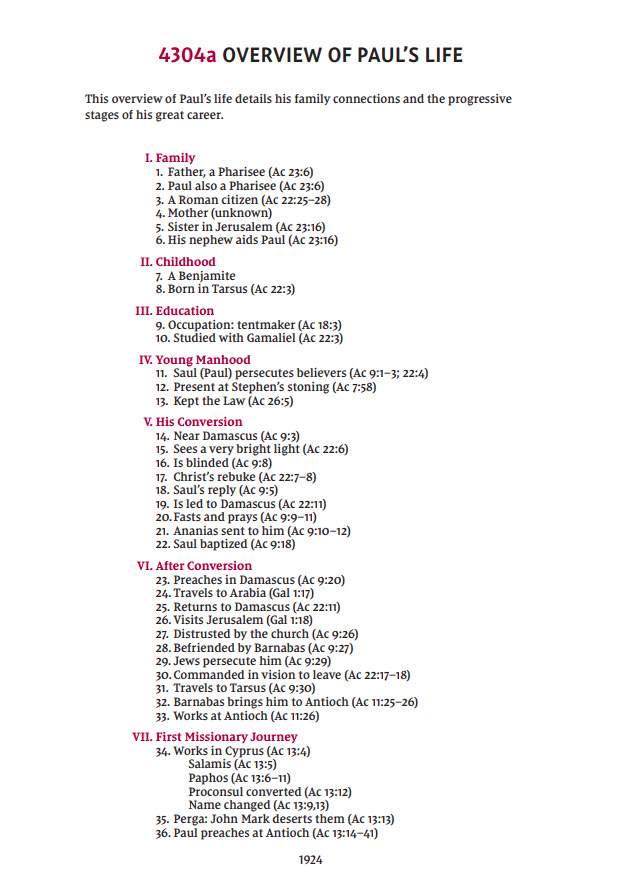
4304a Overview of Paul’s Life
The Overview of Paul’s Life includes an outline of the events of his life and five detailed maps with annotations and Scripture references. These are great for tracking Paul’s missionary journeys while studying his letters. These provide many helpful details and Scripture references so that those pursuing this kind of study can see the full context.
Overview of Paul’s Life
This overview provides lots of interesting detail about the life of Paul. It covers Paul’s family, childhood, education, his life as a young man, his conversion, the time after his conversion, his missionary journeys, his time in Jerusalem and Caesarea, his voyage to Rome, and his time in Rome. This outline is great for building a study on any timeframe of Paul’s life.
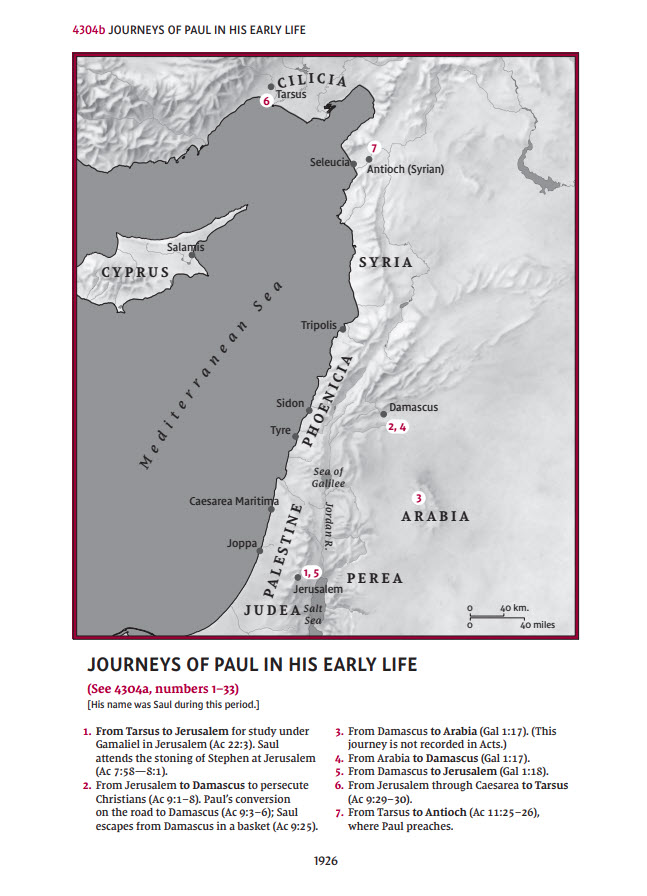
Journeys of Paul in His Early Life
The map of the Journeys of Paul in His Early Life shows the different points of Paul’s travel: from Tarsus to Jerusalem, and then to Damascus, Arabia, back to Damascus, back to Jerusalem, through Caesarea to Tarsus, and then to Antioch. It discusses Paul studying under Gamaliel, the stoning of Stephen, the persecution he faced in Damascus, and his preaching in Antioch.
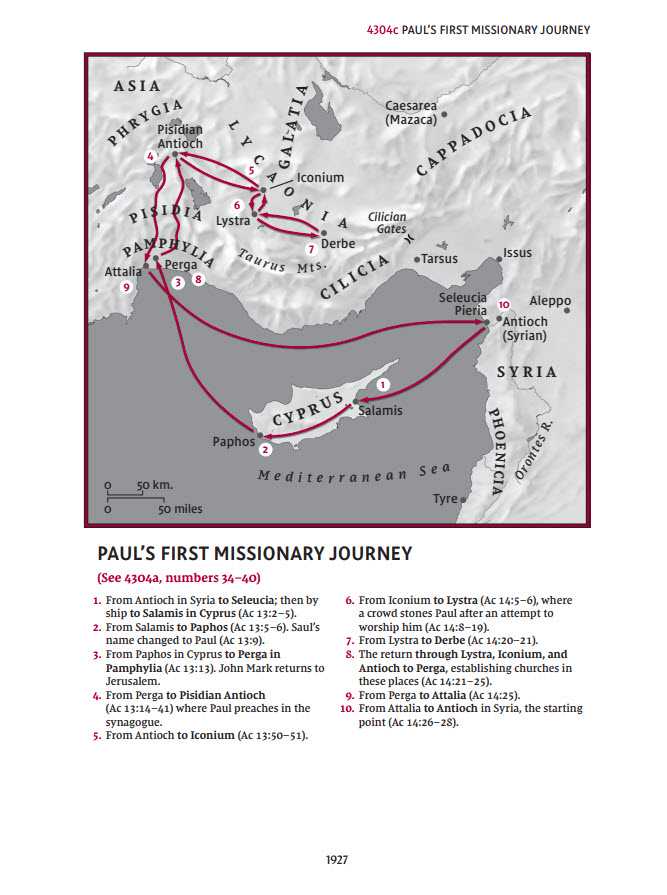
Paul’s First Missionary Journey
The map of Paul’s first missionary journey covers locations such as Antioch, Seleucia, Salamis, Paphos, Perga, Pisidian Antioch, Iconium, Lystra, Derbe, and Attalia. It shows his journey through these locations and points out the times he returned to a previous location. This map highlights the major events at each location through his first missionary journey.
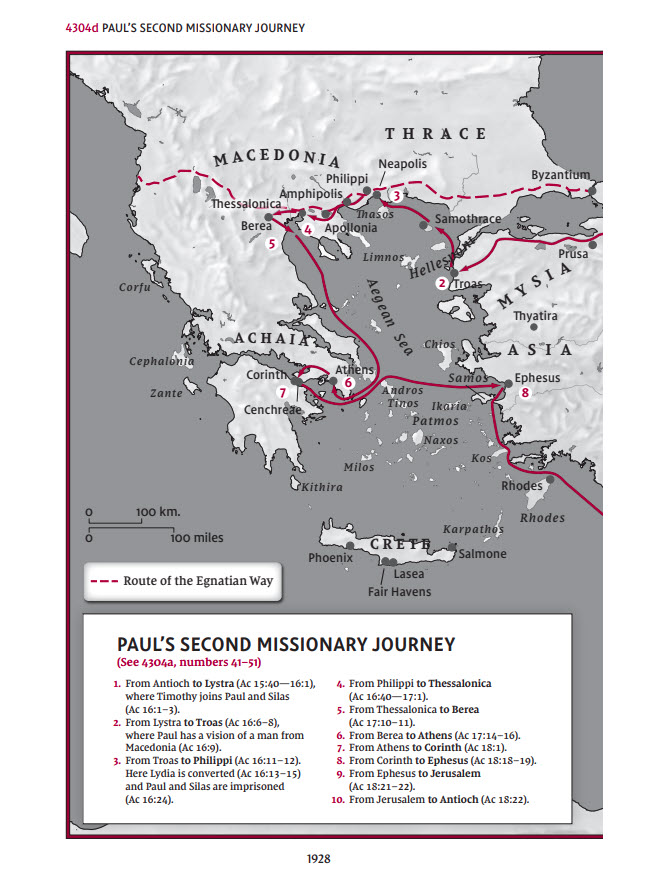
Paul’s Second Missionary Journey
The map of Paul’s second missionary journey covers the events at Antioch, Lystra, Troas, Philippi, Thessalonica, Berea, Athens, Corinth, Ephesus, Jerusalem, and Antioch. It details his ministry relationship with Timothy, his vision of a man from Macedonia, and the conversion of Lydia.
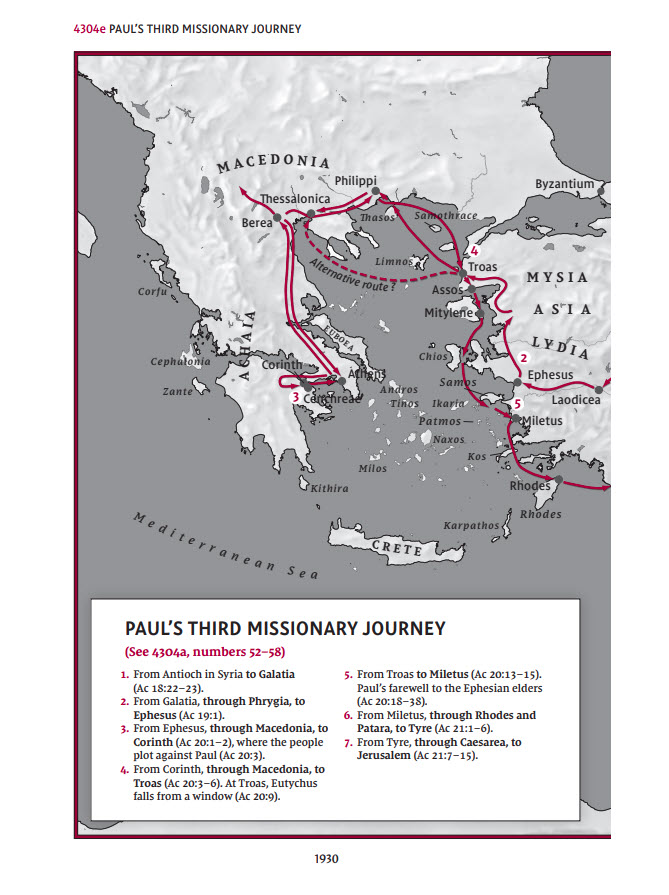
Paul’s Third Missionary Journey
The map for Paul’s third missionary journey covers Antioch, Galatia, Phrygia, Ephesus, Macedonia, Corinth, Troas, Miletus, Rhodes, Patara, Tyre, Caesarea, and Jerusalem. It details the plot against Paul, Eutychus falling from a window, and Paul’s farewell to the elders of Ephesus.
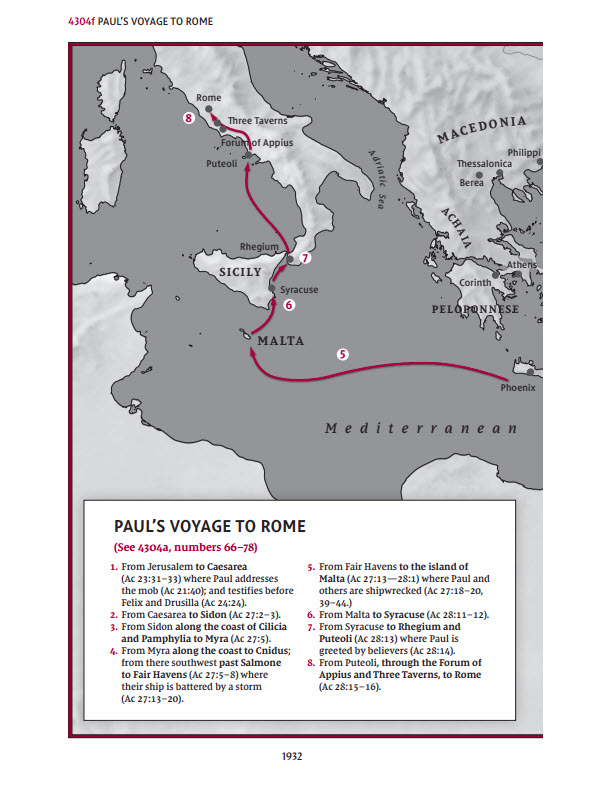
Paul’s Voyage to Rome
The map for Paul’s voyage to Rome includes the events of his arrest and trial. It covers Jerusalem, Caesarea, Sidon, Cilicia, Pamphylia, Myra, Cnidus, Fair Havens, Malta, Syracuse, Rhegium, Puteoli, the Forum of Appius, the Three Taverns, and Rome. Events include Paul’s address to the mob, his testimony before Felix, the storm and shipwreck, and Paul being greeted by believers. All of these events are accompanied by verse references, making in-depth study simple and easy.
Ending Thoughts About How to Build a Study on Paul
There are many things to study in the Bible about Paul. The TCR’s many helpful study tools provide a wealth of information about Paul’s life, the hardships he faced, his missionary journeys, his imprisonment, and his teaching on ministry. The TCR is a great study Bible for building a study on Paul—and many other biblical characters.
Purchase your Thompson Chain-Reference Bible today in the Zondervan TCR shop.
Getting the Most Out of the TCR's Charts and Maps
May 23, 2023
The Thompson Chain-Reference Bible contains several indexes to help study the Word of God, but its tools don’t stop there – the TCR also includes a wide array of tables, charts, outlines, and annotated maps to help readers dig more deeply into the Word of God. In this post, we’ll look at several of the TCR’s tables, charts, and maps to help you get the most out of them to enhance your Bible study. All of these features can be found in the study resource section of each TCR that comes after the Numerical Index of Topics.
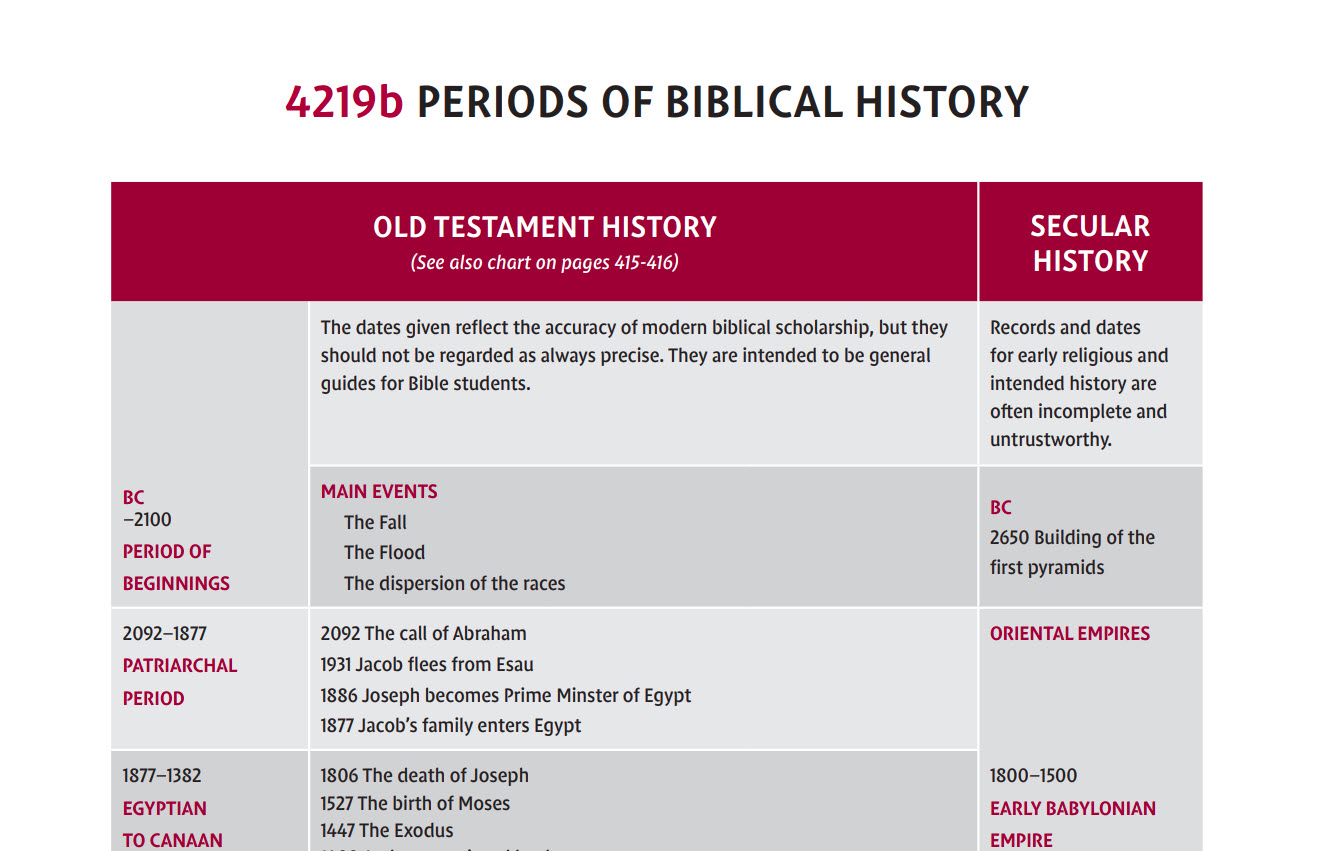
4219b Periods of Biblical History
This chart shows biblical history and how it aligns with secular history, making a critical connection for people who want to understand the broader context of these biblical events. It includes the date with a title for the period of history, biblical events with dates, and secular events or titles with dates. The table is divided into three parts: Old Testament History, Interval Between the Testaments, and New Testament History. The events include the various major empires, the building of the first pyramids, when certain rulers lived, and much more.
This table is excellent for reviewing a simple timeline that compares major biblical and world events. It helps the reader understand the Bible’s broader context and puts all the events of the biblical timeline into a historical perspective.
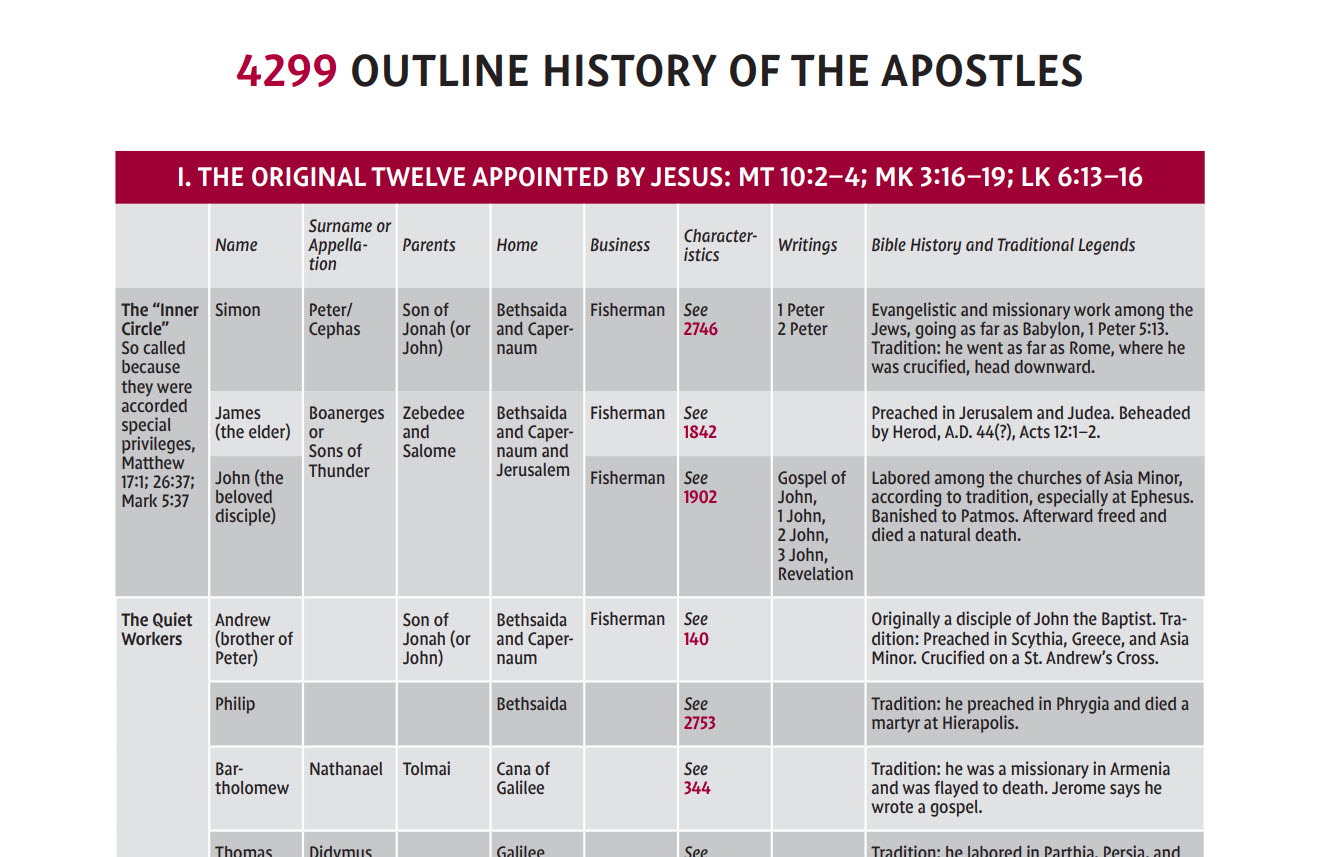
4299 Outline History of the Apostles
This chart provides the names of all the apostles and shows information about them. It divides them according to certain traits, such as the inner circle, little known facts about, etc., and shows their names, parents, homes, businesses, characteristics, writings, and biblical history along with traditional legends that have been told about them. It also includes Matthias and Saul in a separate section of added apostles.
This chart is helpful for studying the character traits and history of each apostle, and the traditional legends help the reader find out a little more about them. The list of characteristics provides topic numbers so the reader can easily find more information in the Numerical Index. Most of this information is straight from the Scriptures, but this chart brings it all together and makes it easy to find.
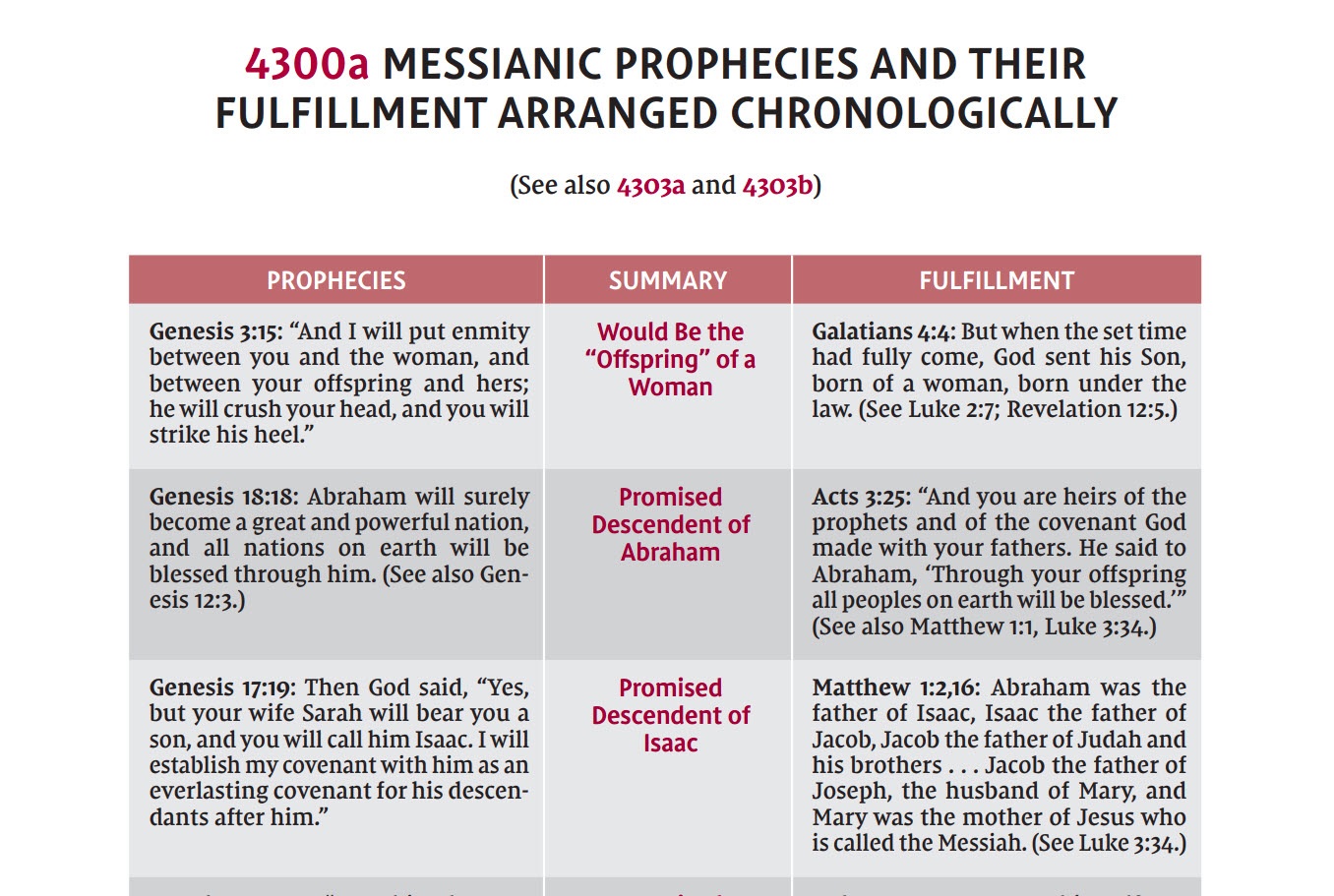
4300a Messianic Prophecies and Their Fulfillment Arranged Chronologically
This chart helpfully pulls together a list of Messianic prophecies including the prophetic verse printed in full, a summary of the prophecy, and the verse where it is fulfilled, which is also printed in full. If the prophecy or the fulfillment is found in multiple verses, one verse is printed, and the references are given for the others.
The prophecies follow an overall chronological order from the birth to the death of Christ, and this chart is an excellent tool for studying the prophecies surrounding both topics. Users can read them from this chart and then turn to the biblical text to see each reading in context.
Pictorial Maps
There are many helpful tools in the section called “Bible Harmonies and Illustrated Studies” to assist readers as they study key biblical characters. They include pictorial maps with annotations, routes of the characters’ journeys, distances between cities, and the like. They also provide a detailed view of specific locations and events.
Let’s look at some examples of the Pictorial Maps. They all work the same, but we’ll review a few that include different details.
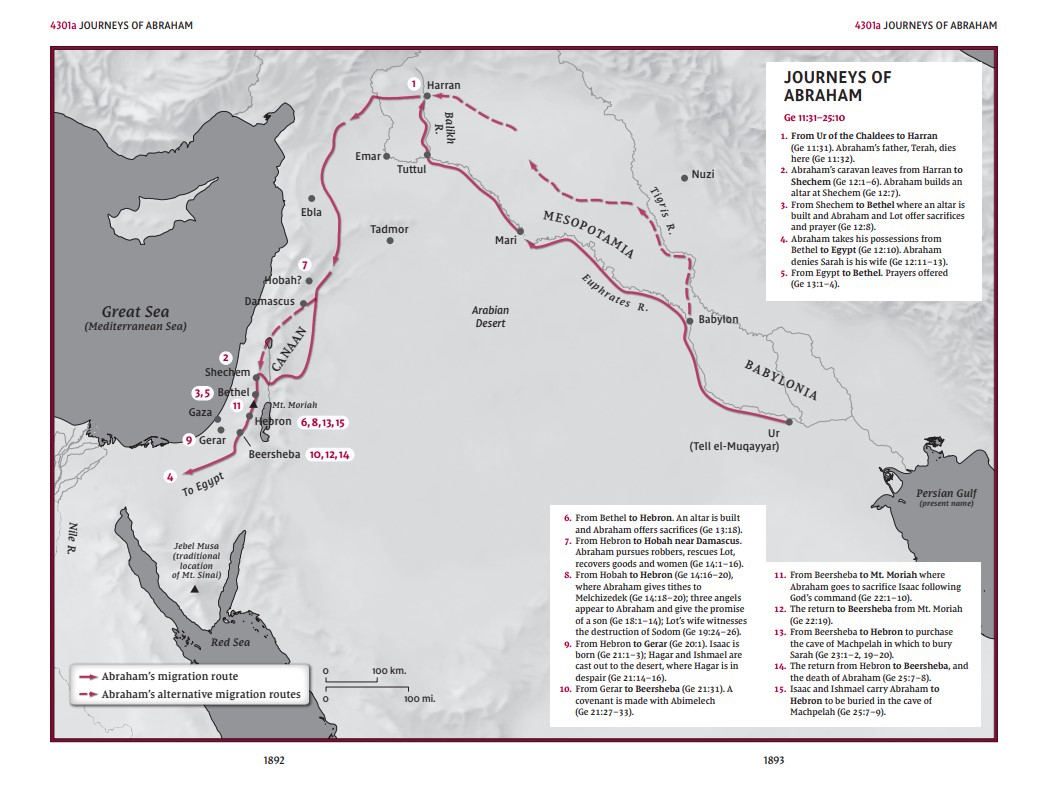
4301a Journeys of Abraham
The Journeys of Abraham is a two-page map that shows Abraham’s migration route and alternative routes that he may have taken as he followed God’s leading. The map includes numbers that correlate to the annotations, which describe 12 points about Abraham’s journeys. They include Scripture references and provide a summary of the events that happened in each location. These also provide the main reference so the reader can review the complete context of all the events covered in the map.
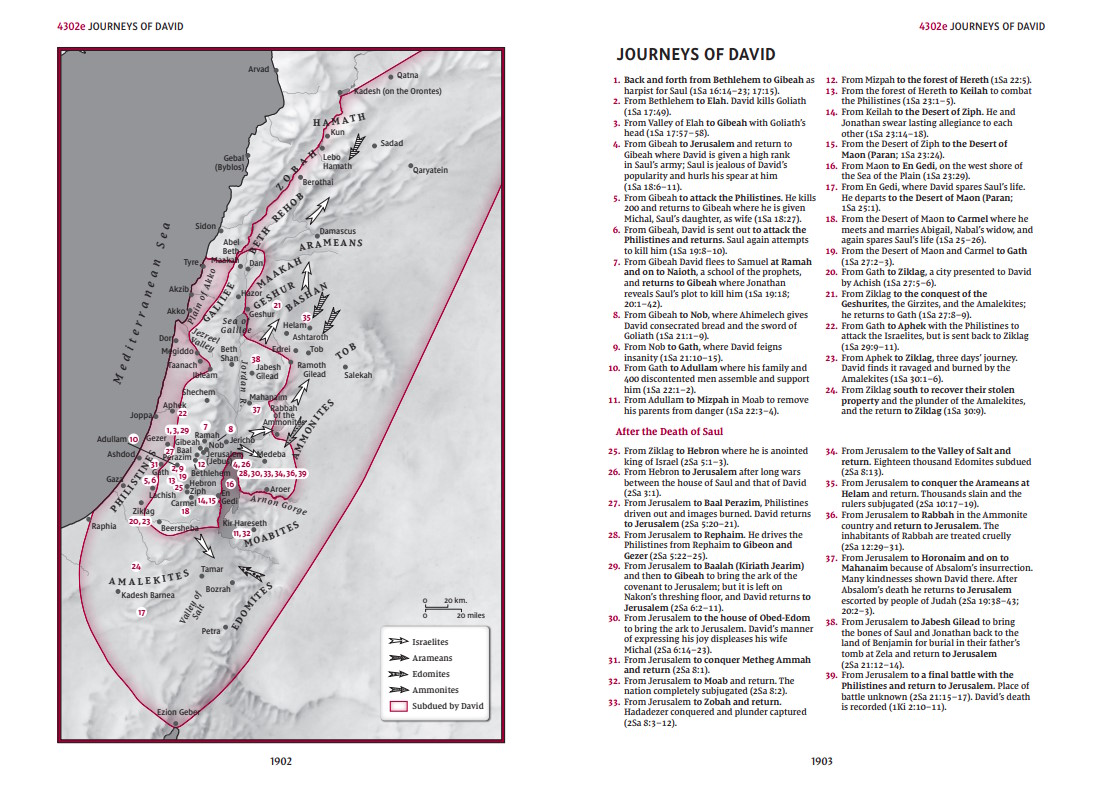
4102e Journeys of David
The Journeys of David provides 39 annotations as it describes the life and movement of this famous king. The map shows the locations of the Israelites, Arameans, Edomites, and Ammonites, giving the reader a sense of the regional context that David had to manage during his reign. The territory subdued by David is circled in red. The annotations are divided into two parts that cover the time before and after the death of Saul.
As they journey with David, the reader can get a better understanding of the surrounding tribes and lands as they get a sense of the background of each event during David’s journeys.
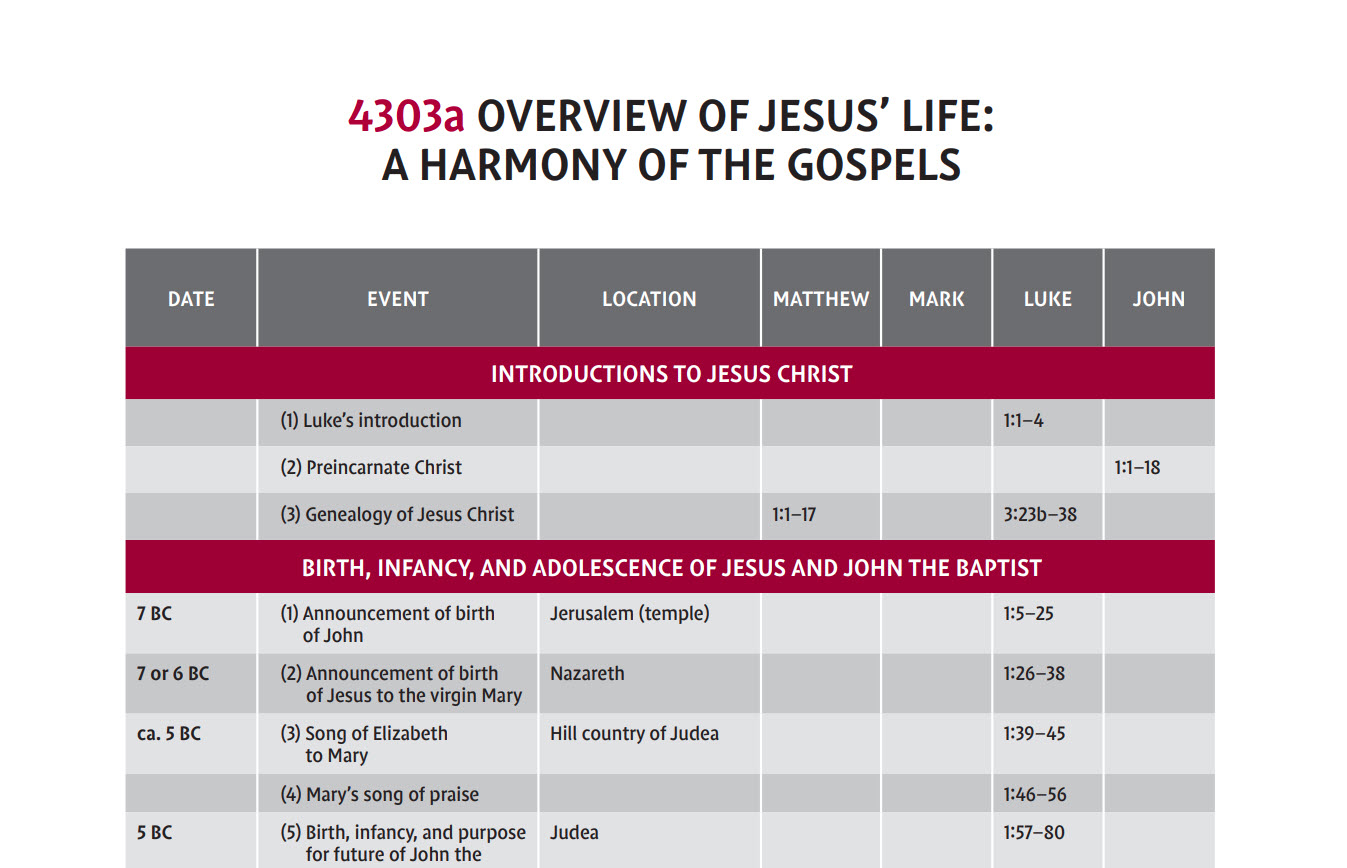
4303a Overview of Jesus' Life
The Overview of Jesus’ Life includes several charts and maps. Here is a look at a couple of the charts.
A Harmony of the Gospels
The Harmony of the Gospels is an eight-page chart that harmonizes the Gospels in detail. The major sections of Jesus’ life are divided by titles to help make the chart easy to use. This extensive chart includes the date, event, and location of the different stories of Jesus’ life as they are described in each of the four Gospels.
This chart is excellent for studying any aspect of the life of Jesus; it is also a great way to locate the events of Jesus’ life in chronological order. First, the reader can search through the headings to choose the specific time period they want to search. Next, they can scan the events in the Event column to locate the particular story or event they’re searching for. Finally, they can read the verses in each of the four Gospels to review all the information the Bible provides about each account.
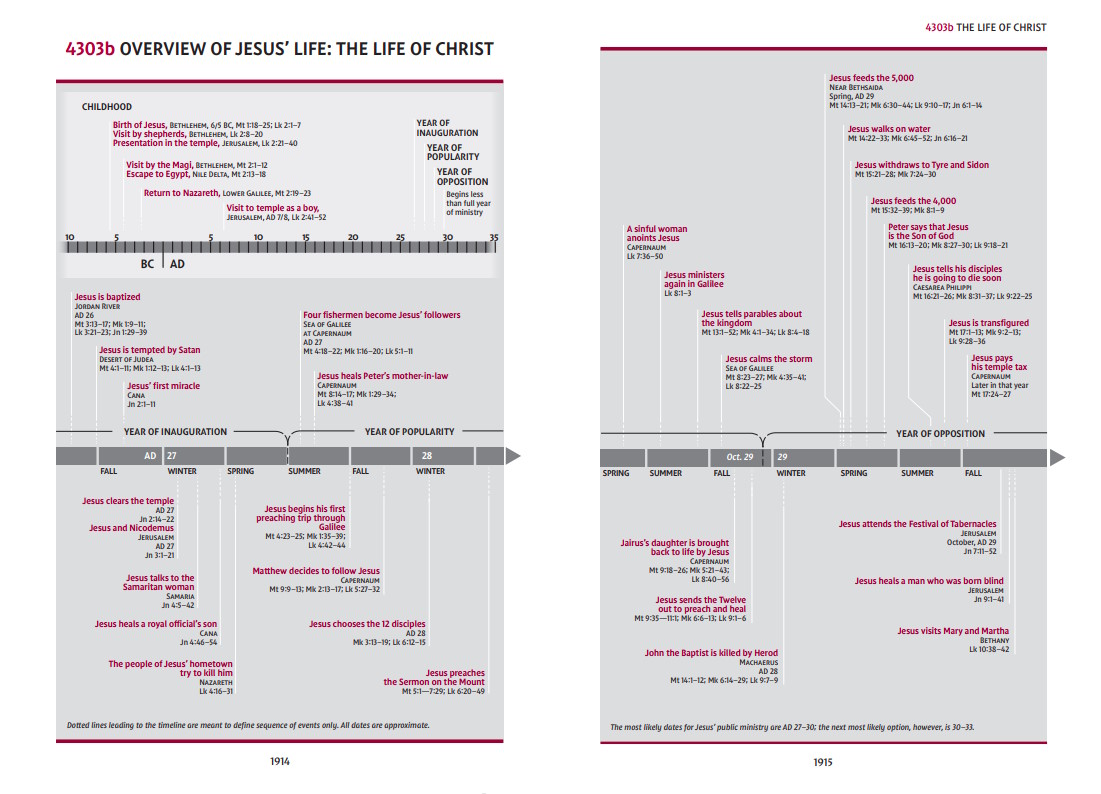
4303b The Life of Christ
The Life of Christ presents a different perspective on the life of Jesus than the Harmony of the Gospels. This three-page timeline shows events in the different phases of Jesus’ life, including the possible year, season, and even the day that each event occurred. The timeline includes each event with its corresponding Scripture reference. The events are divided into the Year of Inauguration, the Year of Popularity, and the Year of Opposition. It also includes references to his childhood, and especially drills down on the events of his last week and events that the Bible records after the resurrection.
This chart provides a quick and simple way to study any event in the life of Jesus. The reader can simply look at the three divisions to find the year they want to study, then look at the titles to find the event. Finally, they can turn to all the Scripture references provided for more information.
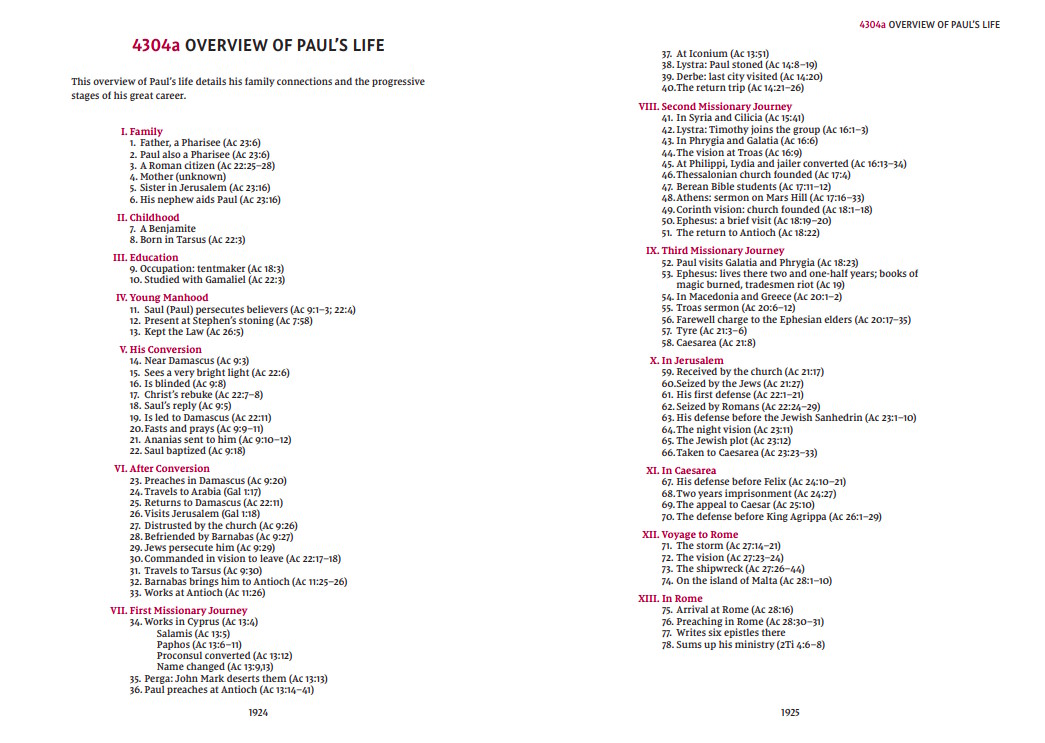
4304a Overview of Paul's Life
The Overview of Paul’s Life includes a detailed outline and several annotated Pictorial Maps to describe and display the events and travels in Paul’s life. The outline provides details of his family connections and the stages of his career; it covers his family, childhood, education, young manhood, conversion, ministry journeys, and more. It has 78 points in total and many of them include Scripture references.
This outline provides an excellent biography of Paul in a way that’s very easy to use. The student of God’s Word can view the titles and search through them for any point about Paul they wish to study. They can also turn to the Scripture references to see the entire context of each story or event.
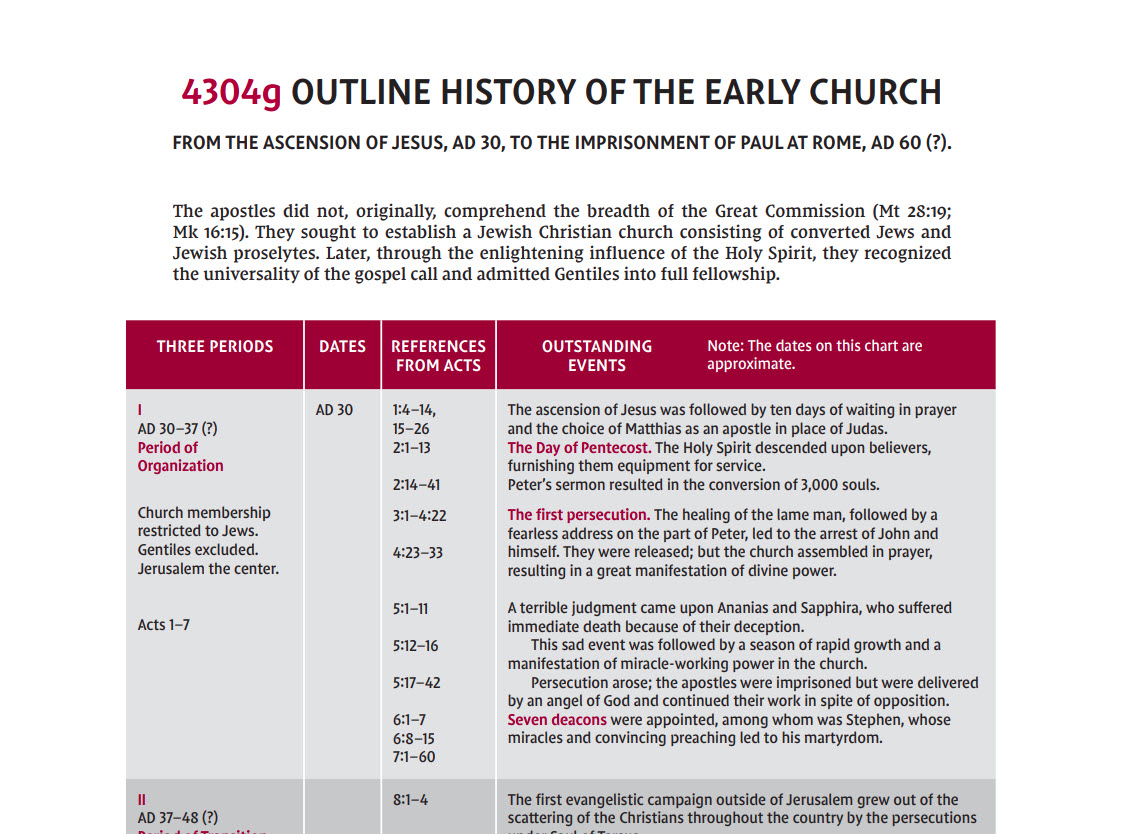
4304g Outline History of the Early Church
The Outline History of the Early Church is a two-page chart that covers the history of the church from after the ascension of Jesus to Paul’s voyage to Rome. It divides the history into three periods that cover AD 30-37, AD 37-48, and AD 48-60. Each section includes dates, references from the Book of Acts, and information about each of the outstanding events in detail. The descriptions include multiple paragraphs of helpful information to start students of the early church on their way to deeper study.
Ending Thoughts on the TCR's Charts and Maps
This overview covers just a few of the many charts and maps found in the TCR, which provide a treasure trove of insights into biblical characters and Bible history. Most of these helpful resources work the same way, so the reader can use the same techniques to glean the most out of their Thompson Chain-Reference Bible. The TCR’s charts and maps are a great way to expand or enhance personal or group Bible study.
Purchase your Thompson Chain-Reference Bible in the Zondervan TCR shop today.

A Topical Study List for the Resurrection
April 5, 2023
The resurrection is the pivotal event in the Christian faith and one of the most important topics to study in the Bible. The Thompson Chain-Reference Bible contains a wealth of information on the resurrection to help anyone understand it more deeply. In this article we’ll focus on the resurrection, and explore how a reader can use the resources of the Thompson Chain-Reference Bible to discover how this major event in the Christian faith is discussed in Scripture.
Resurrection in the Numerical Index
The resurrection refers to the day that Jesus conquered death once and for all time, rose bodily from the dead, and left the tomb that he’d been placed in after his death on the cross. This event is the culmination of all the Bible’s prophecies about the Messiah who would come to save God’s people.
The apostle Paul talks in absolute terms as he reminds members of the church in Corinth about the critical nature of this event:
If Christ has not been raised, our preaching is useless and so is your faith. More than that, we are then found to be false witnesses about God, for we have testified about God that he raised Christ from the dead . . . And if Christ has not been raised, your faith is futile; you are still in your sins. Then those also who have fallen asleep in Christ are lost. If only for this life we have hope in Christ, we are of all people most to be pitied (1 Corinthians 15: 14-19).
As one can well imagine, the Bible has a lot to say about this day. It includes prophecies foretelling the resurrection, the events of the day itself, the events after the resurrection, and the teachings of the NT writers concerning the resurrection and the Gospel. We’ll look at all of these as we trace how the TCR’s the study tools facilitate a deeper look into this critical Easter event.
Turning to the term Resurrection in the Alphabetical Index of Topics, we see 12 topics we can study. They include:
- Promises Concerning
- Doubts Concerning
- Examples of
- Of Christ Foretold
- Of Christ Announced
- Proofs of Christ’s
- Of Christ, a Central Truth
- Emphasized
- Christ Appears After His
- Of All People
- Post Resurrection Appearances of Jesus
- Spiritual
The topic numbers cover 2407-2416, 4308i, and 2583. As we can see from this list, this course of study it covers the topic of Christ’s resurrection as well as the resurrection of others in the Bible’s accounts. For this study, we’ll focus specifically on the resurrection of our Lord Jesus Christ. We’ll find topic 4303i in the end matter section of charts, so we have two places to look.
Topic 2410 Resurrection
Topic 2410 is labeled Resurrection (4) in the marginal references that accompany the Scripture text. This is part four of the outline of Resurrection and it’s titled Of Christ Foretold. It includes one Old Testament and 24 New Testament references with no headers. The major references include:
- Verse: Psalm 16:10
- Verse: Matthew 16:21
- Verse: Matthew 20:19
- Verse: Matthew 26:32
- Verse: Mark 9:9
- Verse: Mark 14:28
- Verse: John 2:19
- Verse: Acts 2:31
- Verse: Acts 26:22-23
Topic 2411 Resurrection
Topic 2411 is labeled Resurrection (5) in the margins. This is part five of the outline of Resurrection and it’s titled Of Christ, Announced by Angels. It includes three references that lead to the different accounts of the angels testifying to Jesus’ victory over death. The major references include:
- Verse: Matthew 28:6
- Verse: Mark 16:6
- Verse: Luke 24:6
The contexts of these passages are a fascinating study; this is the culmination of all the angels’ prophecies and testimonies about Jesus, starting with his birth in Luke 2.
Topic 2412 Resurrection
Topic 2412 is labeled Resurrection (6) in the margins. This is part six of the outline of Resurrection and it details the Infallible Proofs of the resurrection accounts. It includes four references with no headers. The major references include:
- Verse: Matthew 27:66
- Verse: Luke 24:39-40
- Verse: John 20:20
- Verse: Acts 1:3
Topic 2413 Resurrection
Topic 2413 is labeled Resurrection (7) in the margins. This is part seven of the outline of Resurrection and it’s titled Of Christ, Central Truth of the Gospel. As one studies these truths, one will get a sense of how pivotal this account is to the saving faith of the billions of Christians throughout the centuries. This study topic includes 20 references with no headers. The major references include:
- Verse: Acts 2:23-24
- Verse: Acts 3:14-15
- Verse: Acts 4:33
- Verse: Acts 10:39-41
- Verse: Acts 13:30
- Verse: Acts 17:2-3
- Verse: Romans 1:4
This topic helpfully prints all these major verses for ease of study; however, the publisher recommends reading the context of all of these verses for a more comprehensive view of this important subject.
Topic 2414 Resurrection
Topic 2413 is labeled Resurrection (8) in the margins. This is part eight of the outline of Resurrection and it’s titled Of Christ, Emphasized in the Epistles. It includes 26 references with no headers. This study allows readers to examine how the resurrection was viewed, taught about, and celebrated in the early church. The major references include:
- Verse: Romans 1:4
- Verse: Romans 4:25
- Verse: Romans 6:9
- Verse: Romans 10:9
- Verse: 1 Corinthians 15:4
- Verse: 1 Corinthians 15:17
- Verse: Ephesians 1:20
- Verse: 1 Thessalonians 4:14
- Verse: 2 Timothy 2:8
- Verse: 1 Peter 1:3
- Verse: 1 Peter 3:18
Topic 2415 Resurrection
Topic 2415 is labeled Christ Appears in the margins. This is part nine of the outline of Resurrection and it’s titled Appearances of Christ After His Resurrection. It includes 20 references with no headers. It also includes a list of 13 of the people to whom he appeared. These appearances, and the eyewitness accounts of these appearances, support the undeniable truth of the fact of Jesus’ resurrection. The major references include:
- Verse: Matthew 28:9
- Verse: Matthew 28:17
- Verse: Mark 16:8-9
- Verse: Luke 24:15
- Verse: Luke 24:36
- Verse: Luke 24:50
- Verse: John 20:19
- Verse: John 20:26
- Verse: John 21:1
- Verse: Acts 9:5
- Verse: 1 Corinthians 15:5-8
Resurrection In Charts and Tables
The resurrection account is also covered in several helpful charts and tables in the end matter of the TCR; in-depth study of these will add weight and depth to the reader’s understanding.
- Messianic Prophecies, 4300a
- A Harmony of the Gospels, The Resurrection Through The Ascension, 4303A
- The Life of Christ, After the Resurrection, 4303b
- Jesus’ Post-Resurrection Appearances, 4303i
The table that covers Jesus’ post-resurrection appearances is the most prominent, and it’s the one suggested for further study in the Alphabetical Index of Topics.
Topic 4303i Jesus’ Post Resurrection Appearances
Topic 4303i is a table that shows the post-resurrection appearances of Christ. The table shows the time and location of the appearance, the person who saw Christ, and the Scripture references that cover these accounts. It includes 15 references with five headers for Time, which identifies when the events took place. The references include:
Header: Easter Day
- Verse: Mark 16:9
- Verse: Matthew 28:9
- Verse: 1 Corinthians 15:5
- Verse: Luke 34:15-31
- Verse: John 20:19
- Verse: John 20:24
Header: Sunday Following Easter
- Verse: John 20:26-28
Header: Time Unknown
- Verse: John 21:1-24
- Verse: John 21:15-17
- Verse: Matthew 28:16-17
- Verse: 1 Corinthians 15:6
- Verse: 1 Corinthians 15:7
Header: Ascension Day
- Verse: Acts 1:2-6
Header: Time Unknown
- Verse: Acts 9:1-5
- Verse: 1 Corinthians 15:8
Ending Thoughts
The Thompson Chain-Reference Bible features extensive references to topics and charts that are ideal for studying the last week of Jesus’ life and the sacrifice he made for those who believe in him. This walkthrough helps readers explore the topic of the Resurrection—the pivotal event in the work of Jesus Christ and the central reality of the Christian faith. This study of the resurrection can also help the reader get a feel for how the Thompson Chain-Reference Bible works to get them started on any topical study.
Purchase your Thompson Chain Reference Bible today in the Zondervan shop.

A Topical Study List for the Crucifixion
April 5, 2023
The crucifixion and resurrection are two of the most important Christian topics in the Bible. For new believers and for lifelong Christ followers, these two pivotal realities of Christ’s experience, and of the Christian faith, compel deeper study and examination. The Thompson Chain-Reference Bible contains a wealth of information on these topics to help anyone understand them more deeply and completely.
In this article we’ll focus on the crucifixion, and explore how a reader can use the helpful resources included in the Thompson Chain-Reference Bible to discover how this topic of critical importance to Christian belief is discussed in Scripture.
Sufferings of Christ
The events of Jesus’ passion week, his crucifixion and burial are covered in several in-text topics and end-matter charts. First we’ll take a look at where the topics on this subject lead, and then we’ll discuss the charts and the types of information they include.
To get started, one only needs to look up Crucifixion in the Alphabetical Index of Topics. This shows that the topic Crucifixion is number 3494. Turning to 3494 in the Numerical Index of Topics, we see that it’s part of a larger umbrella topic called Suffering of Christ, which covers topics 3489-3495. Let’s take a look at how the TCR leads the reader on the road toward the cross, Following Jesus’ experience and that of his disciples and others along the way.
Topic 3489 Sufferings of Christ
Topic 3489 is part one and two of the outline of the sufferings of Christ. Part one is titled General References To. It includes 35 references with no headers. The major references include both Old Testament and New Testament references to help readers understand how the sufferings of Jesus were both predicted and fulfilled in Scripture:
- Verse: Genesis 3:15
- Verse: Psalms 69:20
- Verse: Isaiah 50:6
- Verse: Isaiah 53:3
- Verse: Isaiah 53:5
- Verse: Zechariah 13:6
- Verse: Mark 15:34
- Verse: Luke 22:44
- Verse: Hebrews 2:10
- Verse: Hebrews 5:8
- Verse: Hebrews 13:12
- Verse: 1 Peter 1:11
- Verse: 1 Peter 2:21
- Verse: 1 Peter 3:18
After this list readers will find the suggested topics Christ’s Sacrifice, 3366; Substitution, 3361; and Christ’s Death, 3367. These topics will more fully round out one’s study on Jesus’ experiences leading up to the cross.
Part two of the outline under topic number 3489 is titled Predicted by Himself. Rather than providing references, this leads the reader to another topic, Sufferings Predicted, 713.
Topic 3490 Sufferings of Christ
Topic 3490 is part three of the outline of the sufferings of Christ, and it’s titled Sorrowful. It’s labeled as Man of Sorrows in the marginal references that accompany the text of Scripture. It includes 14 references with no headers. The major references are printed out in the column in the numerical index for ease of study. The publishers of the TCR recommend, however, that the reader turn to the passages indicated to get a better sense of their context. They include:
- Verse: Isaiah 53:3
- Verse: Mark 7:34
- Verse: Mark 8:12
- Verse: Luke 19:41
- Verse: John 11:33
- Verse: John 11:35
- Verse: John 12:27
- Verse: John 13:21
Topic 3491 Sufferings of Christ
Topic 3491 is part four of the outline of the sufferings of Christ, and it’s titled Despised. It includes 24 references with no headers. Again, there are both Old and New Testament references to direct the reader to prophecies made and fulfilled. The major references include:
- Verse: Psalms 22:6
- Verse: Isaiah 53:3
- Verse: Matthew 13:55
- Verse: Mark 15:29-30
- Verse: Luke 16:14
- Verse: John 10:20
After this list the index suggests also studying the topics Contempt, 827; Derision, 977; Christ Rejected, 2965; and Christ Mocked, 3493. As the reader engages in further study on these topics, they will understand more about Christ’s rejection by the religious leaders of the day as well as those who followed their directives.
Topic 3492 Sufferings of Christ
Topic 3492 is part five of the outline of the sufferings of Christ, and it’s titled Humiliation. It includes 23 references with no headers. The major references include:
- Verse: Isaiah 53:9
- Verse: Matthew 27:38
- Verse: Luke 2:7
- Verse: Luke 22:37
- Verse: John 19:3
- Verse: Acts 8:33
- Verse: 2 Corinthians 8:9
- Verse: Philippians 2:7
- Verse: Philippians 2:8
Topic 3493 Sufferings of Christ
Topic 3493 is part six of the outline of the sufferings of Christ, and it’s titled Mocked. It includes 17 references with no headers. The major references, which in this instance invite the reader to turn to each passage, include:
- Verse: Matthew 27:29
- Verse: Matthew 27:41
- Verse: Luke 22:63
- Verse: Luke 23:11
- Verse: Luke 23:36
Topic 3494 Sufferings of Christ
Topic 3494 is part seven of the outline of the sufferings of Christ, and it’s titled Reviled. With each of these topics the reader is learning more and more about how people in Jesus’ day felt about him. As part of a Lenten study in advance of Easter, these descriptions and the passages associated with them help students of the Word understand more about the stark differences between what Jesus taught and how people in his culture reacted to those teachings.
This topic includes 14 references with no headers. The major references include:
- Verse: Psalms 22:7
- Verse: Matthew 27:39
- Verse: Mark 15:32
- Verse: Luke 23:39
After this list come the suggested topics Contempt, 827; Aha, 101; and Blasphemy (2), 474. They provide even more evidence of how Jesus was treated by his fellow community members.
Topic 3495 Sufferings of Christ
In studying the topic of Crucifixion, the TCR’s study notes lead the reader through a progression that helps them understand what Jesus had to endure not just on the cross itself, but in the years and especially the weeks and days before his crucifixion. So now we come to the eighth part of this larger topic, which is the culmination of the previous seven parts. This portion of the study notes includes 37 references with no headers. The major references include:
- Verse: Psalm 22:16
- Verse: Matthew 27:35
- Verse: Mark 15:24
- Verse: Luke 23:33
- Verse: John 19:18
- Verse: John 19:23
- Verse: 2 Corinthians 13:4
- Verse: Revelation 11:8
Charts That Include the Crucifixion
Several helpful charts and tables found in end matter of the Thompson Chain-Reference Bible provide more insights into the crucifixion account. They also help the reader study the burial of Jesus and all of the other events that surrounded Jesus’ death on the cross.
Topic 4300a, Messianic Prophecies and Their Fulfillment Arranged Chronologically
This incredibly helpful multi-page chart shows how the messianic prophecies of the Old Testament point toward and lead up to and the events of the crucifixion. It displays each prophesy, gives a summary of what that prophecy included, and shows how each one was fulfilled.
This chart is an amazing testament to the unity of Scripture as it demonstrates God’s purposeful intent to offer the world salvation through the death and resurrection of his one and only Son.
Topic 4303a, A Harmony of the Gospels
This chart includes a section called Jesus’ Final Week Around and in Jerusalem. It lists each day of that fateful week and shows the events that happened on each day as well as providing the location of those events and the Scripture references in each Gospel where these accounts are found. This section covers the events that happened in Jesus’ final week, starting with Sunday’s account of his triumphal entry into Jerusalem, and following through to Saturday with the women watching the tomb.
Topic 4303g, Jesus in His Last Days
This map shows a progression of seven events that happened in the days leading up to the crucifixion. They include the Last Supper, Gethsemane, Before the Sanhedrin, Pilate’s Judgement Hall, Jesus Stands Trial, and Golgotha. As they read the associated passages, interested students of the Word can follow along on Jesus’ difficult path toward the cross.
Topic 4303h Jesus in His Hours on the Cross
Topic 4308h is an illustration that shows the events as they happened on the cross. It brings together all the Gospel accounts into one timeline that summarizes Jesus’ experience, and the experiences of those hung with him and those who observed his suffering. This hour-by-hour description includes both the Roman and Jewish expressions of time and describes the events preceding and immediately following the crucifixion.
Ending Thoughts
The Thompson Chain-Reference Bible has a wealth of information that is ideal for studying the complex chain of events that led up to Jesus’ crucifixion. The TCR’s helpful topical study tools and charts make it easy to study the events surrounding the crucifixion and see them in fascinating detail as well as painstaking chronological order. Following this study can also help the reader get a feel for how the Thompson Chain-Reference Bible works to get them started on any topical study.
Purchase your Thompson Chain Reference Bible today in the Zondervan shop.

A Topical Study List for Lent: Abstinence
March 16, 2023
The season of Lent is a time where we think about the sacrifice of Jesus on the cross; in particular, the reasons why Jesus had to go to the cross and how that impacts our own spiritual lives.
The three pillars of Lent traditionally include prayer, fasting and almsgiving. Fasting, the second pillar of Lent, brings with it the practice of abstinence which so many people around the world observe during this 40-day season. These three pillars all work together to bring us closer to God.
The Thompson Chain-Reference Bible contains a wealth of information on all of these important topics to help anyone understand them more deeply.
In this article we’ll focus on the topic of Abstinence and explore how a reader can use the resources of the Thompson Chain-Reference Bible to discover how abstinence is observed and discussed in Scripture.
Abstinence
Abstinence is the practice of doing without something for a period of time in order to draw closer to God. For Lent, this means intentionally giving up something that’s distracting or habitual so that the observer can turn their thoughts to worship. It’s a way of putting God first by setting aside something that has meaning to us or that can get in the way of worship.
What kinds of things do people abstain from during Lent? Traditionally, Catholics will abstain from eating meat on Fridays as an act of turning their communal thoughts toward God. Others decide to give up alcohol or sweets during this 40-day period so that they can remember Jesus’ sacrifice for them on the cross. Still others decide to take a break from social media for the 40-day period of Lent. There are really endless variations to explore, but the general idea is this: what you give up should be replaced with turning your thoughts toward the sacrifice of Jesus.
Whatever you choose to give up during these 40 days, set in place a time during which you are consistently reminded of Jesus’ sacrifice for your sins. Maybe you decide to give up lunch on Monday, Wednesday and Friday to spend more time in prayer and meditation on the Gospels. Maybe you decide to turn the TV off at a certain point in the day so that you can read a devotional book five days of the week. Perhaps instead of eating dessert with your family, you take the time to walk outside and talk to God about your kids as you stroll around the block. Again, the idea is to replace something in your life that you’re used to with an opportunity to focus on God’s Word and will for your life—all centered around the sacrifice of his Son.
The Thompson Chain-Reference Bible is here to help. Two topics in the TCR deal with abstaining. The first is Abstain, topic number 17. This refers to abstaining from evil which is, of course, something we should always strive to do. In this article we’ll look at a second topic, Abstinence, 3568, which includes abstaining from strong drink but is great for demonstrating examples of abstinence in general. We’ll also see a few related topics that will round out a person’s study of abstinence.
Temperance-Intemperance
Abstinence is topic 3568. This is part of the larger topic called Temperance-Intemperance, which covers topics 3567-3576. These topics work together to show the spiritual value of abstinence. As we look at the two topics of Temperance and Self-Control, we can get a better idea of what the Bible says about the practice of giving something up to refocus our thoughts on God during the season of Lent. Topic 3567 Temperance
Topic 3567 is described as “self-restraint.” It’s part one of the outline of temperance and it’s titled General References To. It includes 14 references with no headers. They include large passages of Scripture. The major references include:
- Verse: Proverbs 21:17
- Verse: Proverbs 23:1-35
- Verse: Proverbs 25:16
- Verse: Acts 24:25
- Verse: 1 Corinthians 9:25
- Verse: Galatians 5:23
- Verse: Titus 2:2
- Verse: 2 Peter 1:6
Topic 3568 Abstinence
Topic 3568 is part two of the outline of temperance; it’s titled Abstinence from Strong Drink, but it also covers the basic principles of abstinence and provides a few examples. It includes 23 references with eight headers. The major references include:
Header: Enjoined Upon the Priests
- Verse: Leviticus 10:9
Header: Law for the Nazarites
- Verse: Numbers 6:3
- Verse: Deuteronomy 29:6
- Verse: Judges 13:4
Header: The Wise Man’s Injunction
- Verse: Proverbs 23:31
Header: Rule for Kings
- Verse: Proverbs 31:4
Header: The Law of Rechabites
- Verse: Jeremiah 35:6
Header: Daniel’s Temperance Principles
- Verse: Daniel 1:8
- Verse: Daniel 10:3
Header: John the Baptist a Total Abstainer
- Verse: Matthew 11:18
- Verse: Luke 1:15
Header: Brotherly Love Demands
- Verse: Romans 14:21
- Verse: 1 Corinthians 8:13
After this list is the suggested topics Appetites Restrained, 3207; and Tongue Restrained, 3308. These additional topics are helpful for further study on this important idea.
Topic 3569 Self-Control
Topic 3569 is labeled Self-Control (1) in the margins. This is part one of the outline of self-control and it’s titled The Duty of Believers. It includes 16 references with four headers. The major references include:
- Verse: 2 Kings 18:36
Header: Over the Life
- Verse: Proverbs 16:32
- Verse: Proverbs 17:28
- Verse: Proverbs 25:28
- Verse: Acts 24:25
Header: Over the Lusts of the Flesh
- Verse: Romans 6:12
- Verse: 1 Corinthians 6:12
Header: Over the Tongue
- Verse: James 3:2
Header: A Cardinal Virtue
- Verse: 2 Peter 1:5
- Verse: 2 Peter 1:6
- Verse: 2 Peter 1:7
Topic 3570 Self-Control
Topic 3570 is labeled Self-Control (2) in the margins. This is part two of the outline of self-control and it’s titled Examples. It includes eight references with no headers. The major references include:
- Verse: 2 Samuel 11:11
- Verse: Jeremiah 35:6
- Verse: Daniel 1:8
- Verse: 1 Corinthians 9:27
After this list are the suggested topics Tongue Restrained, 3308; Meekness (3), 2272; and Silence Directed, 3292. These are helpful for further study on similar topics.
Ending Thoughts
The Thompson Chain-Reference Bible features many great study tools for exploring various topics having to do with the season of Lent. The pillars of Lent described above work together to help the believer draw closer to God and one another during this important 40-day period before the celebrations of Passion Week. While this walkthrough helps readers explore the topic of Abstinence, it can also help the reader get a feel for how the Thompson Chain-Reference Bible works to get them started on any topical study.
Purchase your Thompson Chain Reference Bible today in the Zondervan shop.

A Topical Study List for Lent: Almsgiving
March 16, 2023
The season of Lent is a time where we think about the sacrifice of Jesus on the cross; in particular, the reasons why Jesus had to go to the cross and how that impacts our own spiritual lives.
The three pillars of Lent traditionally include prayer, fasting and almsgiving. Fasting, the second pillar of Lent, brings with it the practice of abstinence which so many people around the world observe during this 40-day season. These three pillars all work together to bring us closer to God.
The study tools in the Thompson Chain-Reference Bible contain a wealth of information on these important topics to help you understand them more deeply. In this article, we’ll focus on the topic of Almsgiving, and explore how a reader can use the resources of the Thompson Chain-Reference Bible to discover how giving to others is discussed and demonstrated in Scripture.
Almsgiving
Almsgiving is the practice of giving food or money to those who are disadvantaged or less fortunate. It’s an outward sign of Christian love that epitomizes the sacrifice that Christians are called to because of the sacrifice of Jesus on the cross. The words “alms” and “almsgiving” are not found in the TCR’s Alphabetical Index of Topics; the reason for this is that in some Bible translations this kind of giving is normally referred to as “Charity.” So we can explore these ideas under the TCR topics of Charitableness and Giving. As we’ll see, one of these topics does include Almsgiving in the Numerical Index of Topics.
Charitableness
Topics 659-660 are part of the larger topic called Charitableness-Uncharitableness, which covers four subtopics. Studying these topics more deeply in the TCR will help the reader discover the spiritual value of giving. The examples show us the duty of charitableness we have in believers, as well as helping us understand how to be charitable when we judge others.
Let’s look at a few of these topics to help study the topic of almsgiving for Lent.
Topic 659 Charitableness
Topic 659 is labeled Charitableness in the margins. This is part one of the outline of charitableness and it’s titled Duty of. It includes 18 references with no headers. The major references include:
- Verse: Proverbs 12:16
- Verse: Proverbs 17:9
- Verse: Matthew 7:3
- Verse: Romans 15:1
- Verse: Galatians 6:1
- Verse: 1 Peter 4:8
After this list is the suggested topic Mercy (2), 2298 for further study.
Giving
Giving is simply the act of giving one’s time, talent, and resources to benefit others. The Bible provides many helpful examples of people who gave to others with no thought of getting anything in return. It also shows examples of the benefits of giving, and even provides guidelines for giving. The subject of “Giving” in the Alphabetical Index of Topics covers 11 topics from several locations in the Numerical Index of Topics.
Topics include:
- Giving to God
- Scriptural Rules for Giving
- Giving According to Ability
- Generous Giving
- Giving of Presents
- Sacrificial Giving
- Systematic Giving
- Tithes
- Giving to God, of the Best
- Giving to the Poor (almsgiving)
- Giving Freely
We’ll look at a few of these topics that fit well with the idea of Almsgiving for Lent.
Topic 2121 Giving
Topic 2121 is labeled Giving (2) in the margins. It provides examples of people in the Bible giving and being charitable toward others. This is part two of the outline of Giving and it’s titled Scriptural Rules. It includes 21 references with six headers. The major references include:
Header: According to Income
- Verse: Deuteronomy 16:17
- Verse: 2 Samuel 24:24
- Verse: Matthew 5:42
Header: Without Ostentation
- Verse: Matthew 6:3
Header: Freely
- Verse: Matthew 10:8
- Verse: Luke 6:38
- Verse: Luke 12:23
Header: With Simplicity
- Verse: Romans 12:8
Header: Regularly
- Verse: 1 Corinthians 16:2
Header: Cheerfully
- Verse: 2 Corinthians 9:7
At the end of this list are the suggested topics Alms, 2126; and The Poor (3), 2801. Notice one is named Alms. We’ll look at this one next.
Topic 2126 Almsgiving
Topic 2126 is Giving to the Poor, but it’s called Almsgiving in the Numerical Index of Topics and is labeled as Alms in the margins. This makes it the ideal topic to study for Lent. It includes 30 references with no headings. The major references include:
- Verse: Leviticus 25:35
- Verse: Deuteronomy 15:7
- Verse: Proverbs 31:20
- Verse: Matthew 6:1
- Verse: Matthew 19:21
- Verse: Luke 11:41
- Verse: Luke 12:33
- Verse: Luke 18:22
- Verse: Luke 19:8
- Verse: 1 Corinthians 13:3
After this are the suggested topics The Poor (4), 2802; Sympathy (1), 3515; and Godly Love (1), 2200. All of these will be instructive for further study.
Topic 2115 Giving Freely
Topic 2115, Giving Freely, is labeled Giving (2) in the marginal references that are placed next to Scripture in the TCR. It’s part of the larger topic Liberality-Stinginess-Covetousness, which covers topics 2115-2133. This is one great for seeing real examples of people giving in the Bible. It includes 56 references with eight headers. Several of these references cover large passages. The major references include:
Header: Gifts of Israel for the Tabernacle
- Verse: Exodus 35:22
Header: Abundant Giving
- Verse: Exodus 36:5
Header: Offerings at the Dedication
- Verse: Numbers 7:3
- Verse: Ruth 3:15
Header: David’s Gifts for the Temple
- Verse: 1 Chronicles 29:3-4
- Verse: 2 Chronicles 24:10
Header: Offerings for the Rebuilding of the Temple
- Verse: Ezra 1:6
- Verse: Ezra 2:69
- Verse: Ezra 8:25
- Verse: Nehemiah 7:70
- Verse: Luke 19:8
Header: The Poor Widow’s Offering
- Verse: Luke 21:1
Header: Liberality in the Early Church
- Verse: Luke 21:2-4
- Verse: Acts 4:34-35
- Verse: Acts 11:29
- Verse: 2 Corinthians 8:2
- Verse: Philippians 4:16
After this list are the suggested topics Kindness (2), 1999; Generosity, 3876; and Promises to Generous, 2882. All of these are wonderful topics to expand your study on this topic, which the Bible demonstrates is an issue that is close to God’s heart.
Ending Thoughts
The Thompson Chain-Reference Bible has lots of topics that are ideal for studying the various topics around Lent. The pillars of Lent work together to help the believer draw closer to God and one another. While this walkthrough helps readers explore the topic of Almsgiving, it can also help the reader get a feel for how the Thompson Chain-Reference Bible works to get them started on any topical study.
Purchase your Thompson Chain Reference Bible today in the Zondervan shop.

A Topical Study List for Lent: Fasting
February 17, 2023
As winter passes and we look forward to the celebration of Easter, millions around the world will observe a 40-day period of personal reflection in preparation for Good Friday.
The season of Lent is a time where we think about the sacrifice of Jesus on the cross; in particular, the reasons why Jesus had to go to the cross and how that impacts our own spiritual lives.
The three pillars of Lent traditionally include prayer, fasting and almsgiving. Fasting, the second pillar of Lent, brings with it the practice of abstinence which so many people around the world observe during this 40-day season. These three pillars all work together to bring us closer to God.
The study tools in the Thompson Chain-Reference Bible contain a wealth of information on these important topics to help you understand them more deeply. In this article, we’ll focus on the topic of Fasting, and explore how a reader can use the resources of the Thompson Chain-Reference Bible to discover how fasting is discussed in Scripture. How does one observe a fast? And is there more than one way to observe a fast?
Fasting
Fasting simply refers to going without something for a specified period. That something could be food, but there is a plethora of other fasts that one could observe during the season of Lent, such as fasting from social media, from alcohol, or from too much time spent away from home. No matter what one chooses, fasting is a way of denying one’s physical needs or habits or desires to focus on one’s spiritual needs. Fasting is an important part of Lent because it helps us focus on God and building our relationship with him.
Topics 3212-3214 cover fasting in the TCR. These are part of the larger topic called Self-Indulgence – Denial, which covers 17 topics. These topics work together to show the spiritual value of denying oneself too much food, excessive pleasures, luxury, and more. Fasting is a major part of this practice. The examples in the TCR show us:
- general references to fasting in the Bible
- examples of where fasting was commanded
- examples of when someone went through a fast
These examples are great for helping us see the bigger picture of how fasting works, and how it can benefit us spiritually. As we walk through this study, we’ll look at a few of these topics to flesh out what fasting can mean to the observance of Lent.
Topic 3212 Fasting
Topic 3212 is labeled Fasting (1) in the margins. The description is going without drink and food for a period and a stated purpose. This is part one of the outline of fasting and it’s titled General References To. It includes eight references with no headers. The major references include:
- Verse: Psalm 35:13
- Verse: Psalm 69:10
- Verse: Isaiah 58:3
- Verse: Jeremiah 14:12
- Verse: Zechariah 7:5
- Verse: Matthew 9:15
Topic 3213 Fasting
Topic 3213 is labeled Fasting (2) in the margins. This is part two of the outline of fasting and it’s titled Commanded. This shows us how fasting was practiced in the stories of the characters we read about in the Bible. It includes nine references with no headers. The major references include:
- Verse: Joel 1:14
- Verse: Joel 2:12
- Verse: Matthew 6:17-18
- Verse: Matthew 17:21
- Verse: 1 Corinthians 7:5
Topic 3214 Fasting
Topic 3214 is labeled Fasting (3) in the margins. This is part three of the outline of fasting and it’s titled Examples. These include major characters and people groups in the Bible, which we can observe as we think of denying ourselves for a time to focus on spiritual matters. It includes 36 references with nine headers. The major references include:
Header: Moses
- Verse: Exodus 34:28
- Verse: Judges 20:26
Header: Israel
- Verse: 1 Samuel 7:6
- Verse: 1 Samuel 20:34
- Verse: 1 Samuel 28:20
- Verse: 1 Samuel 31:13
- Verse: 2 Samuel 1:2
- Verse: 2 Samuel 3:35
- Verse: 2 Samuel 12:16
Header: Elijah
- Verse: 1 Kings 19:8
- Verse: 1 Kings 21:27
- Verse: 1 Chronicles 10:12
Header: Ezra
- Verse: Ezra 10:6
- Verse: Nehemiah 9:1
- Verse: Jeremiah 36:6
- Verse: Daniel 6:18
Header: Daniel
- Verse: Daniel 10:3
Header: Christ
- Verse: Matthew 4:2
- Verse: Luke 4:1
- Verse: Luke 4:2
- Verse: Luke 18:12
Header: Paul
- Verse: Acts 9:9
- Verse: Acts 10:30
Header: Leaders in the Church at Antioch
- Verse: Acts 13:2
- Verse: Acts 13:3
Header: Paul and Barnabas
- Verse: Acts 14:23
- Verse: Acts 27:33
Penitence-Impenitence
The TCR provides additional study tools to help deepen our observance of this Lenten pillar. An accompanying topic, Fasts Proclaimed 2710, provides examples in Scripture where someone called for a fast. Reviewing these passages helps us understand the value of fasting during a time of repentance. This is part of the section on Penitence-Impenitence under the section on Repentance; it shows us how observing a period of fasting can be associated with seeking repentance.
Topic 2710 Repentance
Topic 2710 is labeled Fasts Proclaimed in the margins. This is part five of the outline of Penitence-Impenitence and it’s titled Associated with Fasting. It includes seven references with no headers. The major references include:
- Verse: 1 Kings 21:9
- Verse: 2 Chronicles 20:3
- Verse: Ezra 8:21
- Verse: Esther 4:16
- Verse: Jeremiah 36:9
- Verse: Jonah 3:5
Ending Thoughts
The Thompson Chain-Reference Bible has many topics that are ideal for studying the various aspects of Lent. The three pillars of Lent work together to help the believer draw closer to God and one another. While this brief walkthrough has helped readers explore the topic of Fasting, this study can also help the reader get a feel for how the Thompson Chain-Reference Bible works to get them started on any of the thousands of topical studies available in this Bible.
Purchase your Thompson Chain-Reference Bible today in the Zondervan shop.

A Topical Study List for Lent: Prayer
February 17, 2023
As winter passes and we look forward to the celebration of Easter, millions around the world will observe a 40-day period of personal reflection in preparation for Good Friday.
The season of Lent is a time where we think about the sacrifice of Jesus on the cross; in particular, the reasons why Jesus had to go to the cross and how that impacts our own spiritual lives. The three main pillars of the Lenten season include prayer, fasting, and almsgiving. These pillars work together during this reflective season to bring us into a closer relationship with God.
The Thompson Chain-Reference Bible contains a wealth of information on these important topics to help anyone understand them more deeply. In this article, we’ll focus on the topic of Prayer, and explore how a reader can use the resources of the Thompson Chain-Reference Bible to discover how to integrate prayer into their own lives during this season of Lent.
Prayer
Prayer is, in its simplest definition, communicating with God. As Christians, it is both our duty and our privilege to pray, to approach God with our hopes, fears, and praise for the salvation he has so generously given to us.
The Bible addresses the issue of prayer in many different ways, and gives us many examples of prayers spoken to God and prayers answered by God. In the TCR’s study system, the theme of Prayer spans 64 topics. In addition, the theme called “Prayers” covers 10 topics, while “Prayerfulness” and “Prayerlessness” each comprise one topic.
Lent is a perfect time to intentionally ramp up your prayer life, to build a habit of praying more often with more intensity and purpose. The idea behind deepening your prayers involves approaching prayer in a new and different way. A few examples of the types of prayer you could focus on during Lent include:
- Getting closer to God
- Becoming more humble
- Reconciling with others
- Shedding bitterness and resentment
- Praying for others
In this post, we’ll look at a few of these topics to help facilitate a study the on topic of prayer for Lent.
Topic 2816 General References to Prayer
Topic 2816 is labeled Prayer in the margins; the description of this topic in the Topical Index is communication with God. This is part one of the outline of prayer and it’s titled General References To. As such, this is a good place to start a study on prayer throughout the Bible. It includes 21 references with four headers. The major references include:
Header: First mentioned
- Verse: Genesis 4:26
- Verse: Judges 16:28
Header: Universal need
- Verse: Psalm 65:2
- Verse: Isaiah 41:25
- Verse: Isaiah 56:7
- Verse: Luke 11:2
Header: Of the Saints/Believers
- Verse: Romans 8:26
- Verse: Romans 8:27
- Verse: Revelation 5:8
Header: Ascends to God as incense
- Verse: Revelation 8:3
- Verse: Revelation 8:4
These small studies give one a basic overview of the prayers of the people of God in the Bible.
Topic 2817 Prayer Directed
Topic 2817 is labeled Prayer Directed in the margins. This is part two of the outline of prayer, and it deals with how prayer is prescribed in the Bible. It includes 50 references to different passages of Scripture. The major references include:
- Verse: 1 Chronicles 16:11
- Verse: Job 8:5
- Verse: Hosea 14:2
- Verse: Matthew 7:7
- Verse: Matthew 26:41
- Verse: Luke 18:1
- Verse: Luke 21:36
- Verse: John 16:24
- Verse: Acts 8:22
- Verse: Ephesians 6:18
- Verse: Philippians 4:6
- Verse: Colossians 4:2
- Verse: 1 Thessalonians 5:17
- Verse: 1 Timothy 2:8
- Verse: James 5:13
At the end of this list are a few more topics to help the reader study more about prayer. The topics include Seek God, 3191; Ask, 2841; Draw Near to God, 1269; and Wait on God, 3762.
Topic 2824 Conditions of Successful Prayer
Topic 2824 is labeled Prayer (9) in the margins. This is part nine of the outline of prayer and it’s titled Conditions of Successful, which helps readers understand the expectations God has for us when we approach him in prayer. It includes eight references with five descriptive headers. The major references include:
Verse: Deuteronomy 4:29
Header: Contrition
- Verse: 2 Chronicles 7:14
- Verse: Isaiah 58:9
Header: Whole-heartedness
- Verse: Jeremiah 29:13
Header: Faith
- Verse: Mark 11:24
Header: Righteousness
- Verse: James 5:16
Header: Obedience
- Verse: 1 John 3:22
- Verse: 1 John 5:14
Topic 2839 For the Church
Topic 2839 is part 20 of the outline of prayer and it’s titled For the Church. This short study includes 20 references with no headers, and it instructs us how we are to approach prayer for the church communities in which we worship and serve. The major references include:
- Verse: 1 Samuel 12:23
- Verse: Psalm 122:6
- Verse: Isaiah 63:15
- Verse: John 17:20
- Verse: Romans 1:9
- Verse: Ephesians 1:16
- Verse: Ephesians 3:14
- Verse: Philippians 1:4
- Verse: Colossians 1:3
- Verse: Colossians 4:12
- Verse: 1 Thessalonians 1:2
Spiritual Life Manifested in Home
The topic Spiritual Life Manifested in Home introduces us to the prayers of parents in the Scriptures. It’s an excellent extension of the topic of Prayer, and especially instructive for anyone who has children.
Topic 1671 Parental Prayers
Topic 1671 is part one of the outline on Parental Prayers and includes two sub-outlines. The first is General References To and the second is Examples. General Reference To includes nine references with no headers. The examples for the second part include some of the same verses and provide the names of who’s praying and who they’re praying for. The main references include:
- Verse: Genesis 17:18
- Verse: 2 Samuel 12:16
- Verse: 1 Chronicles 29:19
- Verse: Job 1:5
- Verse: Psalm 72:1
- Verse: Matthew 17:5
- Verse: Mark 7:26
Intercession
Intercessory prayer happens when we pray on the behalf of others. The TCR includes four topics covering intercessory prayer.
1786 Intercession
Topic 1786 is Intercession (4) in the margins. This is part four of the outline of intercession and it’s titled With Christ. It includes six references with no headers. The major references include:
- Verse: Matthew 8:6
- Verse: Mark 7:32
- Verse: Luke 4:38
- Verse: Luke 9:38
- Verse: John 4:47
After this list is the suggested topic Prayer Sought, 2836. This topic provides another great opportunity for further study on this important issue.
Ending Thoughts
The Thompson Chain-Reference Bible has study tools that are ideal for looking more deeply into the topics that help us observe the season of Lent. The three pillars of Lent—prayer, fasting, and almsgiving—work together to help the believer draw closer to God and one another as they approach the celebration of Easter. While this brief walkthrough has focused mainly on the topic of prayer, it’s also instructive to help any reader get a feel for how they can begin to explore any of the thousands of topics that are addressed within the study tools of this Bible.
Purchase your Thompson Chain-Reference Bible today in the Zondervan shop.
A Topical Study List for New Believers: Growth in Prayer
February 7, 2023
The Thompson Chain-Reference Bible is rich with topics for new believers. From growing in grace to growth in prayer and everything in between, there are plenty of topics to get the new believer started in the right direction. In this article, we’ll start with the topic of Growth in Prayer, and how a reader can use the resources of the Thompson Chain-Reference Bible to discover how Prayer is discussed in Scripture as they seek to integrate this critical practice into their own lives.
Prayer
The topic of Prayer is a major one in the TCR; it covers topic numbers 2816-2841. This section provides many different facets of the purposes and benefits of prayer. It adds selected readings that include many important chapters or passages throughout the Bible. Like many other studies in this Topical Index, this one includes dozens of subtopics with descriptive subheadings and hundreds of references so that readers can spend as much time as they want engaged in this topic. It also includes 24 additional suggested topics for further study.
The topic of prayer is a broad one that covers many subtopics, including:
- The act of prayer itself
- Examples of prayers in the Bible
- Answers promised
- Causes of failure in prayer
- Social and family prayer
- Conditions of successful prayer
- Prayers of Christ
This is an excellent topic with a plethora of examples to help new believers find reasons and methods to build their daily prayer life. Let’s take a closer look at a few of the more prominent topics on prayer that help the new believer understand how prayer works and the short- and long-term benefits of building a dedicated prayer life.
Throughout this study, the hope is that the reader will come to realize that there is a God who listens to our requests, who understands our hearts, and who pursues active engagement with him on a daily basis. That’s the God we serve, and the God with whom we have the privilege to communicate.
Topic 2816 Prayer, Communication with God
The first topic under prayer covers the first mention of prayer, the universal need of prayer, the saints praying, and the fact that prayers ascend to God. It’s labeled as Prayer (1) in the marginal notes set alongside the Scripture in the TCR. This is a great place to start as it answers many basic questions about prayer in general. This is part one of the outline within the topic of Prayer called General Reference To and includes 21 verses or passages. The major references are:
Header: First mentioned
- Verse: Genesis 4:26
- Verse: Judges 16:28
Header: Universal Need
- Verse: Psalm 62:5
- Verse: Isaiah 41:25
- Verse: Isaiah 56:7
- Verse: Luke 11:2
Header: Of the Saints
- Verse: Romans 8:26, 27
- Verse: Revelation 5:8
Header: Ascends to God as Incense
- Verses: Revelation 8:3, 4
Topic 2817 Prayer Directed
The second topic under prayer is labeled as Prayer Directed in the margins. This shows many places in Scripture where people are instructed and inspired to pray. This is part one of the outline within the topic of Prayer called Prescribed and includes 50 verses that show us that the God of the Bible wants us to communicate with him, and he with us. The major references are:
- Verse: 1 Chronicles 16:11
- Verse: Job 8:5
- Verse: Hosea 14:2
- Verse: Matthew 7:7
- Verse: Matthew 26:41
- Verse: Luke 18:1
- Verse: Luke 21:36
- Verse: John 16:24
- Verse: Acts 18:22
- Verse: Ephesians 6:18
- Verse: Philippians 4:6
- Verse: Colossians 4:2
- Verse: 1 Thessalonians 5:17
- Verse: 1 Timothy 2:8
- Verse: James 5:13
Following this extensive list are the suggested topics Seek God, 3191; Ask, 2841; Draw Near to God, 1269; Wait on God, 3762. These additional topics are wonderful for expanding one’s study on connecting with God through prayer.
Topic 2818 Prayer, Answered Examples
The third topic under prayer shows examples of answered prayers of specific people in the Bible. What better encouragement to have as we approach this study than actual recorded answers to prayer? This topic of Prayer is called Answered Examples and includes 54 verses or passages to study. The major references are:
Header: Moses
- Verses: Exodus 15:24, 25
Header: Gideon
- Verses: Judges 6:39, 40
- Verse: Judges 13:9
Header: Hannah
- Verse: 1 Samuel 1:27
- Verses: 1 Samuel 7:9, 10
- Verse: 1 Samuel 23:12
- Verse: 1 Kings 3:12
Header: Solomon
- Verse: 1 Kings 9:3
Header: Elijah
- Verses: 1 Kings 18:37, 38
- Verse: 2 Kings 6:18
- Verse: 2 Kings 13:4
Header: Hezekiah
- Verses: 2 Kings 19:19, 20
- Verse: 1 Chronicles 5:20
Header: Jehoshaphat
- Verse: 2 Chronicles 18:31
- Verse: 2 Chronicles 32:21
- Verse: 2 Chronicles 33:13
Header: Ezra
- Verse: Ezra 8:23
- Verse: Nehemiah 9:27
- Verse: Job 12:4
- Verse: Psalm 21:2
- Verse: Daniel 2:19
- Verse: Daniel 9:22
- Verse: Daniel 10:12
Header: Zechariah
- Verse: Luke 1:13
Header: The Early Church
- Verse: Acts 4:31
Following this list are these suggested topics for further study: Spiritual Deafness, 941; Prayer Heard, 2821; Devine Hearing, 944. These topics are great for continuing one’s study of answered prayers.
Topic 2820 Prayer, Prayers Unanswered
The fifth topic under prayer covers disobedience, holding onto sin, stubbornness, and the like. It’s labeled as Prayers Unanswered in the margins. This is helpful for rounding out a person’s understanding of why sometimes prayer is, or at least seems to be, unanswered. That’s the universal cry of the believer who finds themselves in distress for an extended period of time, and can be very discouraging for new believers especially. This is part one of the outline within the topic of Prayer called Causes of Failure In, and it has two sub-sections. The first is “General References To,” which includes 43 verses or passages. The second is “Answers Denied” and covers 13 verses or passages.
The first section doesn’t include headers. The second section breaks up the headings differently than the others. They include:
Header: To the disobedient
- Verses: Deuteronomy 1:45; Isaiah 14:31-32; 28:6
Header: To those who hold onto sin
- Verse: Psalm 66:18
Header: To the indifferent
- Verse: Proverbs 1:28
Header: To those who neglect mercy
- Verse: Proverbs 21:13
Header: To those who despise the law
- Verse: Proverbs 28:9
Header: To those who shed blood
- Verse: Isaiah 1:15
Header: To those living in sin
- Verse: Isaiah 59:2
- Verse: Micah 3:4
Header: To the stubborn
- Verse: Zechariah 7:13
Header: To those who waiver
- Verse: James 1:6-7
Header: To the self-indulgent
- Verse: James 4:3
Following this list are the suggested topics Sin Separates, 3353; God’s Face Hidden, 1275; Wicked Rejection, 3072. These topics are great for further study on why prayer is sometimes unanswered, which can be reassuring especially to the new believer who faces uncertain or difficult circumstances in their life.
Topic 2824 Prayer, Conditions of Successful
The ninth topic under prayer covers contrition, wholeheartedness, faith, righteousness, and obedience. It’s labeled as Prayer (9) in the marginal references next to the Scripture in the TCR. This study is a wonderful one for the new believer, as it outlines and details an understanding of the proper attitude and to approach prayer The major references are:
- Verse: Deuteronomy 4:29
Header: Contrition
- Verse: 2 Chronicles 7:14
- Verse: Isaiah 58:9
Header: Whole-heartedness
- Verse: Jeremiah 29:13
Header: Faith
- Verse: Mark 11:24
Header: Righteousness
- Verse: James 5:16
Header: Obedience
- Verse: 1 John 3:22
- Verse: 1 John 5:14
Ending Thoughts
The Thompson Chain-Reference Bible has thousands of topics that are ideal for helping new believers discover God’s Word. This brief walkthrough was designed to help readers dive into the topic of Growth in Prayer, and also get a feel for how the Thompson Chain-Reference Bible can get them started on any topical study they may want to pursue.
Purchase your Thompson Chain Reference Bible today in the Zondervan shop.

A Topical Study List for New Believers: Bible Reading and Study
February 7, 2023
The Thompson Chain-Reference Bible is a rich resource with thousands of topics for new believers to explore. From building a devoted life to studying the Bible and everything in between, there are plenty of topics to get the new believer started in the right direction. In this article, we’ll delve into the topic of Bible reading and study, giving the reader a glimpse into how they can use the resources of the Thompson Chain-Reference Bible to discover how the people in the Bible engaged in and benefitted from this activity.
Bible Reading and Study
What the Bible says about itself can teach new believers how to read it, study it, love it, live it, and share it. To facilitate a deeper dive into this subject and begin a study, the new believer can study the major topic The Bible, the Word of God, which covers topic numbers 414-445. This in-depth section includes numerous helpful subtopics, dozens of headings, and hundreds of references that cover almost five full pages in the Numerical Index. The Alphabetical Index also includes a reference to the feature entitled Bible Study Methods. Those two short articles provide the reader with many additional and helpful Bible study tips.
Word of God
The rich store of subtopics under this heading cover such wide-ranging subjects as divine inspiration, food for the soul, hiding the Word in your heart, God’s Word as a light, love of God’s Word, power of God’s Word, blessings of God’s Word, the Word purifies, searching the Scriptures, God’s Word is sure, profitable for instruction, speaking the Word, and more. This section also includes hundreds of selected readings that are helpfully printed out for ease of study, and close to 40 suggested topics for further study. Here are a few prominent topics under Word of God to help new believers in their Bible reading and study.
Topic 414 Word of God
Topic 414 reflects the reality that the Bible is God’s Word as it walks readers through multiple proofs of that fact. It includes the description Divine communication in written form, which starts the study off beautifully. This study has 14 verses, eight of which are primary verses printed for quick topical study.
- Verse: 2 Samuel 22:31
- Verse: Psalm 12:6
- Verse: Psalm 119:9
- Verse: Psalm 119:50
- Verse: Psalm 147:15
- Verse: Mark 12:24
- Verse: Luke 8:11
- Verse: Ephesians 6:17
Following this list is another set of suggested topics that include Commandments, 444; Ceremonial Law Abolished, 435; Statutes, 442; Truth Precious (1), 3697; Gospel (1), 1440, Word Despised, 2968
Topic 416 Word of God
Topic 416 is called Word as Food in the marginal study notes alongside the TCR Bible text and Food for the Soul in this index. This brief study is great for getting a solid understanding of how Bible reading and studying nourish us and our understanding of the God who has loved us enough to leave his instruction book for us to study.
- Verse: Deuteronomy 8:3
- Verse: Job 23:12
- Verse: Psalm 19:10
- Verse: Psalm 119:103
- Verse: Jeremiah 15:16
- Verse: Ezekiel 2:8
- Verse: Ezekiel 3:1
- Verse: Matthew 4:4
- Verse: 1 Peter 2:2
It also adds the topics Spiritual Festivals, 1307; and Spiritual Food, 1306 for further study.
Topic 419 Word of God
Topic 419 is labeled God’s Word a Light in the TCR’s marginal notes. Part six of this studyoutline is aptly named Furnishes a Light in Darkness. It includes 10 verses total, six of which are primary verses. This is a great study for showing us how God’s Word can lead and inspire us as we face the darkness of this world in the power of his Word and Spirit.
- Verse: Psalm 19:8
- Verse: Psalm 119:105
- Verse: Psalm 119:130
- Verse: Proverbs 2:6
- Verse: Proverbs 6:23
- Verse: 2 Peter 1:19
- Topic 420 Word of God
Topic 420 Love of Word
Topic 420 is labeled Love of Word in the TCR marginal notes. It shows us how the saints in the Bible expressed their love and devotion to God after spending time in his Word, primarily by pointing us to verses in Psalm 119. It includes 17 verses total, 12 of which are primary verses.
- Verse: Psalm 119:47
- Verse: Psalm 119:72
- Verse: Psalm 119:82
- Verse: Psalm 119:97
- Verse: Psalm 119:113
- Verse: Psalm 119:140
- Verse: Psalm 119:159
- Verse: Psalm 119:163
- Verse: Psalm 119:167
- Verse: Psalm 119:174
- Verse: Jeremiah 15:16
- Verse: Titus 1:9
Topic 425 Word of God
Topic 425 is labeled Word Read in the marginal notes. This study includes 11 verses total, six of which are primary verses. Reading these will show how the readings of the Bible were proclaimed in the ancient world, teaching us how we too can benefit from the public reading of the Bible.
- Verse: Exodus 24:7
- Verse: Joshua 8:34
- Verse: Jeremiah 36:8
- Verse: Jeremiah 51:61
- Verse: Luke 4:16
- Verse: Colossians 4:16
It also adds the topics Law Read, 440; and Instruction (2), 1779 for further study.
Topic 428 Word of God
Topic 428 is labeled Search the Word in the margins. It includes 13 verses total and six are primary verses. This is great for showing the reason we should study and search God’s Word for our spiritual benefit.
- Verse: Deuteronomy 17:19
- Verse: Isaiah 8:20
- Verse: Isaiah 34:16
- Verse: Daniel 9:2
- Verse: John 5:39
- Verse: Acts 17:11
It also adds the topics Knowledge (3), 2022; and Wisdom Sought (2), 3844 for further study.
Bible Study Methods
The TCR also includes two short articles on studying the Bible. The Alphabetical Index of Topics includes an entry called Bible Study Methods with a page number that takes the reader to two short articles with a list of Bible study tips.
Principles of Bible Study
The first article is Principles of Bible Study. This article encourages readers to approach Scripture with the right attitude, to cultivate a conscious need for God’s Word, to study it for themselves for their own personal instruction, and to approach the Bible as a traveler would the path they are walking down: being patient and careful to observe the wonders along the way as they search the contours of the path. Overall, this short article welcomes new readers to Bible study and encourages them as they begin. It also suggests additional topics to study, such as Spiritual Discernment, 1007; Word as Food, 416; Ignorance of Word, 432; and Search the Word, 428.
Best Methods of Study
The second article is Best Methods of Study. This article gives practical advice for how to approach a beneficial study of the Bible and points readers to the different features the TCR has that can facilitate such a study. These tips include other topics and sections to see to help guide the reader in studying the Bible, such as Bible Character Studies, topics 4286-4297; Book Introductions before each book, topics 4200-4285; Memory Verses, 4307; and Aids to Memorization, 4308.
Ending Thoughts
For the new believer who wants help finding the best ways to begin their study of the Bible, the Thompson Chain-Reference Bible has thousands of topics that are ideal for helping them along their way. The features we’ve highlighted in this brief article will help readers dive into the topic of Bible reading and study, and also get a feel for how the Thompson Chain-Reference Bible can get them started on any topical study they may want to pursue.
Purchase your Thompson Chain Reference Bible today in the Zondervan shop.

A Topical Study List for New Believers: Growth in Grace
February 7, 2023
The Thompson Chain-Reference Bible is rich with topics for new believers. From building faith to building a prayer life and everything in between, there are plenty of topics to get the new believer started in the right direction. In this article, we’ll start with the topic of Grace, and how a reader can use the resources of the Thompson Chain-Reference Bible to discover how Grace is discussed in Scripture.
Grace
To get started on studying the topic of Grace, turn to the entry for Grace in the Alphabetical Index of Topics in the back of the Bible. The topic of Grace includes seven subtopics:
- 1446 Christ’s
- 1445-1449 Divine
- 4030 Enabling
- 1445 God’s
- 995-996 Growth in
- 1448 Riches of
- 1447 Salvation by Grace
From here, the reader can choose a subtopic to focus on, or just read through all the related chains. For our example, we’ll choose to dive deeper into the fifth topic on the list, Growth in Grace.
Growth in Grace
As we focus in on Growth in Grace, we see that it has two topic numbers associated with it: 995 and 996. Turning to these topic numbers in the Numerical Index of Topics, we see they are subtopics of the larger topic Deterioration-Development, 992-1000. Topics 995 and 996 work together to create a two-part outline of sorts on the larger topic of Growth.
Topic 995 Growth
Topic 995 explores Growth as it pertains to development and progress toward maturity. In the marginal references, this is labeled as Spiritual Growth (1). This is part one of the outline, titled “Prescribed,” and it includes 21 Scripture references that the reader can look up. The most prominent of these verses are printed in the index and are broken out under seven subject headings to help the reader find the broad themes within the topic. Readers can dive deeper into these subtopics by reading these verses:
Header: (Growing) In Fruitfulness
- Verse: 2 Corinthians 9:10
Header: (Growing) Into Christ
- Verses: Ephesians 4:15 & Colossians 1:10
Header: (Growing) In Love
- Verses: 1 Thessalonians 3:12 & 4:10
Header: (Growing) Unto Perfection
- Verse: Hebrews 6:1
Header: (Growing) Through the Word
- Verse: 1 Peter 2:2
Header: Accumulated (Growth)
- Verse: 2 Peter 1:5
Header: (Growing) In Grace and Knowledge
- Verses: 2 Peter 1:6 & 3:18
Other Verses: Malachi 4:2, Matthew 25:17, Mark 4:8 & 4:27, 2 Corinthians 6:13 & 10:15, Philippians 1:9, Colossians 2:19, 2 Thessalonians 1:3, 3 John 2, Jude 20
Following this list is the suggested topic of Divine Perfection, 2730. This topic is a great next step to pursue after the topic of prescribed growth, offering even more helpful references for further study.
Topic 996 Growth
Next in the two-part series is topic 996, exploring Growth through several examples. In the marginal references, this is labeled as Spiritual Growth (2). This topic has six Scripture references broken out under five headings, and in this case, all six are printed in full.
Header: (Growth of) The Boy Samuel
- Verse: 1 Samuel 2:26
Header: (Growth of) John the Baptist
- Verse: Luke 1:80
Header: (Growth of) The Boy Christ
- Verses: Luke 2:40 & 2:52
Header: (Growth of) Paul (Power)
- Verses: Acts 9:22
Header: (Growth of) The Thessalonians (Faith)
- Verses: 2 Thessalonians 1:3
Once a reader finishes reading all of the verses related to Growth, they can start on a new topic that interests them, or continue on in order to discover other related topics. After 996, we see 997 Spiritual Maturity, 998 Spiritual Immaturity, 999 Progress, and 1000 Progress; each of these topics supports the others and greatly expands the study.
Ending Thoughts
The Thompson Chain-Reference Bible has thousands of topics that are ideal for helping new believers discover God’s Word. This walkthrough will help readers dive into the topic of Growth in Grace, and also get a feel for how the Thompson Chain-Reference Bible can get them started on any topical study they may want to pursue.
Purchase your Thompson Chain Reference Bible today in the Zondervan shop.

A Topical Study List for New Believers: Devotional Life
February 7, 2023
The Thompson Chain-Reference Bible contains a wealth of information for new believers, including information about exploring salvation, building faith, building a prayer life, and everything in between. In this article, we’ll focus on the topic of the Devotional Life—what it is and how to cultivate it and explore how a reader can use the resources of the Thompson Chain-Reference Bible to discover how these ideas are defined, promoted, and discussed in Scripture.
Devotional Life
Devotional Life is a major topic that covers numbers 1001-1005 in the Numerical Index of Topics. This section offers new believers a helpful outline to aid in their study and includes many Scripture references that will help the new believer discover how to build a life devoted to God. The topics include:
- 1001 Devoted Things, Cultivating a personal relationship with God – 6 references
- 1002 Devotional Life, 1. Morning Devotions – 17 references
- 1003 Devotional Life, 2. Prayerfulness – 92 references
- 1004 Devotional Life (M. Daily Prayers), 3. Prayer Three Times a Day – 2 references
- 1005 Devotional Life (M. Night Prayers), 4. All-Night Prayers – 7 references
This topic covers 124 references before adding the suggested topics for further study. This is enough to give the new believer a helpful overview of the practices the characters in the Bible integrated into their devotional lives. It also covers many themes that help build a strong foundation for the new believer’s daily walk.
Let’s look a little more closely at some of this information.
Topic 1002 Devotional Life, Morning Devotions
Topic 1002 explores devotional life as it starts with morning prayer, examining the lives of many of the Bible’s characters who engaged in this practice. It’s labeled as Morning Devotions in the marginal references and is part one of a larger outline that covers the wider topic of the devotional life. It includes eighteen verses, with twelve printed in full. Those eighteen fall under six headings.
Header: (Morning Devotions) None
- Verses: Genesis 22:2, 3
Header: (Morning Devotions) of Jacob
- Verses: Genesis 28:16, 28:18
This topic also points to Moses’ practice in Exodus 24:4
Header: (Morning Devotions) of Samuel’s Parents
- Verse: 1 Samuel 1:19
Header: (Morning Devotions) of Hezekiah
- Verse: 2 Chronicles 29:20
Header: (Morning Devotions) of Job
- Verse: Job 1:5
Header: (Morning Devotions) of David
- Verse: Psalms 57:8, 119:147
Header: (Morning Devotions) of Jesus
- Verse: Mark 1:35, John 8:2
After this topic, there are three more under Devotional Life that add depth of insight to personal study.
Topic 1003 Devotional Life, Prayerfulness
The next topic of the devotional life is 1003, which covers Prayerfulness. It’s designed to show the new believer that individuals within the Bible approached God with all of their hopes, fears and dreams; it’s also designed to inspire new believes to do the same in their daily lives, demonstrating God’s reliability to listen to and answer prayer.
It includes 92 verses with 14 verses printed in full. This topic doesn’t separate the verses with headings.
- Verse: Genesis 4:26, 12:8
- Verse: 1 Kings 22:5
- Verse: Psalm 5:3, 55:17, 119:147, 140:6
- Verse: Jeramiah 26:19
- Verse: Zechariah 8:21
- Verse: Luke 2:37
- Verse: Acts 10:2, 16:25
- Verse: 1 Thessalonians 3:10
- Verse: 1 Timothy 5:5
After this list, we see Importunity, topic 2840, and Worshipers, topic 3952; these topics add to this more general topic of prayerfulness and can expand one’s study even further.
Topic 1004 Devotional Life, Prayerfulness
Next, we find Topic 1004, which explores how the devotional life grows when one intentionally practices the habit of coming to God in prayer throughout their day. It’s labeled as Daily Prayers in the marginal references that appear next to Scripture in the TCR.
This portion of the outline covers Prayer Three Times a Day and gives two examples of people who were devoted praying multiple times throughout the day. It includes two verses, both printed in full.
- Verse: Psalm 55:17
- Verse: Daniel 6:10
These examples help us understand that regular prayer, practiced intentionally multiple times a day, allows us to foster a state of mindfulness in which we turn to God when we’re in distress or facing difficult situations. The story of Daniel is especially helpful in this regard; reading the entire chapter of Daniel 6 is inspiring as well as instructive as we see Daniel’s faithfulness in the face of persecution and a potentially deadly situation.
Topic 1005 Devotional Life, Prayerfulness
Topic 1005 explores the idea of expanding one’s devotional life with prayer at night. It’s labeled as Night Prayers in the marginal references and gives examples of people in the Bible praying throughout the night. It includes seven verses, all printed in full.
Header: (Night Prayers) Jacob
- Verse: Genesis 32:24
Header: (Night Prayers) Samuel
- Verses: 1 Samuel 15:11
This topic also points to the psalmists’ practice in Psalm 55:17, 119:62
Header: (Night Prayers) Jesus
- Verses: Matthew 26:36, Luke 6:12
Header: (Night Prayers) Paul
- Verses: Acts 16:25
After this list, we see the additional and related topics of Search the Word, 428; Spirit-Filled, 1125; Holy Spirit (5), 1605; Spiritual Mind, 2355; Fellowship with Christ, 1265; Prayer (1), 2816; and Secret Prayer (1), 2833. These topics greatly expand this critical study even further, giving the reader multiple options for deeper study and inspiration for integrating a new mindset of prayerfulness into their daily lives.
Ending Thoughts
The Thompson Chain-Reference Bible offers thousands of topics of study that are ideal for helping new believers discover the different aspects of God’s calling on their lives through his Word. While this brief walkthrough has been designed to help readers dive into the topic of Devotional Life, the principles behind this study can also help any reader get a feel for how the Thompson Chain-Reference Bible works to get them started on any topical study.
Purchase your Thompson Chain Reference Bible today in the Zondervan shop.

A Topical Study List for New Believers: Faith
February 7, 2023
The Thompson Chain-Reference Bible is an excellent topical resource for both new and seasoned believers. For all readers, it is a nearly inexhaustible source of content for advanced study on hundreds of topics of interest, but for new believers there are some topics that lend themselves to very fruitful study.
From researching salvation to growing in grace to building faith and everything in between, the TCR offers hundreds of topics to get the new believer started in the right direction.
In this article, we’ll briefly examine the topic of Faith and learn how a reader can use the extensive resources of the Thompson Chain-Reference Bible to discover how to build their faith.
Faith
The faith of a new believer is unlike that of any other. Excited to learn more about what faith is and how it can be integrated into their daily lives, new believers typically approach the topic with an eagerness and a passion that drives them to constantly search for new information that they can apply to their lives right here, right now.
In the Thompson Chain-Reference Bible, the topic of Faith is part of a major topic chain called “Faith-Unbelief” that covers topics 1201-1227. A summarized listing of this study material can be found in the Numerical Index of Topics found in the end matter of the TCR.
These integrated topics work to build an outline that covers 15 subtopics on the subject of faith. The subtopics include dozens of headings that together create a large outline that’s perfect for in-depth study, as it includes hundreds of references.
Let’s look at a few of the best topics on Faith for new believers.
Topic 1201 Faith
The first topic under Faith covers the concepts of belief, trust, confidence, and reliance. A reader who is new to the TCR can look up this topic in the Alphabetical Index of Topics and find the location of this subject matter in the Numerical Index of Topics.
This category is labeled as Faith (1) in the marginal references found alongside the TCR’s Bible text. This topic is a great place to start as it covers some of the more general concepts involved in having and growing one’s faith. These topics comprise part one of the outline within the topic of Faith called General Reference To and include 35 verses. The major references are printed in full in the Numerical Index of Topics, and include:
- Verse: 1 Kings 20:14
- Verse: Psalm 56:3
- Verse: Luke 17:5
- Verse: Luke 18:8
- Verse: Romans 10:17
- Verse: Romans 14:23
- Verse: 2 Corinthians 5:7
- Verse: Galatians 5:6
- Verse: 1 Timothy 1:5
- Verse: Hebrews 11:1
- Verse: Hebrews 11:39
- Verse: James 2:17
- Verse: 1 John 5:4
Other Verses on these topics: Psalm 106:12; Acts 6:5, 11:24; Romans 1:8, 1:12; 1 Corinthians 2:5, 12:9, 13:7, 13:13; 2 Corinthians 4:13, 8:7; Colossians 2:5; 1 Thessalonians 3:5, 3:6, 4:14; 2 Thessalonians 1:3; 1 Timothy 3:13; 2 Timothy 1:5, 2:22; 2 Peter 1:1, 1:5; Revelation 2:19
These verses reflect the goal and intent of all of these topical studies—to assure the reader that Scripture is the best content to interpret Scripture. A careful review of these verses provides good insights into Faith in general and shows that we as new believers should allow our faith to integrate into our daily thoughts and actions. As we grow in our newfound faith, we should strive live by faith, walk by faith, and do everything we do through faith out of gratitude for our salvation in Jesus.
Topic 1202 Faith
The second topic under Faith includes the heading outline Faith Prescribed, reason for. It’s labeled as Faith Directed in the marginal references next to the text of the Bible in the TCR. It includes 35 verses, the major references of which are:
Header: Assures Success
- Verse: 2 Chronicles 20:20
- Verse: Mark 11:22
- Verse: Luke 8:50
Header: A Fundamental Duty
- Verse: John 6:28
- Verse: John 6:29
- Verse: John 20:27
Header: A Defensive Weapon
- Verse: Ephesians 6:16
- Verse: 1 Thessalonians 5:8
- Verse: 1 Timothy 1:19
- Verse: 1 Timothy 6:12
- Verse: Hebrews 10:22
Header: An Indispensable Element in Religion
- Verse: Hebrews 11:6
Header: Essential in Prayer
- Verse: James 1:5
- Verse: James 1:6
Header: Should be United with Love
- Verse: 1 John 3:23
Other Verses on these topics: Psalms 4:5, 37:6, 115:9; Isaiah 50:11; Matthew 21:21; Mark 1:15, 5:36, 9:23; John 11:40, 12:36, 12:44, 14:1, 14:11; Romans 16:26; Philippians 1:29; 1 Timothy 2:8, 2:15, 4:12; 1 Peter 1:21, 5:13
All of these references focus on the advantages of building our faith and show how important faith is to our daily walk with God.
Topic 1205 Faith
The fifth topic under Faith creates the outline section called Victorious, examples of. This topic is excellent for showing how people whose stories are told in the Bible used faith to help them get through difficult situations.
It’s labeled as Faith (5) in the marginal references next to the Bible text in the TCR. This is also a wonderful section to explore as it covers many general aspects of the concept of faith. It includes 34 verses.
The major references are:
- Verse: Genesis 7:5
- Verse: Genesis 15:6
Header: Abraham
- Verse: Genesis 22:8
- Verse: Joshua 2:24
Header: Caleb
- Verse: Joshua 14:12
Header: Johnathan
- Verse: 1 Samuel 14:6
Header: David
- Verse: 1 Samuel 17:37
Header: Jehoshaphat
- Verse: 2 Chronicles 20:12
Header: Hezekiah
- Verse: 2 Chronicles 32:7
Header: Job
- Verse: Job 19:25
Header: The Three Hebrew Captives
- Verse: Daniel 3:17
Header: Paul
- Verse: Acts 27:25
- Verse: Romans 4:20
Header: The Ancient Worthies
- Verse: Hebrews 11:33
Other Verses include: Genesis 24:7, 24:40, 30:24; Numbers 13:30, 14:8’ Joshua 2:11; Judges 13:12; 1 Samuel 1:18, 7:8; 1 Kings 17:14; 2 Kings 5:3; Matthew 14:28, 21:21; Mark 2:5; Luke 1:38, 7:7, 17:6; Hebrew 11:8; James 2:23; Revelation 13:10
Following this list are the suggested topics Committal, 1217; Trust God (3), 1216; and Confidence in God, 1218. Each of these topics is useful for further study on building faith.
Topic 1208 Faith
The eighth topic under Faith covers a review of God’s special promises to those who exercise faith in their lives. It includes two sections as part of the outline study.
The first section is a, General References to. This includes 13 references. The most prominent references are:
- Verse: Matthew 21:22
- Verse: John 1:12
- Verse: John 7:38
- Verse: John 14:12
- Verse: Romans 10:11
- Verse: Colossians 1:23
- Verse: Hebrews 4:3
- Verse: James 2:5
- Verse: 1 Peter 2:6
- Verse: 1 John 5:14
- Other Verses: Psalm 2:12, 40:4, Galatians 3:5
The next section is b, Facts Concerning. This section includes:
- Answer to Prayer, Matthew 21:22
- Heirship, John 1:12, 7:38
- Power, John 14:12, Romans 10:11, Colossians 1:23
- Soul rest, Hebrews 4:3
- Spiritual Inheritance, James 2:5
- Spiritual foundation, 1 Peter 2:6
- Spiritual assurance, 1 John 5:14
As a new believer studies this list, they will come to realize that God does indeed answer prayer, and we should always have faith that God listens to our prayers and is concerned about every aspect of our daily lives.
Further Study
Once new believers have studied these topics, they can move on to the next major topic, Faithfulness-Unfaithfulness, which covers topic numbers 1228-1239 and includes 11 subtopics, dozens of verses, and 16 suggested topics for further study.
Ending Thoughts
The Thompson Chain-Reference Bible has thousands of topics that are ideal for helping new believers discover God’s Word. This walkthrough has been designed to help readers begin their study of this critical topic of Faith, and also get a feel for how the Thompson Chain-Reference Bible can get them started on any topical study they may want to pursue.
Purchase your Thompson Chain-Reference Bible today in the Zondervan shop.

How to Use the TCR to Build a Sermon or Teaching Series on Advent
November 22, 2022
Advent is the season of waiting: waiting for the arrival of the celebration of the birth of Christ, looking forward to the celebration of Easter and, ultimately, to Jesus’ Second Coming. This season of quiet anticipation takes place during the four weeks before Christmas; during those four weeks, many preachers and teachers prepare sermons and lesson plans for Advent that have a different focus each week.
Even though the word “Advent” is not found in the Bible, the message of the Advent season pervades both the Old and the New Testaments, as observant Jews wait for their Messiah over the centuries. The Thompson Chain-Reference Bible includes many topics that are useful for creating Advent-themed studies. In this article, we’ll look at a blueprint for using the TCR to build one or multiple sermons or studies on Advent. This outline can also be used by any reader to create their own personal study to use during the season of Advent.
The Tradition of Advent
The word “Advent” is derived from the Latin “adventus,” as translated from the Greek word “parousia,” which means “coming.” The original Greek word was used to describe both the birth of Christ and his Second Coming. The celebration of Advent has been a tradition for centuries; it’s multi-denominational and is celebrated in churches and privately in homes around the world. The season of Advent starts four Sundays before Christmas, which is typically known as “Advent Sunday,” and ends on Christmas Eve. Each successive Sunday covers a different topic that many pastors and teachers choose to follow in this short season.
Using the TCR to Build a Sermon on Advent
Since the word “Advent” isn’t found in Scripture, the topic itself is not included in the Thompson Chain-Reference Bible. However, the TCR does include the traditional topics used by pastors and teachers during the season of Advent, making it an excellent tool for creating an Advent sermon series. To start building a sermon or a teaching session, consider the four traditional topics that Advent follows:
- Hope
- Peace
- Joy
- Love
Each of these four topic areas are widely represented in the TCR’s study tools, making the TCR a great resource for discovering verses to focus on, highlight, or use for supporting points.
TCR Topics for Advent
The Thompson Chain-Reference Bible includes major topics with many related subtopics, allowing sermon and lesson-plan creators to start broadly and then drill down to get more specific. With this in mind, let’s look at the four major topics for Advent and see which of the subtopics would work well for a sermon or teaching series on Advent.
The Need for a Savior and the Birth of Christ
Although it’s not listed as one of the four weekly topics, the purpose and birth of the Messiah should be at the heart of any Advent sermon series, with threads from this overarching topic woven through each of the four weeks. The TCR contains many useful topical studies surrounding the need for a savior, and pointing to the fact that Jesus himself is the Savior that all humanity has been waiting for, including:
- Jesus the Messiah, 695
- Incarnation, 720
- Second Coming of Christ, 1344-1350
- Messianic Prophecies, 2890, 4300a
- Sin, 3338-3359
- Christ Our Savior, 3360-3368
- Christ King, 3421
- Virgin Birth, 4217
- Overview of Jesus’ Life, 4303a
Most of these topics include many Scripture references that can be used to create a richly nuanced, in-depth sermon or teaching session. The Messianic Prophecy chart included in the end matter of the TCR (4300a: Messianic Prophecies and Their Fulfillment Arranged Chronologically) is especially interesting for Advent because it includes, in a single chart, references to prophecies and their fulfillment of both the birth of the Messiah and his Second Coming.
Hope
Turning to Hope in the Alphabetical Index of Topics, we see five subtopics:
- Eternal, 1692
- In God, 1693
- Messianic, 4186
- Of the Wicked, 1191
- Spiritual, 1691
All these topics work well for an Advent sermon series or lesson plan on Hope. They provide a wide range of directions the preacher or teacher can lead their listeners as they examine this topic during this time of hopeful anticipation. The topic Messianic Hope (4186) includes 12 verses with eight headings to highlight examples of passages to be used in teaching on this topic. It also suggests the topic Messianic Prophecies (2890), which will help develop critical talking points on both the birth of Christ and his second coming.
Peace
Turning to Peace in the Alphabetical Index of Topics, we see 12 subtopics:
- Spiritual, 3012
- Promised, 3013
- Given, 3014
- Duty of Seeking, 3015
- God of, 3016
- To be Cultivated, 3017
- Social Prescribed, 3774
- Social Foretold, 3775
- Periods of Social, 3776
- False, 2699
- Invoked, 2700
- No Peace, 3019
The topic of Peace covers several themes for personal application, for growth, and for strengthening one’s faith. The topic of Peace Promised (3013) covers 23 verses with six headings that point to related readings. Surrounding this topic are five other topics on Peace that cover numbers 3012-3017. Each of these can be profitably used to add to helpful talking points as the teaching is developed and the subject matter explained.
Joy
Turning to Joy in the Alphabetical Index of Topics, we see 12 subtopics:
- Christ’s, 1926
- Departed, 1812
- Earthly, 1940-1943
- Great, 1927
- Heavenly, 4175
- In Service, 3900
- In Sorrow, 1938
- In Trial, 1934
- Promised, 1928
- Restored, 1929
- Soul-Winners’, 4206
- Spiritual, 1930
Joy covers a wide range of themes. But exploring the joy that Christ had personally (1926) is especially helpful for a sermon on Advent. It covers eight verses and includes five headings to help direct the development of talking and teaching points. Surrounding this are more topics on Joy (1927-1943) to greatly expand the topic with more examples and illustrations taken straight from the words of Scripture.
Love
Turning to Love in the Alphabetical Index of Topics, we see 26 subtopics. Here are a few that are great for Advent:
- Brotherly, 2200-2202
- Christ’s, 2203
- Directed, 2207
- Family, 1623-1625
- Father’s, 1625
- For Christ, 2205
- For Friends, 2202
- God’s, 2206
- Married, 1623
- Maternal, 1624
- Paternal, 1625
- Spiritual, 2209
- To Christ, 2204
- To God, 2208
- To People, 2200-2202
- Universal, 4124
The topic of Love provides a vast number of themes to cover for Advent, including the love of God and the love of family. These and all related topics on Love are also great to study for personal application. Christ’s Love (2203) is an especially helpful path of study for the season of Advent. It includes 25 verses, seven headings, four suggested topics, and nine surrounding topics to build out a well-rounded sermon or lesson plan.
Faith
This topic is not traditionally associated with the four points of Advent, but a study of Faith and all of its nuances can support and round out teaching on any one of the four traditional topics. The topic of Faith in the Alphabetical Index has 15 subtopics. A few that are great for Advent include:
- General reference, 1201
- Directed, 1202
- Justification by, 1203, 1985
- Blessings according to, 1204
- Example of Victorious, 1205
- Secures Salvation, 1206
- Great, ex. Of, 1207
- Promises to those who Exercise, 1208
- Honored, 1211
The topic of Faith also includes lots of themes that can strengthen the other topics, or perhaps be the subject of its own sermon. The General References to Faith (1201) includes 35 verses. Faith also covers topic numbers 1202-1218, and these can be expanded further with the topic Faithfulness (1228-1229).
Creating the Advent Sermon Series
Once you’ve identified the topics and Scriptures you want to use, you’re ready to build the sermon or teaching series. Be sure to include the significance of each one of the multiple topics of Advent in each sermon or teaching as you develop a well-rounded explanation. Interweave each topic liberally as you build a solid series, and support the Scripture passages you cite with illustrations from other parts of Scripture, word studies, and parallel passages.
Ending Thoughts on How to Use the TCR to Build a Sermon on Advent
Every Advent sermon and teaching series is different, so there are many angles these same topics can cover and a plethora of biblical characters and stories to include. Fortunately, the TCR’s indexes, tables, and charts work together to provide many helpful Scriptures to help you build substantial teachings on the subject of Advent. May God bless your preparation as you strive to inspire those you lead to wait patiently and hopefully for the celebration of Christmas and, ultimately, Jesus’ victorious Second Coming.
Purchase your Thompson Chain Reference Bible in the Zondervan shop today and get started on your Advent sermon series.
Who was Dr. Frank Thompson and How Did He Get Started in Bible Publishing?
November 11, 2022
The Thompson Chain-Reference Bible was named for Dr. Frank Charles Thompson, the pastor who conceived of and started to develop the study system that we enjoy today.. While we often hear about the Bible that’s named for him, we rarely hear about Dr. Thompson himself. In this post, we’ll discover a little more about this man and see how his early work progressed into the TCR we have today.
Early Ministry
Dr. Frank Charles Thompson was a Bible scholar, minister, and teacher. He was born in 1858 in Elmira, New York and received his Ph.D. from Boston University. Ordained in 1879, he began his ministry in a Methodist church in Genesee County, New York. But as he prepared his sermons and studied the Word more deeply, he soon became dissatisfied with the few reference Bibles that were readily available at the time.
Dr. Thompson thought that these reference Bibles were difficult to use and didn’t allow for the kind of in-depth study that he was searching for. He wanted a Bible that was presented in a clear, scholarly, and interesting form that was also simple and compact. He wanted a well-organized reference Bible that would be practical for both professionals in ministry and for those who studied the Bible on their own.. His hope was that this Bible would be practical in a number of ways—it would be clear and easy to use by anyone who studied the Bible, and compact enough to replace the multiple commentaries sometimes carried by traveling ministers.
Developing a Reference Bible
After Dr. Thompson decided to produce this Bible for himself, he began his research around 1890 with the help of his wife, Laura Boughton Thompson. He was a scholar in Hebrew, Aramaic, and Greek, and he referred to the Greek and Hebrew manuscripts for thought suggestions that he placed opposite the verses in the margins of an Oxford wide-margin KJV Bible. As he worked his way through the Bible, he repeated these thought suggestions at various other locations, developing a series of interconnected links and allowing one passage to comment on another.
Over the years, as Dr. Thompson and his wife added more and more of these marginal notes to the Bible, the study system grew more and more robust. When some of the members in his church saw the markings in his Bible, they recognized that these interconnected marginal notes would also help them in their Bible study. They encouraged Dr. Thompson to have his Bible published so that everyone could take advantage of these kinds of marginal references for their own personal Bible study.
Publishing the Thompson Chain-Reference Bible
Unfortunately, Dr. Thompson was a poor Methodist preacher and didn’t have the money to publish a Bible with his marginal references on his own. However, some of the families in Dr. Thompson's church had successful businesses in the fruit and vegetable canning industry and they stepped forward to help Dr. Thompson as he prepared to have this new reference Bible published.
Together they formed the Chain-Reference Bible Publishing Company of Mount Morris, Livingston County, New York. They chose Henry Frowde, the renowned English printer and typesetter, to select the typefaces for the text and marginal references. After Frowde’s work was complete, the first edition of the Thompson Chain-Reference Bible was printed and bound in 1908 by Methodists Book Concern of Dobbs Ferry, New York.
Getting the Thompson Chain-Reference Bible on the Market
Once the Bible was printed, Dr. Thompson began the process of taking it to potential consumers in his local area. But soon after he did so, he decided he wanted to make improvements to the study system and expand sales to a wider market. This was difficult to do under the Methodists Book Concern of Dobbs Ferry, so Dr. Thompson started to search for other marketing and distribution options.
He found a company in Lincoln, Nebraska that was handling the marketing for other reference Bibles, such as the New Indexed Bible by the John A. Dickson Company. This was one of the bestselling reference Bibles on the market at that time, so Dr. Thompson sold the franchise for distributing the TCR to them. But despite Dr. Thompson’s personal efforts, early TCR sales were slow. In fact, after a number of years, the TCR was still the poorest-selling reference Bible on the market.
B. B. Kirkbride Expands Sales
During his last year as a student at Cotner College, Mr. B. B. Kirkbride signed up with the firm in Lincoln to sell the Thompson Chain-Reference Bible. At that time marketing was often done in the field, with sales reps incentivized to hand-sell as many Bibles as they could. Kirkbride didn’t have any financial backing from his company, so he paid his own expenses—both to finish his college career and to be on the road selling Bibles. That was motivation enough: Kirkbride committed the TCR sales presentation to memory and learned how to sell as many Bibles as possible.
Kirkbride soon learned, however, that the firm in Lincoln was not pushing the TCR. He appreciated the TCR’s helps and knew others did as well, so he developed a plan to sell more TCR Bibles. He made the trip to see Dr. Thompson in New York and made a personal guarantee that he would sell 3000 Bibles in one year if Dr. Thompson sold him the sales franchise. Dr. Thompson was impressed with Kirkbride’s ideas and enthusiasm, so he agreed to this plan, and Kirkbride got to work.
Kirkbride personally contacted ministers, Bible teachers, and Bible students to obtain orders. He also hired and trained others to sell the TCR, organizing several crews of agents to sell in large cities such as Buffalo, Atlanta, and St. Louis. With all these efforts, Kirkbride exceeded the quota of Bibles he had promised to sell in his first year. As a result, Dr. Thompson awarded him the full franchise rights for all future TCR sales.
Expanding the TCR
As he continued to sell the TCR, Mr. Kirkbride wanted to help expand sales of the TCR to make it the best-selling reference Bible on the market. He surveyed ministers and students and asked them what they needed in a reference Bible to help in their personal Bible study. Some asked for an outline of each of the books of the Bible. Others asked for an abbreviated concordance. Others wanted good maps of the Holy Land.
Mr. Kirkbride used this feedback and worked with Dr. Thompson to develop the additional helps that his customers requested. These features were then printed in the back of each Bible and improved the TCR for the second edition. Dr. Thompson and his wife Laura continued to prepare additional helps for the Third Improved Edition that would be published in 1934, the last edition that Dr. Thompson and his wife would help improve.
Continued TCR Improvements
By 1964, the Kirkbride Bible Company was under new management and the Fourth Improved Edition was published. The new helps in this edition included the numbering of all the marginal references throughout the Old Testament, thus completing the numerical system in the TCR. This edition also saw the addition of the Archaeological Supplement.
Other Languages and Translations
For many years, Bibles in foreign languages such as Spanish and German had Bible translations but did not have access to additional materials for Bible study. Kirkbride licensed the TCR’s notes to German Bible publisher Hanssler-Verlag to publish the TCR in German in 1982. Kirkbride then cooperated with Vida Bible Publishers to introduce a Spanish TCR in 1984, a Portuguese version in 1989, and a French version in 1990.
The KJV TCR continued to grow in popularity, but new translations began to appear on the market from the 1950s through the 1970s. In 1983, with the cooperation of Zondervan, the TCR was made available in the NIV for the first time. The 1977 edition of the NASB TCR was published in 1993, the NKJV TCR in 1997, and finally the ESV TCR in 2016.
HarperCollins Christian Publishing acquired the rights to the Thompson Chain-Reference Bible from Kirkbride Bible Company in 2020 to be stewarded by the Zondervan publishing group. Zondervan’s Bible team continued Kirkbride’s tradition of surveying the purchasing public as they worked to create a new TCR that would appeal to a 21st-century audience. The 2011 NIV and the KJV translations are now available in a newly improved typesetting with an updated feature set; the updated NKJV TCR is set to follow in May 2023.
Ending Thoughts
Through his detailed work in the TCR’s system, Dr. Frank Charles Thompson made a deep and abiding impact on the way ministry professionals and laypersons study the Bible. Over 100 years later, it’s easy to see why his Thompson Chain-Reference Bible is still one of the most popular study Bibles in the Christian market today.
Purchase your TCR in the Zondervan shop today.

A Look at the TCR Concordance
October 11, 2022
A Look at the TCR Concordance
The Thompson Chain-Reference Bible contains several detailed topical indexes that point to the various study tools featured in this Bible, but it also includes a large concordance to help the reader in finding biblical passages that they’re looking for in their study.
Each TCR translation includes a concordance that’s unique to that translation, allowing readers to look up words specific to the translation they are using. And the TCR’s indexes and concordances work well together to expand Bible study even further. In this article, we’ll take a look at the concordances found in the NIV and the upcoming KJV and NKJV TCR.
Concordance Vs Topical Index
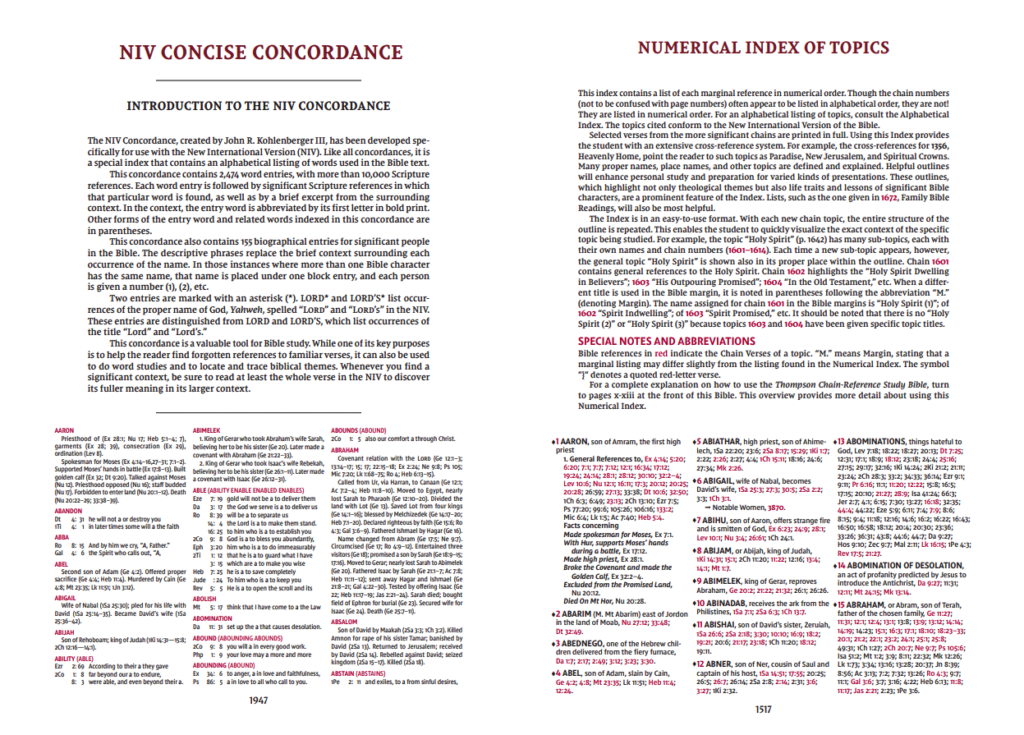
Most reference and study Bibles feature a concordance. Although the Concordance and the large Numerical Index of Topics pictured above might look similar at first, these are very different tools. They work differently and serve different purposes, which is the reason the TCR has both.
Here’s a description of each to show their purpose and how they’re different.
Concordance
A concordance is an index with an alphabetical listing of words that are found in the Bible text. Each contains thousands of word entries followed by the most significant Scripture references that contain each specific word entry. The references are listed under the book name and include the chapter and verse numbers, an excerpt from the text, and an abbreviation of the keyword in bold print. A concordance only lists Bible text verses that contain the exact word in the entry, which makes it ideal for finding specific verses that contain a certain word.
Topical Index
The Thompson Chain-Reference Bible includes two main indexes: the Alphabetical Index of Topics, which lists the topic numbers for each topic, and the Numerical Index of Topics, which lists the references for each topic. The Numerical Index is the most similar to a concordance, but rather than pointing to the scripture text, it points to the study material that sits alongside the Bible text. That information is based on themes rather than specific words in the Bible text. The Numerical Index of Topics lists verses that contain the themes regardless of the words used in the Bible text, making it ideal for studying topics, people, places, and much more.
Translation Specific
Each translation of the TCR includes a concordance that’s specific to that translation, because many translations include words that others do not. For example, the KJV contains words that are no longer used in general conversation today, while the NIV and other translations use modern equivalents.
NIV TCR Concordance
The 57-page NIV Concordance used in the TCR was created by John R. Kohlenberger III. It was designed specifically for the NIV and contains 2,474 word entries and more than 10,000 Scripture references. It also displays other forms of the entry word and related words in parentheses.
The NIV concordance also includes 155 biographical entries for many of the significant people in the Bible. Each includes a description with a list of references for specific points in the description. If more than one Bible character has the same name, the name is placed under one entry and each person is given a number to identify each different individual.
KJV TCR Concordance
The KJV TCR uses a KJV Concise Concordance. This is a 60-page concordance that includes over 800 word entries with around 7,400 Scripture references. It includes the proper names of many of the prominent people in the Bible. Many of the entries include a list of other references to see for further study.
NKJV TCR Concordance
The upcoming NKJV TCR will feature the NKJV Concise Concordance. This concordance includes 3,547 word entries and 9,320 Scripture references. We’ll provide more information closer to the publication date of the NKJV TCR, but this will be a good concordance to use for in-depth Bible study and sermon preparation.
Using the TCR’s Concordance
The main purpose of the concordance is to locate the books, chapters and verses in which a specific word appears. This is the most helpful when a reader remembers a particular word in a passage but may not remember the rest of the passage. It works well as a stand-alone tool and in conjunction with the TCR’s topical tools.
For example, if you are thinking of Psalm 23 and remember the word “shepherd” but can’t remember the rest of the passage, looking under the word “shepherd” in the concordance will lead you to that passage.
Once you’ve found the specific verse or verses you want, continue your study of the themes in that verse by following the topical chains in the margins. Once you’ve exhausted the passages in a topical chain, turn to the concordance to find other themes around the specific keyword you’re interested in studying.
To get more out of your Bible study, engage with the NIV’s concordance when studying biblical characters, since the included biographies provide many helpful insights into their backgrounds, character, and key events of their lives.
Ending Thoughts on the TCR Concordance
A concordance is a valuable tool for personal Bible study and sermon preparation. It helps readers find references to verses that contain specific keywords; it is also a great help for doing word studies and tracing biblical themes. Concordances show only a small portion of the biblical text, so when you find the passage you’re looking for, be sure to view the complete verse or passage to see the larger context.
A concordance is a very different tool than either the Alphabetical or Numerical Indexes of Topics in the TCR, but the concordance and indexes work great together. Using a concordance alongside the many study helps in the TCR is easy and can contribute to a significant deepening of the reader’s study of God’s Word.
Purchase your TCR in the Zondervan shop today.
A Look at the TCR Maps
September 27, 2022
A Look at the TCR Maps
Maps of the biblical lands are important tools for study Bible users. They help readers to visualize the settings or regions in which biblical events occurred; they also help place the journeys of various biblical characters and people groups into context.
There are two types of maps found in the Thompson Chain-Reference Bible; taken together, they make up some 30 maps that have been carefully crafted to assist readers in their Bible study. One of the major factors in the TCR’s recent update was the revamping of all of the previously published map sets.
In this article, we’ll discuss the types of maps found in the Thompson Chain-Reference Bible and review a few tips on using them for Bible study.
Annotated Maps in the Comprehensive Bible Helps
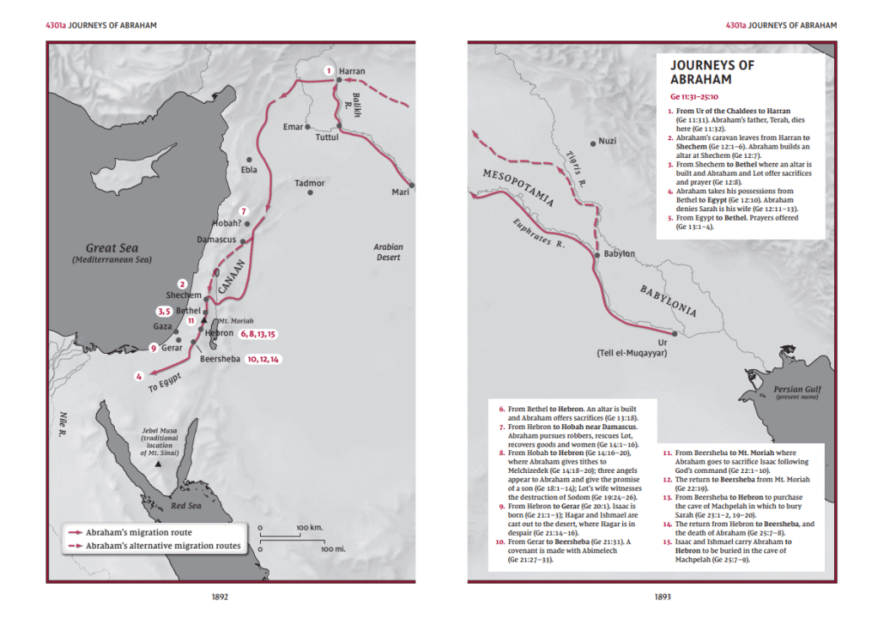
The text of the TCR Bible, from the books of Genesis to Revelation, has been intentionally left in an uncomplicated state. No maps or other study materials have been inserted into those books beyond the book introductions and two charts (one at the beginning of 2 Kings and one between the testaments). So the maps we’re reviewing in this article all appear in the end matter of the TCR Bible.
Several helpful maps are printed throughout the study material that readers will find at the end of the Bible. These focus on specific biblical characters and cover locations specific to their stories. They cover journeys, events, and locations where these characters were at certain times in their lives. They’re printed in grayscale with topographical elements in shades of gray and routes printed in dark red. They include detailed annotations under, next to, or within the maps. These maps were created specifically for the TCR and have been updated to match the TCR’s new design.
As mentioned above, rather than printing them within the text, these maps are placed within the Comprehensive Bible Helps in the back. Most are found within the Bible Harmonies and Illustrated Studies section along with life overviews, outlines, lists, and other study helps.
These maps include:
- 4287 Abraham, the Spiritual Pilgrim
- 4301a Journeys of Abraham
- 4302b Journeys of the People of Israel
- 4302c Journeys of Joshua
- 4302d Journeys of Gideon and Samuel
- 4302e Journeys of David
- 4302f Journeys of Solomon
- 4303c Jesus in the Year of Inauguration
- 4303d Jesus in the Year of Popularity
- 4303e Jesus in the Year of Opposition
- 4303f Jesus in His Last Months
- 4303g Jesus in His Last Days
- 4304b Journeys of Paul in His Early Life
- 4304c Paul’s First Missionary Journey
- 4304d Paul’s Second Missionary Journey
- 4304e Paul’s Third Missionary Journey
- 4304f Paul’s Voyage to Rome
Full-Color Maps
The TCR has 13 comprehensive full-color maps printed on thick, semi-glossy paper. They’re bound in the very back of the Bible. These maps are generally broader than the more targeted maps featured earlier in the end matter and cover larger land areas. These were created for Zondervan by International Mapping, and variations of these maps are used in many Bibles published by Zondervan and Thomas Nelson. Study Bibles typically include all 13 maps with an index, while reference and text Bibles include fewer maps without the index. Here’s a closer look at the index and maps.
Color Map Index
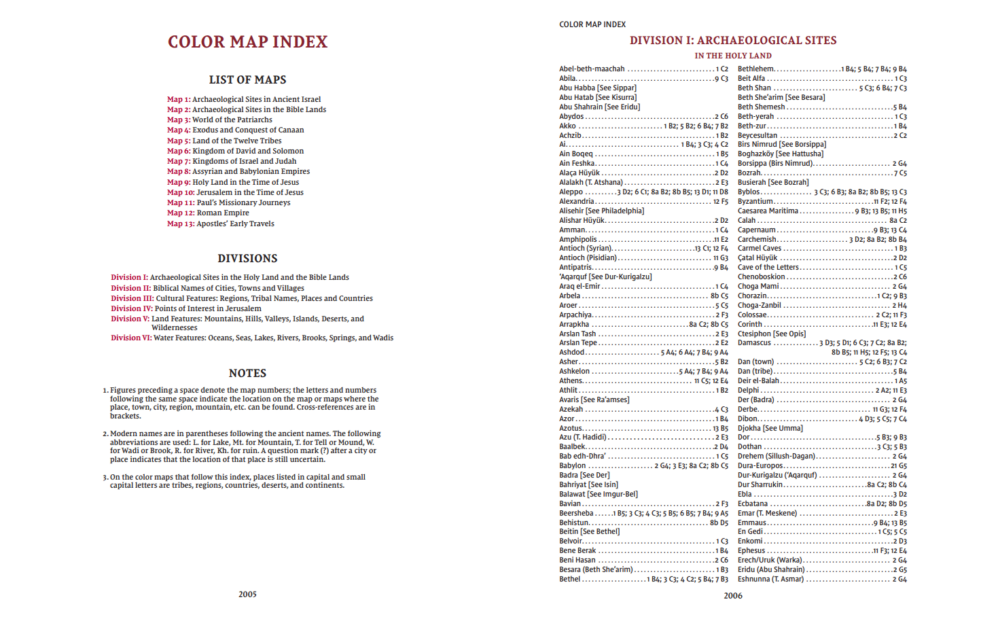
The Color Map Index is a 10-page index that highlights map locations based on five divisions. The divisions cover:
- Division I: Archaeological Sites in the Holy Land and the Bible Lands
- Division II: Biblical Names of Cities, Towns and Villages
- Division III: Cultural Features: Regions, Tribal Names, Places and Countries
- Division IV: Points of Interest in Jerusalem
- Division V: Land Features: Mountains, Hills, Valleys, Islands, Deserts, and Wildernesses
- Division VI: Water Features: Oceans, Seas, Lakes, Rivers, Brooks, Springs, and Wadis
The index is easy to use. Simply go to the division of the location you want to find and look up the place’s name alphabetically. Each location provides the map number and coordinates on the map. The coordinates include a letter that goes across the map horizontally and a number that goes across the map vertically. These work together to create a grid. Many of the locations cited are placed on multiple maps; when this is the case, all the maps and their coordinates are listed.
Color Maps
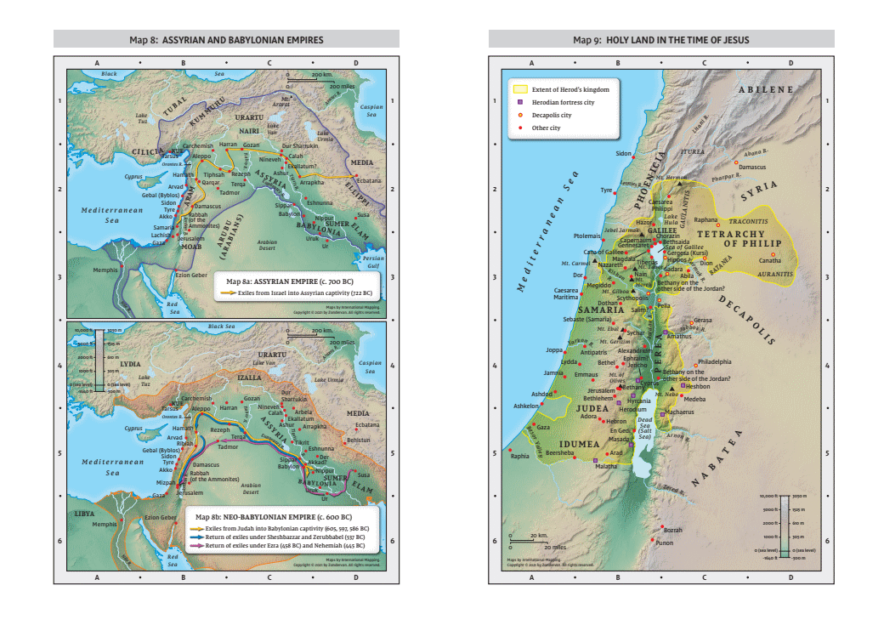
These full-color maps represent the topography of the areas and show seas, rivers, mountains, grassy lands, and deserts. Map keys show how the colors relate to elevation and distance (shown in kilometers and miles). Some of the maps include passage routes, color-coded keys for other kinds of information, annotations, and dates.
Maps include:
- Archaeological Sites in Ancient Israel
- Archaeological Sites in the Bible Lands
- World of the Patriarchs
- Exodus and Conquest of Canaan
- Land of the Twelve Tribes
- Kingdom of David and Solomon
- Kingdoms of Israel and Judah
- Assyrian and Babylonian Empires
- Holy Land in the Time of Jesus
- Jerusalem in the Time of Jesus
- Paul’s Missionary Journeys
- Roman Empire
- Apostles’ Early Travels
Thoughts and Tips for Using the Maps in the Thompson Chain Reference Bible
Biblical maps are useful for more than just understanding biblical geography. They give us a broad view of the biblical lands and the characters who lived there. Here are a few thoughts and tips on using them.
- Use the maps when reading the Scriptures to help visualize the locations of the passages you’re reading. Check the distances to understand how far someone had to travel. Travel was often on foot and sometimes by boat, animal, or carriage. Knowing the distance helps the reader understand why certain characters stopped where they did or took the routes that they did. (As an example, many scholars believe that Jonah, after he was expelled from the great fish, had to travel some 500 miles to get to Nineveh. That adds meaningful detail to this story.)
- Use the divisions in the Color Map Index to better understand the biblical locations and their features. View multiple maps of the same area or focus on the dates provided to see how borders, kingdoms, and cities changed over time.
- When studying a particular character’s journeys, look closely at the topography and the availability of water in the regions that they passed through. This often shows why they stopped where they did. As you read characters’ stories in the Scriptures, trace their journeys on the maps to get a better understanding of how far they traveled and what regions they needed to avoid.
- Notice the dates printed on the maps and in the annotations. These can help readers understand how events are interlaced throughout the Scriptures. Look at the large pathways that run from one region to another to understand how cities interacted with their surrounding nations.
- Look at the topography to understand the military advantages or disadvantages of nations, the trade routes, and why individuals and armies “went up” to Jerusalem regardless of the direction they came from. Study the topography, rivers, mountains, and climate to understand how each affected events in the Bible. This can help the reader to better understand the biblical narrative.
- Read through the annotations to better understand the dates and events. Read the verses they provide to see how the people, places, and events are tied together. Follow the topic numbers that link the maps together and link to other TCR resources, such as overviews, outlines, and the like.
Ending Thoughts
That’s our look at the maps found in the Thompson Chain-Reference Bible. Maps are a great addition to any study Bible because they help the reader visualize locations and get further insights into the biblical accounts. The Thompson Chain-Reference Bible includes updated maps and a full set of Zondervan color maps to help the reader dig deeper into God’s Word.
Purchase your Thompson Chain Reference Bible in the Zondervan shop today.

Thompson Chain-Reference Bible Reading Tips
September 14, 2022
Thompson Chain Reference Bible Reading Tips
The Thompson Chain Reference Bible is primarily a Bible designed for studying themes and topics. However, it is also an excellent Bible for reading, as the themes inform the reader’s study at many different levels. In this article, we’ll discuss six tips to get the most out of reading the TCR.
This list won’t cover the most common Bible reading tips, such as always starting and ending your Bible reading with prayer. This and other tips are a given regardless of the Bible you’re using. Instead, we’ll focus on tips that are specific to the TCR. Along the way, we’ll also discuss how the TCR’s tools help in your everyday Bible reading.
1. Read the Bible Text
The Thompson Chain-Reference Bible has been crafted from the ground up to provide an easy and pleasant reading experience. Its clear, clean layout and large, readable Comfort-Print font have been designed to be easy on the eyes and to compliment the translation you’re reading.
The text of the TCR includes very few distractions. On each page you’ll see verse numbers, helpful section headings, and a few footnote callouts that will help you understand the text more completely. While the marginal references can be helpful, if you decide to just do a straight text read, simply use a bookmark or an index card to cover those marginal references.
However, note that quickly perusing the topics in the side margins while you’re reading the text is instructive, as these topical notes summarize themes within the verses or passages you’re reading and in so doing provide a brief overview of the relevant topics included within the passage. We think you’ll be surprised at the connections you make as you include those marginal references in your daily study.
2. Choose a Theme to Read
One of the greatest strengths of the Thompson Chain-Reference Bible is the way it delves deeply into the Bible’s themes. There are many different options for choosing themes to read within the study tools that the Thompson offers.
The Alphabetical Index of Topics is a great place to start, as it lists all the topics in the TCR in alphabetical order. Simply browse the topics to find one that you’re interested in reading more about, then turn to the topic number in the Numerical Index of Topics to see the all the references and verses that the TCR offers for that topic.
The Numerical Index of Topics includes topic names, topic numbers, and many robust topical studies to review on the spot, as many entries include important and relevant verses printed in full. Turn to a specific topic number or browse the topics until you find something that interests you.
In the end matter of the Bible, the Topical Treasury also provides a great way to select themes to review. Its topic number is 4305, and it lists many topics under 8 major themes. It also provides the topic names and numbers so you can turn to them in the Numerical Index.
Finally, the Christian Worker’s Text, topic number 4306, includes lists of verses that focus on 10 relevant points for those who engage in Christian work, either as volunteers or as paid staff. These points feature a few verses printed in full and include the verse references so you can study each topic more deeply.
3. Read the Scriptures in the Numerical Index
Once you’ve chosen your topic, turn to the topic number in the Numerical Index and you’ll find verses for the topic printed in full. These Scriptures on a single theme serve to provide a concise overview of related themes in the Bible that help you to get a feel for how this theme is interrelated throughout Scripture.
Keep in mind these verses don’t include the context, so only reviewing the topics by reading these passages in the index isn’t meant to replace regular Bible reading. Rather, it serves to list the exact phrases the Bible includes on the theme, which can be great for focused reading.
4. Read the Chains in Context
For the best reading experience, as you’re following the topics through the Scriptures, it’s best to read verses in their proper context. Read entire passages rather than just the recommended verses, and then follow the chain reference to the next passage in your topic.
To accomplish this, we recommend that you use the information in the Topical Index as a starting-off point for your study. Read through the listed verses to get a sense of the direction of the topic, then turn to those verses and their related passages in Scripture to get the full context. Once you’ve found the theme you want to read, turn to the first verse in the topical chain. Rather than just reading the verse, start at the beginning of the paragraph, topic heading in the text, marginal heading, or the chapter and read the entire passage in context. Once you’ve read the context of the passage, locate the topic you’re studying in the side margins, turn to the next verse in the chain, and continue the process.
5. Group Topics Together
The Numerical Index groups topics together so they’re easy to access. The subtopics surrounding the larger topics are similar, and are designed to expand and broaden your view of a particular topic. Once you’ve read the verses in the list in the Numerical Index, consider expanding your reading by browsing the surrounding topics or turning to the suggested topics printed at the end of the list and continuing the process.
6. Utilizing Other TCR Study Tools in Your Reading
Use the charts, tables, maps, book introductions, and outlines to read important information about a topic before digging in to study that topic. These tools include a significant amount of relevant information for a wide range of study, and they’re designed in a way that makes them easy to read and use. They can also help you decide what topics to read along with your chosen topic to expand your reading even further.
Once you’ve read the preliminary information and familiarized yourself with the topic, turn to the topic number in the Numerical Index and continue reading the specific verses in the index itself. After that, consider turning to the verses in the text to see them in their full context.
Ending Thoughts
That’s our look at six Thompson Chain Reference Bible reading tips. Even though the TCR is a topical reference Bible with a strong focus on topical study, it’s also an excellent tool for simple everyday Bible reading, as the font size and page design make for an easy and pleasant reading experience.
Building topical study into your daily reading program using the TCR’s various study tools, as recommended above, will help you get the most out of your Bible reading.
Purchase your Thompson Chain Reference Bible in the Zondervan TCR shop and start reading today.
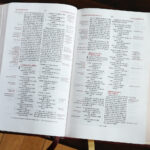
Thompson Chain-Reference Bible Marking Tips
August 23, 2022
Thompson Chain-Reference Bible Marking Tips
A sign of a well-used and well-loved Bible is that when the weathered cover flips open there’s a series of markings inside. There is great value in marking your Bible—highlighting special passages and making notes from sermons or small-group meetings draws attention to certain things you’ll want to find easily. Rereading these notes can bring something back to mind that has great meaning to one’s life. Marked Bibles become personal and precious over time, and can even serve as a legacy to one’s family in years to come.
The TCR provides many opportunities for unique methods of Bible marking. Although the TCR isn’t technically a wide-margin Bible, it does leave room in the margins between the topical reference notes to mark its text, margins, and study tools so that the user can get even more from his or her TCR. In this article, we’ll look at Thompson Chain-Reference Bible marking tips to help TCR users decide what works best for them.
Marking Tools
Recommended marking tools include pens, markers, and pencils specifically designed for Bible marking. Here’s a quick overview of the types of writing utensils you can use to deepen your study of the Bible and their purpose. Be sure to test them on pages in the back of your Bible before using them to mark the biblical text in your TCR.
Dry highlighters are best for Bible paper. They’re designed to not bleed through the page. They’re great for highlighting important passages in the text. Markers, such as Pigma Microns or similar, have archival ink and come in several sizes and colors. They’re great for underlining, making notes, drawing symbols and the like because they won’t bleed through thin paper, and they stand out as you’re flipping through the pages.
Colored pencils can be used to highlight and underline. These are perhaps the best option for avoiding bleed-through, although they’re less vibrant on the page than highlighters or markers.
Create a Color Code
Using different colors in a specific pattern is an excellent way to draw attention to specific themes, such as theology, people, places, events, and the like. Use colors from Scripture that have a symbolic meaning. For example, red could stand for the blood of Christ, redemption, and salvation. Green could symbolize growth. Blue could symbolize heavenly things. Alternately, you could use different colors to highlight different kinds of information, such as yellow for prophecy, blue for teaching, green for wisdom literature, and so on. Or perhaps set up your color-coded marking system to reflect the way the text speaks to you: yellow for encouragement, blue for hard teachings of the Bible, green for important stories about characters, and the like. But you’ll want to keep it simple; using somewhere around five colors to keep it straightforward and understandable.
Highlighting
Use dry highlighters to highlight the text or the topics in the margins. Highlight specific words, phrases, or passages, and note why these passages spoke to you with a few words and perhaps a date in the margins. Small notes like these can become very meaningful as the years wear on.
Underlining
Use markers or colored pencils to underline the text or the topics in the margins. Underline specific words, phrases, or passages that speak to your heart and your mind. Again, consider noting the date or your location when you underline passages.
Draw Brackets
Draw brackets alongside verses for the entire passage of your favorite topics. This helps to quickly see the full context of the story or teaching you’re wanting to remember for the future. Seeing these brackets will draw your eye back to these important passages again and again.
Mark the Topics in the Margins
As you work through your topical study, use color again to highlight specific topics in the margins. Mark the topic names, topic numbers, the next reference in the chain, or all of the elements. Highlight them, draw a square or circle around them, place an arrow to point to them, or whatever will help you note these important topics in the future. This is great for anyone who wants to memorialize a fruitful study by making certain topics stand out on the page.
Use Letters as Abbreviations
Write letters as abbreviations to represent specific points of interest. For example, the letters AP could repress answered prayer, IP could represent intercessory prayer, etc. Use letters that represent something from Scripture that will have immediate meaning to you or to those who see your Bible after you. Letters also work well with symbols to create even more detailed markings.
Create Symbols
Anyone who is comfortable with drawing can create simple symbols to use to graphically represent anything they want. Keep them simple and easy to recognize, such as a square, circle, cross, heart, altar, sun, boat, tree, book, sword, harp, or whatever you like. Draw them in the margins using markers, or over the text itself with dry highlighters or colored pencils that allow the text to show through. Choose images from Scripture and draw them in a way that they are easy to see in miniature.
Marking the TCR’s Tools
Aside from marking the text and margins, feel free to also mark up the other tools in the TCR. For example, you can color-code the Alphabetical and Numerical Index of Topics, as well as any of the tools in the back, to make certain kinds of information stand out at a glance.
Mark Consistently
If you can manage it, try to keep the markings consistent and mark the same way every time. Use color to represent one thing rather than using color at random. Doing so will infuse a level of meaning to your markings that you just can’t indicate in any other way. For example, if you’ve chosen to highlight your TCR, try not to change to underlining halfway through the Bible. Being consistent with your marking methods makes it easier to know what every mark means anywhere in the TCR.
Add a Marking Key
With all of the ideas offered in this brief article, it’s critical to create a key in the front few pages of the Bible to keep the markings straight and to help others who will see your markings in the future. Replicate all of the colors, letters, symbols and abbreviations and write out what these were intended to mean when you started marking your TCR. Reviewing these every once in a while will also remind you to look for certain types of information within the pages of the Bible.
Keep it Simple
Don’t go overboard with the details or make the markings too complicated. The more difficult it is to perform the marking, the less often you’ll want to make marks in the text of the Bible. As you plan out and start using a system, don’t worry about changing your marking tactics along the way. While we still want to encourage you to be consistent, times change and people change, so give yourself the freedom to change as well.
Be Creative
The pages of the Bible are there to teach you and to lead you into worship. If you’re inspired to draw or to write your prayers within the margins of the Bible, feel free to do so. Express your praise along with the psalmists; mark your agreement with the words of Jesus; write what you commit to do in the next phase of your discipleship journey in the notes pages in the back of the Bible; date your entries so that you can remember the month and year you heard a particular sermon or had a life-changing insight.
The TCR’s pages are there to be used and worked; the empty space is intended to offer you the benefit of deepening your study by personalizing the pages. Don’t be afraid to express yourself in a meaningful way that will help you reflect on your spiritual journey in the future.
Getting Started
Before marking in the TCR, it’s a good idea to practice first to see what works best. One way to do this is to print a page and test the marking methods. The TCR website includes downloadable PDFs of the NIV and KJV TCRs in Comfort Print. Try printing a few pages and practicing first.
And again, before using a marker, highlighter, or pencil in the text of the Bible, be sure to test the writing tools on pages in the back of the Bible. Doing so will allow you to discover how well the implement works with the Bible so you can decide if it’s right for your needs.
Conclusion
The Thompson Chain-Reference Bible is unique in the tools that it offers readers to expand their study of the Bible as part of a life-long learning process. As you use those tools, don’t be afraid to mark the pages to track your journey along the way. Your system doesn’t have to be perfect; it’s okay to make mistakes or change your minds on how you’ll approach the Bible marking process. We hope we’ve given you some tips here that will help you get started quickly on your Bible marking journey.
Purchase your TCR today in the Zondervan Thompson Chain Reference Bible shop.
How to Save Time in Study and Sermon Using the Thompson Chain-Reference Bible
June 21, 2022
How to Save Time in Study and Sermon Preparation Using the Thompson Chain-Reference Bible
The Thompson® Chain-Reference® Bible is an excellent tool to engage for Bible study and sermon preparation. For well over 100 years, professional clergy, lay pastors, and Bible teachers in many settings have profitably used its study systems to enrich their instruction. The TCR’s in-depth study system identifies the interconnectedness of God’s inspired Scripture as it links topics throughout the Bible. In this article, we’ll examine how this study system, and all the tools associated with it, save time in study and sermon preparation.
TCR Bible Study Tools
The Thompson Chain-Reference Bible includes several tools that simplify Bible study and sermon preparation. Here’s a look at some of the best tools for preachers and teachers.
Topics and Chain References in the Margins
Over 100,000 marginal notes detail the topics that can be found in each verse, allowing the preacher or teacher to see the associated topics at a glance. These notes also help to identify the main points for studying or expositing the text.
The marginal topic entries also include chain references that point to the next verse in the topic chain. This allows the preacher or teacher, as they follow the references through the chain, to study multiple related passages that correspond to the theme of their teaching. Each of the topics also includes a number that leads the preacher to the tools in the expansive indexes in the back of the Bible for further study.
Alphabetical Index of Topics
The Alphabetical Index of Topics lists every topic and subtopic found in the TCR in alphabetical order. This includes people, places, and themes, and makes each topic easy to find quickly. Each topic also includes the topic number, which leads the preacher or teacher to the Numerical Index of Topics.
Numerical Index of Topics
The Numerical Index of Topics contains all the topics included in the marginal notes along with the major verses associated with those topics. Of these, the main or most applicable verses are printed in full, allowing for quick and easy in-index study of both the major points and their related subtopics. The Numerical Index of Topics keeps all related topics together under major headings, making them easy to see and use.
This Numerical Index of Topics has been carefully crafted to identify the most prominent verses associated with over 8000 curated topics. The at-a-glance nature of this expansive index greatly simplifies theme study for pastors and teachers, no matter if they’re preaching to a crowd of thousands or working in a small-group setting.
Topical Treasury
The Topical Treasury is a list of topics that make great sermon starters. It lists topics relevant to various audiences in many different categories that include evangelistic meetings, men’s meetings, women’s meetings, youth-oriented meetings, holidays, and more. The topics addressed in this treasury include names and topic numbers that lead to the Numerical Index of Topics.
Multiple Study Methods
The TCR promotes multiple methods of Bible study including topical, biographical, book, passage, and verse study. These methods help the preacher or teacher study any topic or passage. Preachers and teachers can use each method along with the basic Bible study principles outlined in various articles in the front and back of the Bible to develop strong themes, specific points, and illustrations for their sermons or lessons. Let’s look at the methods that can be fruitfully used based on the TCR’s extensive study tools.
Topical Study Method
When you decide on a topic to study, first search the Alphabetical Index of Topics for the topic number. Next, turn to the Numerical Index of Topics to see the verses associated with that topic. Within that index, the preacher or teacher can scan and study the printed verses, turn to the first verse and follow the chain through the Scriptures, and look through all the related and suggested topics.
As they engage with these tools, the preacher or teacher can make notes on the topics and verses they want to use for their sermon or teaching, analyze the passages, and create their teaching outline from their notes.
Following this process allows the preacher or teacher to form a balanced overview of any topic, as well as helping them study their chosen topic within the context of related Scriptures. Having a wide variety of topical information identified and listed keeps the preacher or teacher from having to spend time researching to find the same information on their own.
Biographical Study Method
The Bible Character Studies section provides information about key biblical characters. It includes a range of major and minor biblical characters along with detailed information about their lives. It also includes outlines, charts, and synopses that identify key events and points to study, so that critical information on each Bible character is easy to access and follow.
Book Study
The TCR also includes several tools to help study books of the Bible.
The book introductions provide information on the book’s author, date the book was written, its purpose, audience, main theme, key word, and key verse. These introductions also include a detailed synopsis, point to prominent people that readers will find in the book, and outline the book’s major themes. Finally, the book introductions list the major topical chains to follow throughout each of the Bible’s books.
The Condensed Outline of the Bible divides the Bible’s books into their traditional literary sections and provides a short description of each book of the Bible.
As they examine these tools, the preacher or teacher can use them as a starting point for preparing their teaching and for generating ideas to highlight within those teachings. They can quickly see the main themes, key events, and main characters of each book, and so much more. These are especially helpful to those who preach or teach through entire books of the Bible.
TCR Sermon Prep Tips
The Thompson chain-reference system removes the detailed research needed for sermon or teaching preparation so you can focus on the message itself. Here are a few further tips for sermon and teaching outline development with the TCR:
- Use all the TCRs tools together for the best and most in-depth study results.
- Use a physical or digital notebook for your sermon notes.
- Make notes on your thoughts and findings as you study.
- Write down the main topic and passage that you want to address.
- Read the full passages related to each topic to see the entire context.
- Write down the main points you discover through your research to help you analyze the passage.
- Make note of the supporting topics associated with your chosen topic, along with their Scripture references.
- Write out the ideas found in supporting passages to help build supporting points.
- Make note of recommended topics for further study.
- Prayerfully build your outline from these notes.
Ending Thoughts
The Thompson Chain-Reference Bible is a robust study resource for sermon and teaching preparation. Its tools simplify the research process and make it easy to study any book, topic, character, or passage. Rather than providing easy answers that a preacher or teacher can simply repeat, it allows the speaker to complete a more comprehensive study as it breaks topics out and lists them so they can be easily seen and traced. All of this saves time and effort in sermon and teaching preparation.
Are you ready to save time while still deepening your study with the Thompson Chain-Reference Bible? Purchase your TCR today in the Thompson shop.

Thompson Chain-Reference Bible Study Tips
June 7, 2022
Thompson Chain-Reference Bible Study Tips
The Thompson Chain-Reference Bible is an excellent resource for students of the Bible to use for deep study on any subject. Its tools identify and connect 8000 carefully selected topics in a way that’s easy to learn and use. The tools in the TCR have all been designed so that they work together to allow Scripture to interpret Scripture. In this post, we’ll look at a list of tips to help you get the most out of your Bible study with the Thompson Chain-Reference Bible.
1. Follow Basic Bible Study Principles
With the TCR, readers don’t need to learn a new or different study system that has convoluted methods of Bible study. Instead, using solid Bible study principles, in the TCR the reader has access to tools that promote good Bible study practices. As they engage the text, readers should still ask fundamental questions about the text they’re studying, such as:
- Who is the author?
- To whom was it written?
- What was the purpose of the writing?
- How does this book or passage fit within the context of Scripture?
- What is the clear teaching within this context?
As you engage the TCR’s vast study resources to answer these questions for the text you’re studying, use a notebook or journal to record your thoughts or notes on the topics and chains, and insights that you’ve discovered or encountered during your study.
2. Focus on Context
The purpose of the topical chains that are represented in the marginal notes is to identify the topics that are embedded within the verses and connect each verse to other verses that deal with those same topics. While it may be tempting to read one verse in a chain and then quickly move on to the next verse in the chain, doing so may inhibit a deeper understanding of the context of the verse.
When following a topical chain through the Bible, be sure the read the verses that come before and after the verses in the chain to gain a larger perspective on the verse or passage’s broader context. As you carefully focus on context while studying these topical chains, you’ll get better answers to your questions about each verse and passage, such as the author, purpose of writing, its location in Scripture, and the like.
3. Use the Book Introductions
Read through the book introductions to get more information about the book that you’ll be studying. Each of these introductions features several themes for readers to focus on as they approach their Bible study and are great resources for digging more deeply into any book. Book introductions are placed at the beginning of each Bible book to make them easy to access, and provide helpful information about the book, such as:
- The Book’s name: includes the topic number that links to the Condensed Outline of the Bible that features a short description of each book.
- Author: includes information that is known about the author of the book.
- Date Written: the date if known, and the location in which it was written.
- Purpose: a brief paragraph that discusses the circumstances that led to the writing of the book.
- To Whom It was Written: the primary audience and, when applicable, a verse number to see this information in the text.
- Main Theme: a sentence describing the primary theme of the book.
- Key Word: a word that best describes the book and when applicable, the number of times the word appears in that book.
- Key Verse: the verse that best describes or summarizes the book.
- Synopsis: an outline of the book with a detailed description of each element of the outline. This brief statement provides an excellent overview of the book.
- Special Features in the Book: a list of special features that are unique to the book so that readers can look for and study those features.
- Prominent People: the main characters one will study in the book.
- Major Chains: the most important or prominent topical chains in the book. These include the topic name and number.
4. Note the Content in the Margins
The marginal notes include several tools to help readers understand a specific verse or passage. These tools include:
- Subject headings
- Topic names
- Topic numbers
- Chain references
- Parallel passages
As you address a passage of Scripture, carefully consider all the topics that are highlighted in the passage through these study notes. Rather than simply following one chain, consider going back to your key verse and examining the other topics that appear in the margin. Follow multiple chains from your key verse to get more detailed insights into any theme.
5. Search for Topics in the Alphabetical Index of Topics
The Alphabetical Index of Topics lists every topic and subtopic that is featured in the TCR. This index is a great place to start when studying a theme, person, or place within the pages of Scripture. After you find the person, place, or theme in this index, note the topic numbers and turn to the Numerical Index of Topics to study lists of related Scripture references.
6. Consider the Surrounding Topics in the Numerical Index of Topics
The Numerical Index of Topics lists topics that appear under larger primary topics. Rather than just reading the references for the topic you’re looking for, browse through the surrounding topics and look for the larger headings to see the primary topics for any given subtopic. These surrounding topics are great for expanding the scope of your study to gain a deeper understanding of the subject you’ve decided to examine.
7. Consult the TCR’s Bible Study Articles
The TCR features numerous articles to help the reader as they get started in their Bible study. Users can peruse the front and back sections of the Thompson Chain-Reference Study Bible for articles that provide timeless information on addressing the subjects in which they’re interested. These articles on Bible study cover the principles behind deeper study and offer strategies and methods for approaching Bible study as they help to point the reader in the right direction.
Ending Thoughts
The Thompson Chain-Reference Bible is a classic, in-depth resource for Bible study. Its extensive study tools work together to lead readers down a path of fruitful and engaging learning. As they walk that path, they’ll see how these study helps allow Scripture to interpret Scripture. The TCR’s study system is simple to use and understand, and will help anyone from any denominational background to gain a new appreciation for the interconnectedness of Scripture – and of the God who so graciously gave this revelation of himself to the world.
Purchase your Thompson Chain-Reference Bible today from the Zondervan TCR shop.
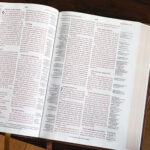
What Are the Hidden Features of the Thompson Chain-Reference Bible?
May 18, 2022
Throughout this blog series I have been talking to you about the major features of the Thompson Chain-Reference Bible. Some of these tools comprise the larger study features of the TCR Bible that allow for in-depth topical study: the topical reference system, the Alphabetical Index of Topics, the Numerical Index of Topics, biblical character studies, and book introductions.
But among these larger tools are many helpful and useful tools that are not as large, usually taking up one page or less. We don’t want those smaller reference works to go unnoticed, so in this article, we’ll look at those smaller, sometimes hidden features of the TCR.
Table of Weights and Measures
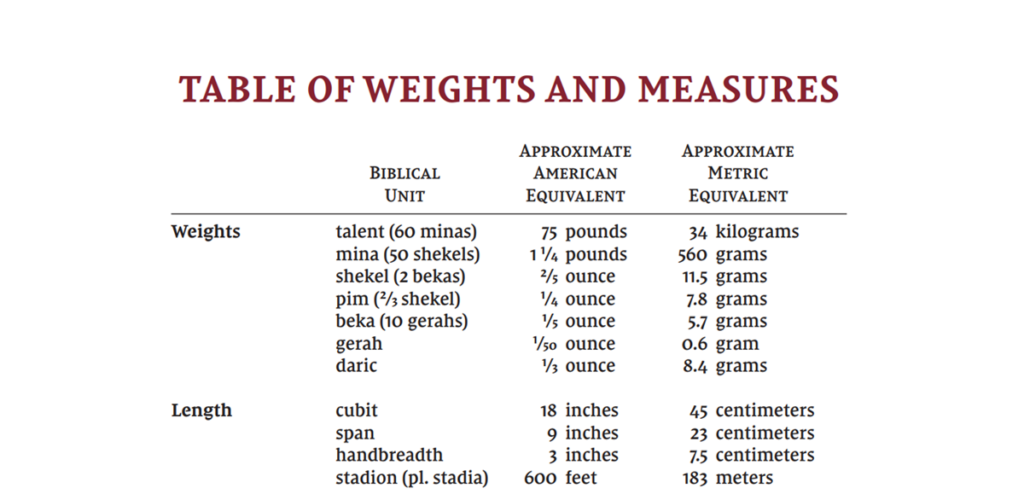
The Table of Weights and Measures used to be a topic within the Numerical Index. It wasn’t difficult to find, but the table didn’t fit the index’s formatting, so it looked out of place. It’s now the first tool in the end matter, situated just after the end of the book of Revelation. It covers the biblical units of measure that readers will find within the text of the Bible, the approximate American equivalent, and the approximate metric equivalent.
Principles of Bible Study
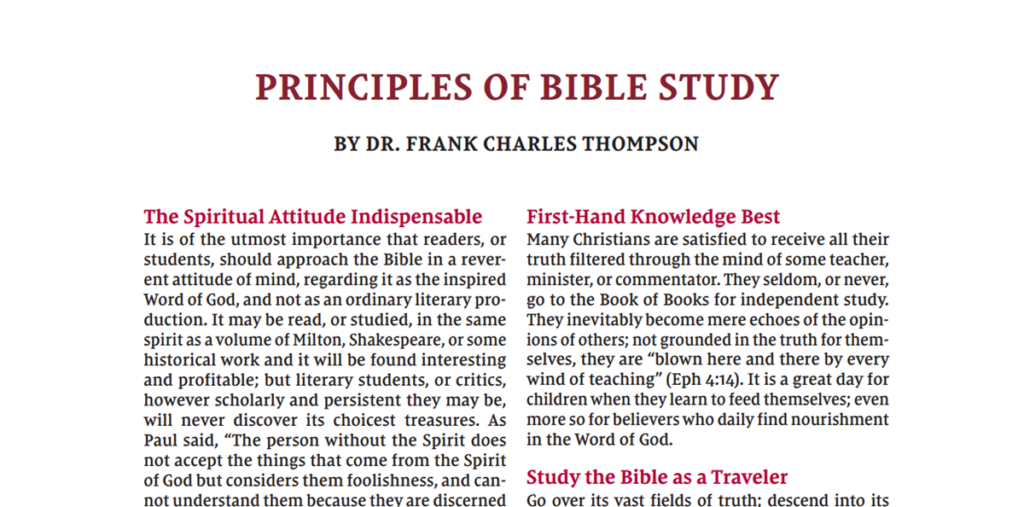
This is an article situated just before the Alphabetical Index of Topics. It provides helpful insights from Dr. Frank Charles Thompson on how to approach studying the Bible. Dr. Thompson discusses the proper mindset of personal study and includes several suggested guiding principles for mining the riches of God’s Word.
Best Methods of Study
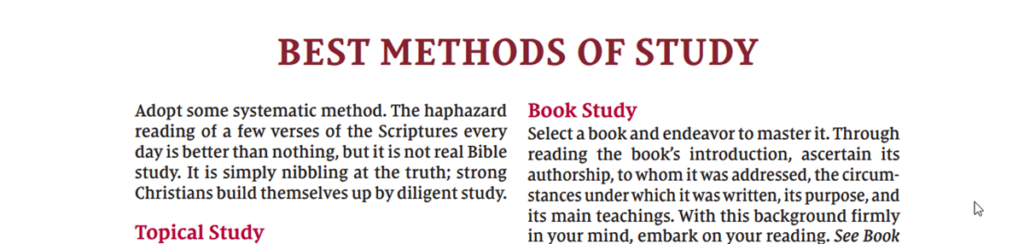
This short article discusses four types of Bible study. After reading this practical guide, readers will be able to pick up on one of the four and begin. Because each of the four types of study are different from one another, the authors encourage the reader to use all four methods to expand the depth of their study.
Titles and Names
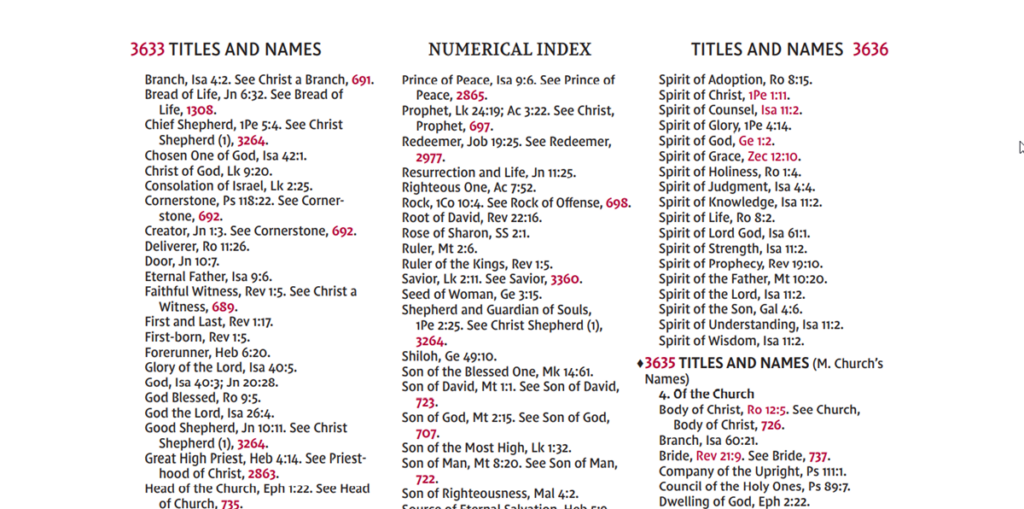
Topic numbers 3632-3640 include lists of titles and names for Christ, God the Father, the Holy Spirit, the Church, ministers, believers, Satan, the wicked, and God’s Word. Every title included in the list comes with Scripture references or topic names and numbers that readers can use to continue to explore these subjects. These are the types of lists we often see in modern study Bibles, but many don’t realize they’ve been included as part of the TCR’s study tools for many decades.
Periods of Biblical History
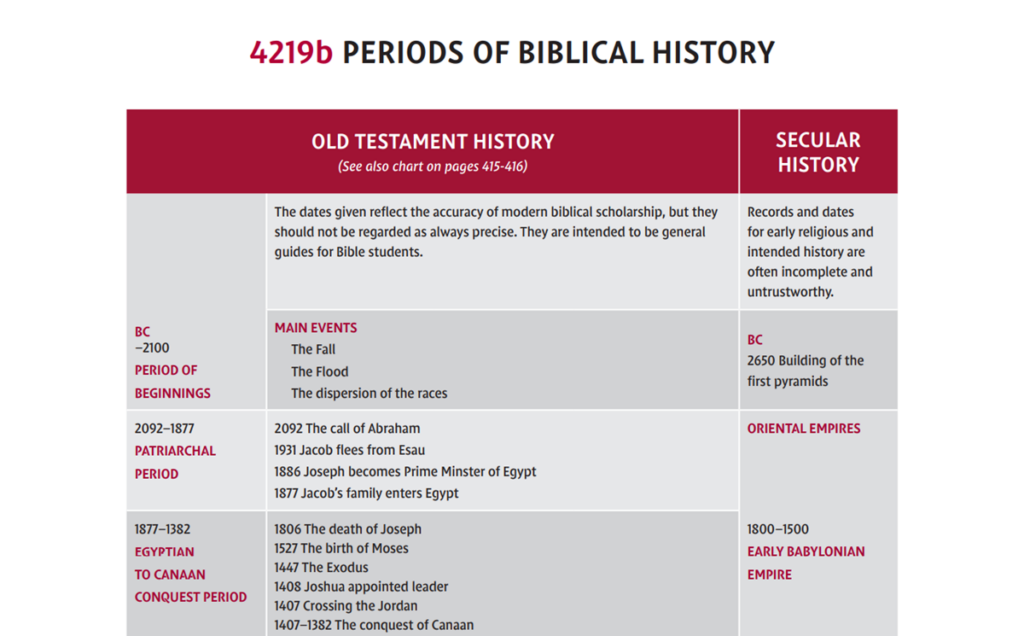
Topic number 4219b is a table that places key periods and events of the Old and New Testaments alongside events that occurred within secular history. This is an excellent chart that helps put the biblical timeline into a larger historical perspective, helping readers to understand what was happening in the wider Mediterranean culture at the same time the biblical events were occurring. Finally, it also includes details of what happened in the world in the 400 years between the writings of the Old and New Testaments.
Outline History of the Apostles
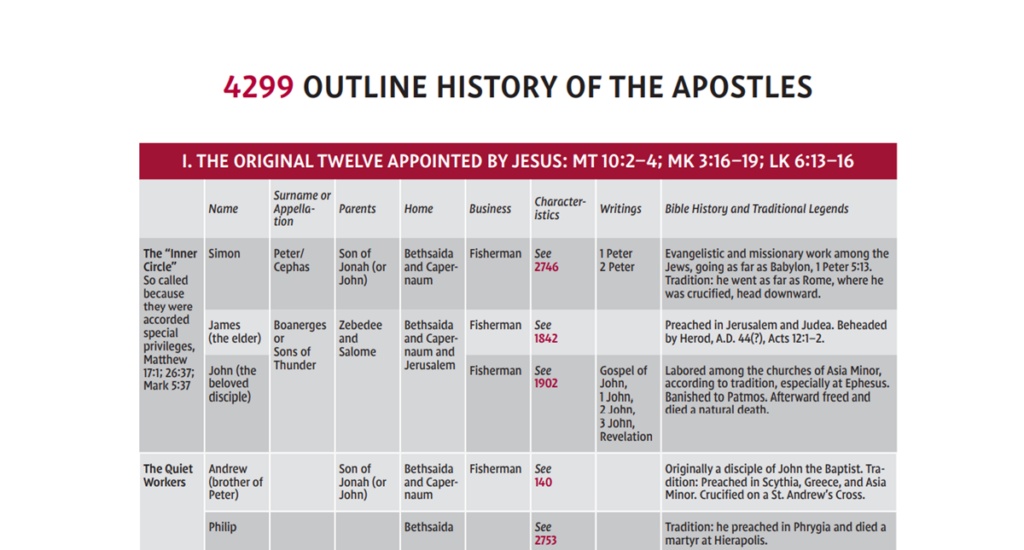
Topic number 4299 is a table that covers the names, surnames, parents, home cities, and occupations of the original twelve apostles, as well as those who were added to the apostolic ranks after the ascension of Jesus. Additional information on these individuals is also included, such as their personal characteristics, writings, and final history and legends surrounding each one.
Messianic Prophecies and Their Fulfillment Arranged Chronologically
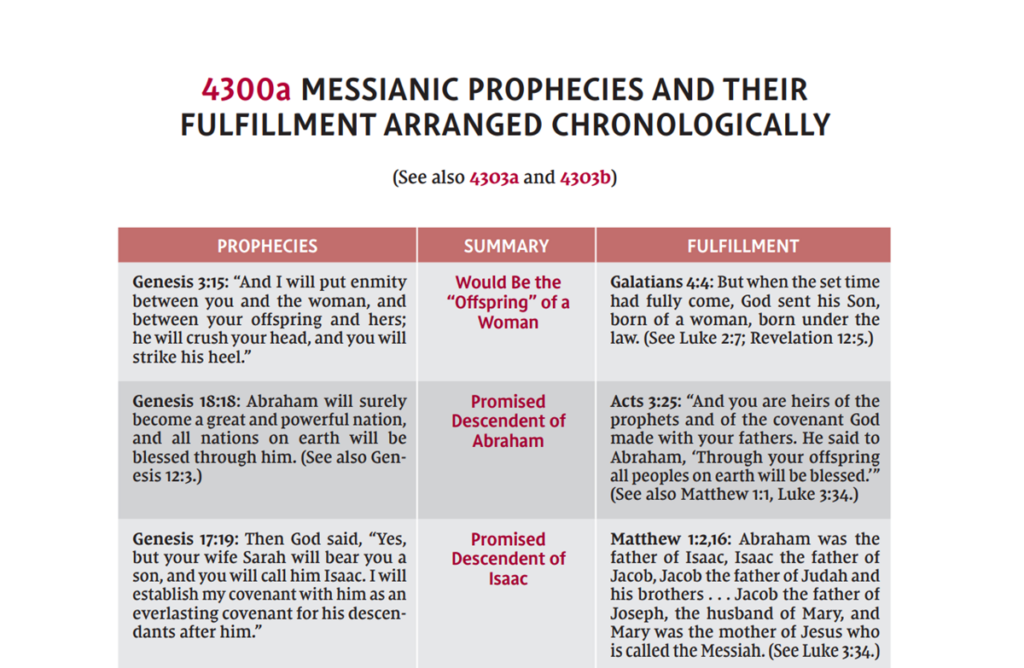
Topic number 4300a is an important chart that details many of the Old Testament prophecies that were fulfilled in the life, death, resurrection, and other activities of Jesus. This chronological chart allows the reader easy access to these critical proofs of Jesus’ divinity, showing the reader each prophecy, a summary of the same, and its fulfillment.
Harmony of the Gospels
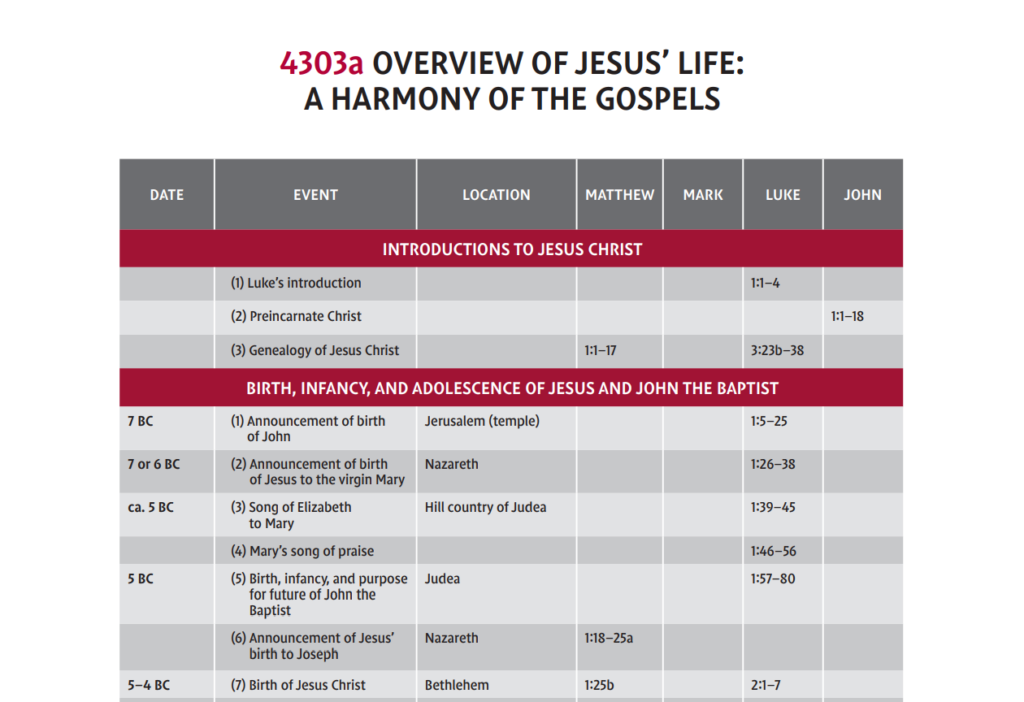
Topic number 4303a is a helpful and robust multi-page table that harmonizes all the events of Jesus’ life in the gospels. This at-a-glance reference work includes the date of the event, its location, and the references where the event can be found in each of the Gospels. The major sections are divided by titles that allow readers quick access to the period of Jesus’ life that they’re interested in studying.
Jesus in His Hours Upon the Cross
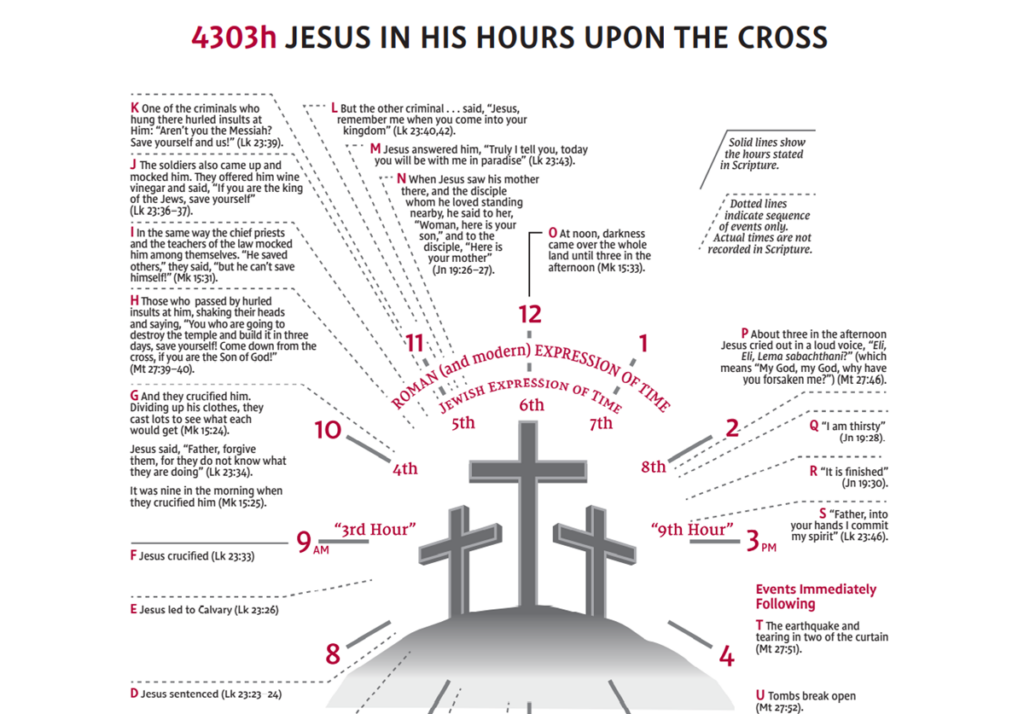
Topic number 4303h is a beautiful illustration that provides a visual treatment of all the events that happened in the hours that Jesus was suffering on the cross as a sacrifice for all of human sin. It includes a clock-like timeline of those critical six hours, and shows the reader all the most helpful scripture verses that describe Jesus’ words and actions on that eternity-altering day.. It also lists the events immediately following the crucifixion.
Jesus' Post-Resurrection Appearances
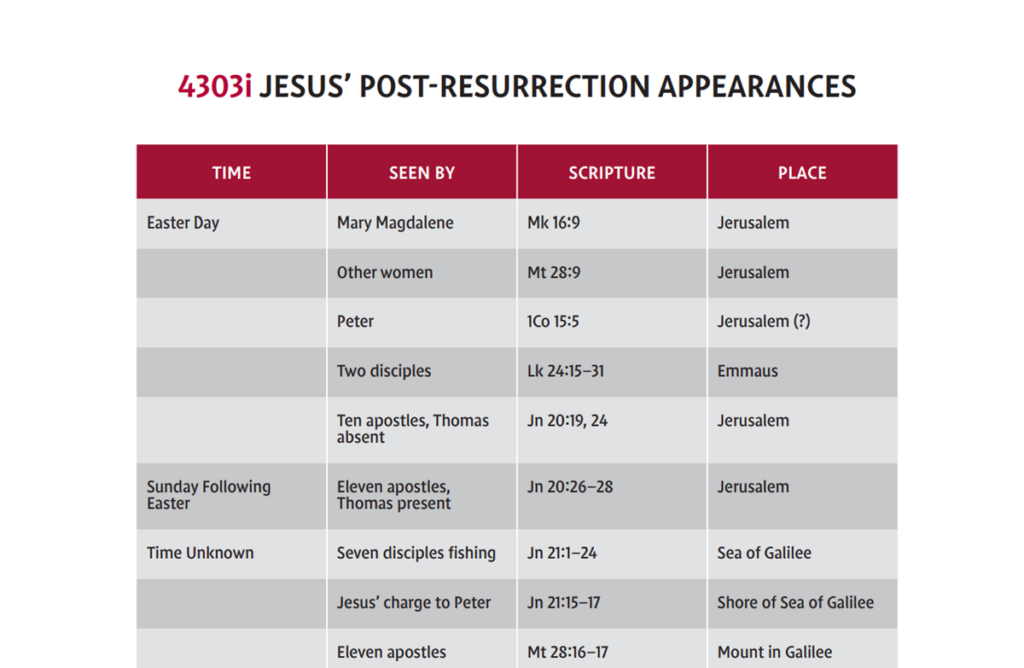
Topic number 4303i records Jesus’ post-resurrection appearances. It includes information on the day and time that Jesus was seen, who saw him, where the Scripture references of these events can be found, and the place where he appeared. This helpful reference tool pulls all of these disparate verses together in one place for ease of study.
Outline History of the Early Church
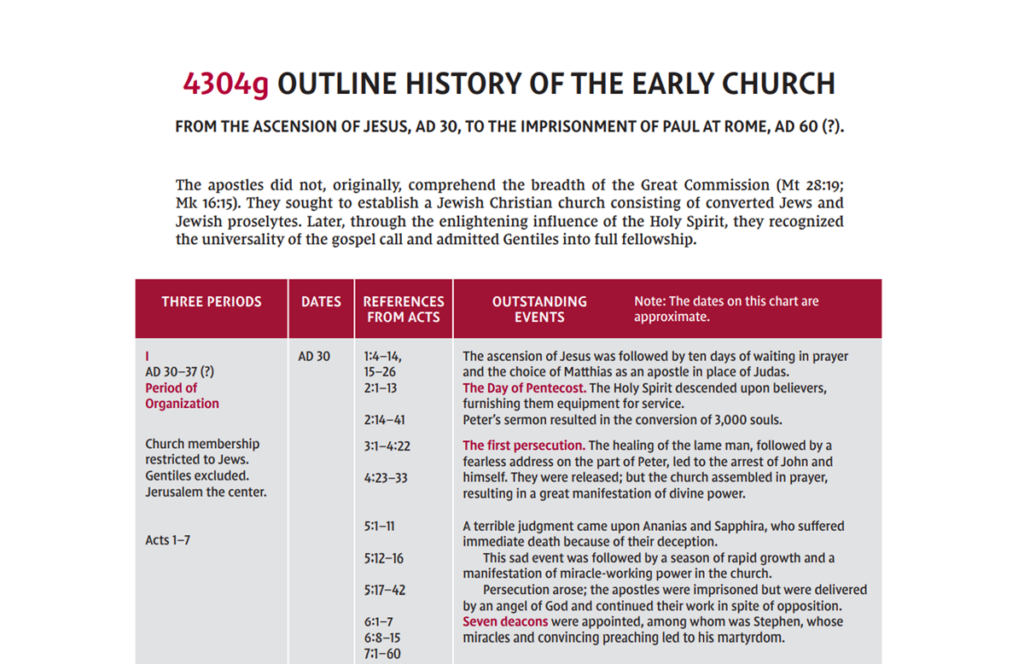
Topic number 4304g is a table that covers the events of the early church from the ascension of Jesus to the imprisonment of Paul in Rome. It covers three periods of time, the approximate dates of the events cited, references from the book of Acts, and descriptions of the outstanding events themselves.
Distances in Miles Between Old Testament Cities
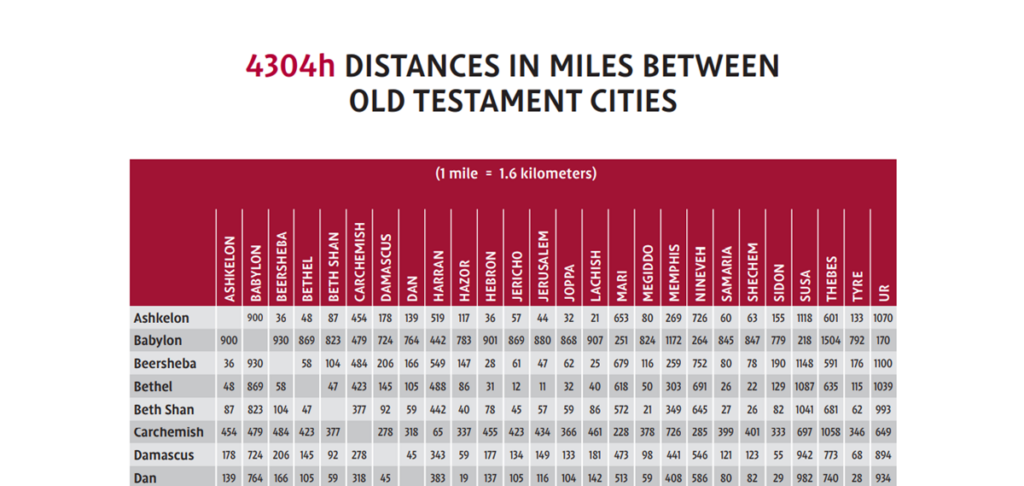
Topic number 4304h lists the distances between Old Testament cities, which is helpful for determining what a particular Bible character or group of people experienced on their journeys between these cities. It displays the names of the OT cities across the top and on the side of the chart, listing the distance between each city following ancient routes. For example, with one quick glance one can discover that the exiles of Judah had to trek some 880 miles from Jerusalem to Babylon after their defeat at the hands of Nebuchadnezzar II in 597 BC.
Topical Treasury
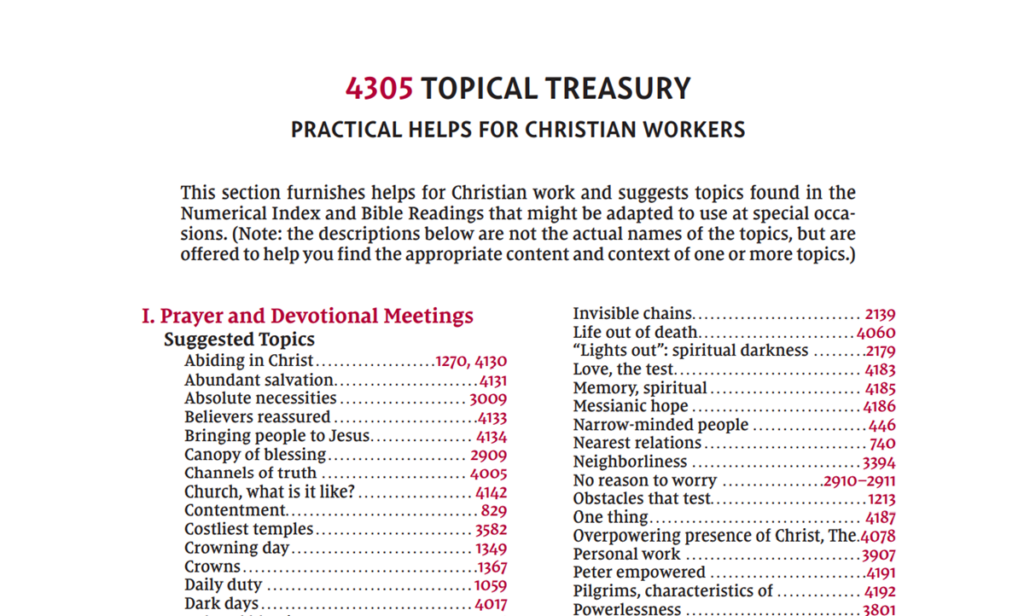
Topic number 4305 is a large chart with practical helps and topical numbers for relevant topics that Christian workers can use in their labors. It covers many different types of meetings that Christian workers might be involved in, and directs readers to the locations of these topics for further study.
The Christian Worker's Text
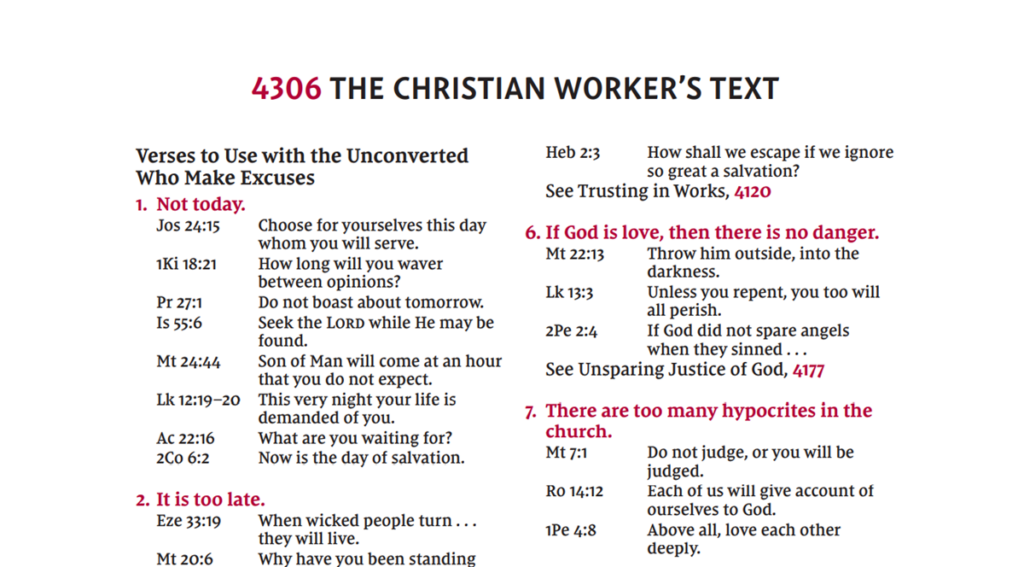
Topic number 4306 is a list of Scriptures for Christians to use with individuals who are unconverted and who make excuses for not believing in the gospel of Jesus. It includes a list of Scriptures that counteract the main excuses such people often make, which aids the Christian worker in graciously addressing each excuse.
Memory Verses
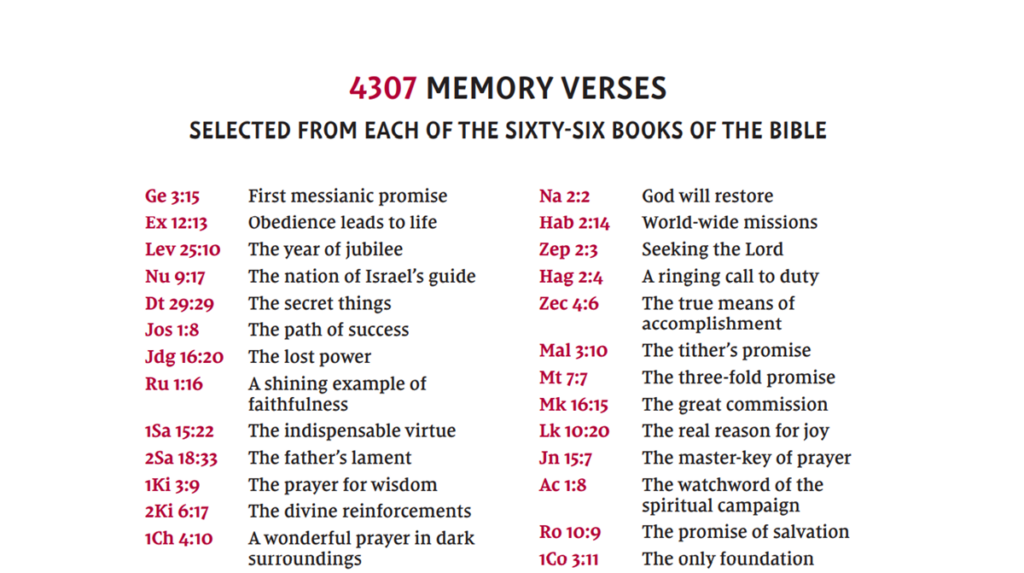
Topic number 4307 is a chart that lists a recommended memory verse from each book of the Bible. It provides a key Scripture reference from each book along with a short explanation of what the verse says and/or why it was chosen.
Aids to Memorization
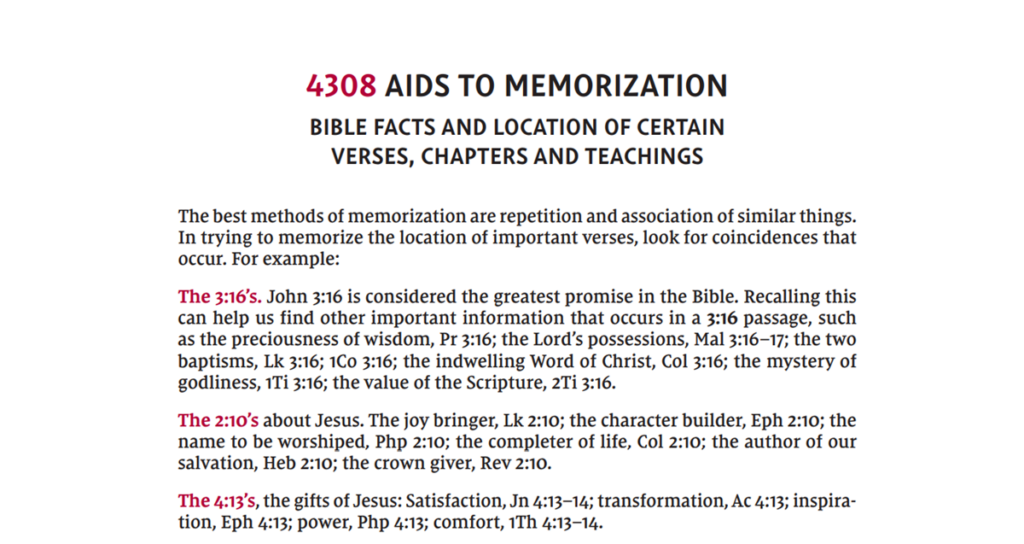
Topic number 4308 is a guide that provides helpful insights on how readers can memorize Scripture. It discusses different methods of approaching the task of memorization along with specific patterns that interested readers might choose to follow.
Ending Thoughts
The Thompson Chain-Reference Bible is packed with many helpful features. The smaller tools, including charts, tables, lists, and a few articles often go unmentioned when discussing the TCR, which is why we’ve covered many of those hidden features here. Be sure to check them out when using the TCR for your personal or group Bible study.
I strongly recommend browsing the TCR’s multiple indexes and thumbing through the tools in the back of the TCR to see for yourself what’s there and how it can expand your study. With all of the rich and in-depth tools at your disposal, there’s always something to study.
See all the Thompson Chain Reference Bibles in the Zondervan shop to purchase your TCR today.
A 21st-Century Bible That Reflects 21st-Century Excellence
May 4, 2022
Ever since the Thompson® Chain-Reference® Bible released in 1908, the designers and type setters involved in laying out the complex pages have partnered with the most advanced printers of the era to deliver a beautiful Bible that is easy to read and simple to use. Over the decades, that partnership has delivered legendary design paired with clear, beautiful printing to make the TCR one of the most beloved reference Bibles ever produced.
The latest editions of the TCR are no different.
The Latest in Font Designs
The Thompson Chain-Reference Bible’s latest update reflects 21st-century advances in printing and font design. Each of the Thompson Chain-Reference’s translation pairings (including the recently released NIV TCR and the soon-to-be-released KJV TCR) use cutting-edge fonts that have been specifically designed by the leading font foundry in the world: 2K in Denmark.
In recent years, Zondervan and Thomas Nelson have worked with the experts at 2K to create bespoke, custom fonts for the NIV, KJV, NKJV, NRSV, and NASB translations. These fonts reflect the heritage of these translations while also matching the style of their vocabulary to create beautiful and appropriate font families for the audiences who use these translations.
The use of these new fonts has made the design of the new TCR Bibles the best that it can be. Generous font sizes combine with beautiful new advanced papers and cutting-edge printing techniques to produce Bibles with bright, crisp, two-color designs. All these factors combine to produce the most beautiful, easiest-to-use TCR Bibles ever produced.
The Latest in Printing Techniques
Over the past decades Bible publishers the world over have been able to take advantage of the latest advances in printing techniques. Global printing competition has improved the printing trade to the extent that publishers can expect the same excellence in print quality whether they print in the U.S., China, India, or any other location worldwide. And U.S. printing companies have expanded their operations overseas to compete with indigenous printing companies, sharpening the quality and range of options for publishers the world over.
To be successful and keep business rolling in, every one of these printers must comply with global print-quality standards set by ISO (the Geneva, Switzerland-based International Organization for Standardization). This organization has set printing standards for every conceivable aspect of print—from print density, to pages per minute, to the quality standards that paper producers must follow, and many more. ISO standards cover everything from desktop printers to the massive printers employed by newspaper and magazine publishers. One online source reports that the ISO has generated over 17,000 global print standards to which all printers and manufacturers must comply.
For Bible publishers, these print standards are critical. The volume of pages that need to race through the presses require exacting conformity to these ISO benchmarks. Printing millions of pages a year on paper that is thin enough to fit 1200 stacked pages into just over an inch of thickness is no small task. Assuring the print quality of the pages running through these high-speed presses is something that press operators watch with great care and concern.
So how do the designers and printers working on the latest TCR editions make it look so beautiful while also making it clear and easy to use? Zondervan, a company located in Grand Rapids, Michigan, can proudly claim that one of its GR-based neighbors, a company called X Rite, innovated early on to develop a machine that can help printers maintain these exacting global printing demands: A hand-held machine called a “densitometer.”
Assuring Font Density
So what is a densitometer?
A quick online search for this information yields the following definition: “A densitometer is a device that measures the density, or the degree of darkening, of a photographic film or plate by recording photometrically its transparency (fraction of incident light transmitted).” That’s a fancy way of saying that it’s a machine that measures the density of the font on the page, as its name belies.
When Bible titles are on press, a densitometer is used to measure the ink density so that printers can verify that all printed sheets are within a proper ink tolerance. Generally speaking, the presses that print Bibles print at very high speeds produce thousands of sheets per hour, which translates to several sheet sets (called “signatures”) per second. Depending on the size of the printing press, a “signature” can be anywhere from 8 to 32 pages thick. As they’re being printed, these thin sheets of paper are literally speeding through these high-efficiency presses at an incredibly fast rate.
To ensure that all pages are printed within ISO tolerances, the vendor uses a densitometer to read color bars on each page of a signature to verify that those signatures are reading the correct density.
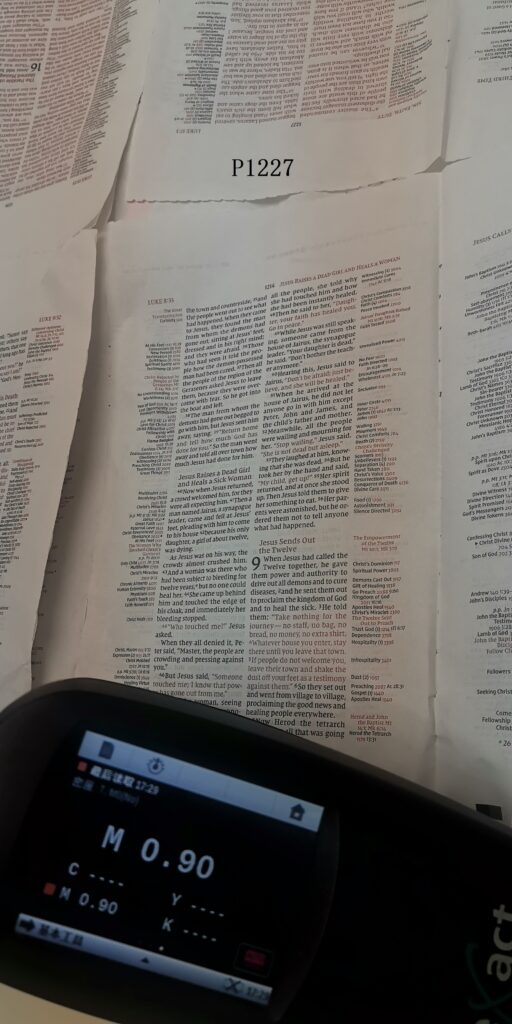
Target font density for a Bible title can change based on different variables. For red-letter/two-color Bibles like the TCR, there may be one target for the red font and a different target for black ink on the same sheet. Simply stated, the red ink can measure within a specific range on the densitometer and still be within ISO tolerance.
Put another way, sometimes one page might register one number on the densitometer while the next page registers a different number. This density difference may be somewhat noticeable to the trained eye; however, rigorous checks are performed to ensure the pages fit within the ISO tolerance for font density and are able to be approved for manufacturing.
The Whole Package
Please forgive our “printer nerdiness” here, but we wanted to tell the whole story of the new TCR editions for fans of these Bibles.
We wanted you to know that from the beginning of its development of the revised Thompson Chain-Reference Bible, Zondervan has been working with its partners around the world to assure that consumers of the TCR experience the very best the world has to offer. From font development, to paper selection, to printing and binding excellence, to packaging, each new TCR has been purpose-built to deliver the whole package. We want our readers to have the best possible experience with their new TCR Bibles.
It is our privilege to spend our time and effort working with Bible projects such as the TCR. We are humbled and amazed that we get to wake up every day and work on projects that build the kingdom of God here on earth. As such, we want to execute our work with the highest concern for quality and excellence.
It is our hope and prayer that the efforts of every member of the Zondervan team to produce these new TCR Bibles have combined to deliver a product that is as beautiful and durable as it is easy to read and use.

What Makes the Thompson Chain-Reference Bible So Popular?
April 26, 2022
What Makes the Thompson Chain-Reference Bible So Popular?
The Thompson Chain-Reference Bible has been in print since 1908. In the intervening years, many study Bibles have been published and gone out of print, yet the Thompson has remained popular. So, what makes the Thompson Chain Reference Bible so popular? In this article, we’ll explore that question and look at some of the best reasons to use the TCR along the way.
It’s a complete library of study material
With the Thompson Chain-Reference Bible, users don’t need outside resources to study the Bible. The tools allow the user to study by theme, book, chapter, passage, location, or character. It’s had over 100 years of improvements and sold millions of copies, and the topical study system has been refined with every update. The most recent editions use cutting-edge fonts and design to make the TCR more readable and useable.
It has a vast number of topics
The TCR has nearly 8,000 topics to research and study. This vast number of topics means the TCR can serve readers for a lifetime of Bible study. Other topically based Bible projects feature far fewer topics or require the reader to use external tools along with their Bible. The TCR makes it easy to find any topic the reader is interested in within the Bible that they’re studying.
It’s easy to use
The TCR may look complex at first glance, but once the reader understands how it works, it’s easy to use. Anyone can learn to use the TCR within a few short minutes. Topics are listed in the margins and point to the indexes, making it easy for the reader to jump into any topic no matter where they’re reading in the Bible. And the lists of printed scriptures in the indexes allow for quick but comprehensive study of the topics at hand.
It provides a unique Bible study experience
Rather than telling the reader what to believe, the TCR encourages readers to think for themselves as the notes allow Scripture to interpret Scripture. Furthermore, any reader can expand their study using the TCR’s topical indexes, high-quality concordance, detailed maps, and many other resources that provide analytic and synthetic forms of Bible study. Each of these tools is designed to help the reader get the most out of their study time.
It’s easy to find answers
The indexes and charts make finding answers to questions fast and easy. The reader only needs to look in the Alphabetical Index of Topics for the topic they’re interested in and go from there. This leads them to the Numerical Index of Topics, Character Studies, and other tools.
It provides a lifetime of Bible study
Rather than pointing to outside articles or notes for further study, the extensive tools in the TCR ensure the reader will never exhaust the available topics to study within the pages of each TCR edition.
The Bible text isn’t filled with commentary
The tools within the biblical text are placed in the margins, keeping the text clear of distractions. Readers don’t have to read past commentary on the page to figure out what’s Bible text and what’s not. This keeps the pages consistent, unlike most study Bibles which the number of verses per page varies greatly. The lack of commentary and focus on topical references is one of the TCR’s many strengths for personal Bible study.
It’s unbiased
It links Scriptures together on specific topics without commentary or other types of theological notes. Because every single note allows scripture to interpret scripture, its over 600 pages of study helps are completely unbiased. Anyone can profitably use this Bible regardless of their denominational affiliation or theological perspective.
It’s up to date
Even though the TCR itself is over 100 years old, it’s been updated and improved multiple times, so it doesn’t look or feel like an old or out-of-date design. Since it doesn’t include commentary with ideas that may change over time, the content is timeless--always reliably biblical and solid.
It simplifies sermon prep
Preachers find the TCR simplifies the sermon prep process. Topics within each verse are identified, giving the preacher insights into each verse. Topics are listed in the indexes in the back, which makes it easy to find verses on any topic. The character studies and book introductions provide Scriptural insights that save study time and enhance teaching preparation. All these tools are invaluable for creating a single sermon, or an entire sermon series. The TCR is ideal for preparing expository, topical, and biographical sermons.
Pastors can recommend it
While the typical study Bible has a specific theological focus, the Thompson Chain-Reference Bible is influence-free. It does not include theologically specific notes and articles. Since it does not include commentary, pastors can trust its content and recommend the TCR to the members of their congregation. Its tools allow Scripture to interpret Scripture, so the congregation learns what the Bible itself says rather than what someone else says on any given topic.
It encourages Bible study
The TCR doesn’t have comments and articles that give the reader the answers. Instead, it encourages readers to research the Scriptures for themselves. The topical chains and indexes help promote personal Bible study as the congregation is encouraged to dig into the many topics featured in the TCR.
It’s an excellent gift
Many churches and Christians have given a Thompson to their church members, family, and friends. Since it’s cross-denominational, they don’t have to worry about what they or the recipient believes. Anyone can use it regardless of their theological view.
It’s available in multiple sizes, covers, translations, and languages
The TCR is currently available in the KJV, NKJV, NASB, and ESV, and it will soon be available in the NIV. Some translations are available in handy size, standard print, and large print editions and all are available in multiple cover options. The TCR is also available in a Spanish edition which will soon be updated as well.
Ending Thoughts
It’s easy to see why the Thompson Chain-Reference Bible has been popular for over 100 years and why it remains practical and timeless today. Its tools solve the problem that Dr. Frank Charles Thompson set out to solve: to provide both ministers and laypeople with a well-organized reference Bible that would allow the Bible to speak for itself. It’s a practical and invaluable classic that’s great for ministry and personal use. The Thompson Chain-Reference Bible is a great addition to any Bible study library.
Find your Thompson Chain-Reference Bible in the Zondervan TCR Shop.
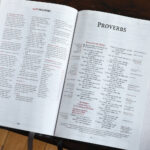
What are the Standout Features of the Thompson Chain-Reference Bible?
April 12, 2022
What are the Standout Features of the Thompson Chain-Reference Bible?
The Thompson Chain-Reference Bible is a popular topical study Bible with many useful features and in-depth study tools. Like most study Bibles, the TCR includes a thorough concordance, maps, and many other features that organize the Scriptures to increase reader understanding, but there are a few tools in this robust study Bible that stand out and set it apart . In this article, we’ll look at the features that most clearly distinguish this title from others.
Unbiased and Interdenominational
All of the tools in the TCR focus on allowing Scripture to interpret Scripture. Rather than providing notes and articles that approach the text from a certain theological point of view, the TCR lists and links biblical topics that include themes, people, places, and events. These topical links and tools allow the reader to see what the Scriptures themselves have to say about any given theme, free of any additional commentary. This makes the Thompson Chain-Reference Bible useful for anyone who wants to study the topics that the Bible addresses, regardless of their denominational affiliation.
Clean, Four-Column Layout
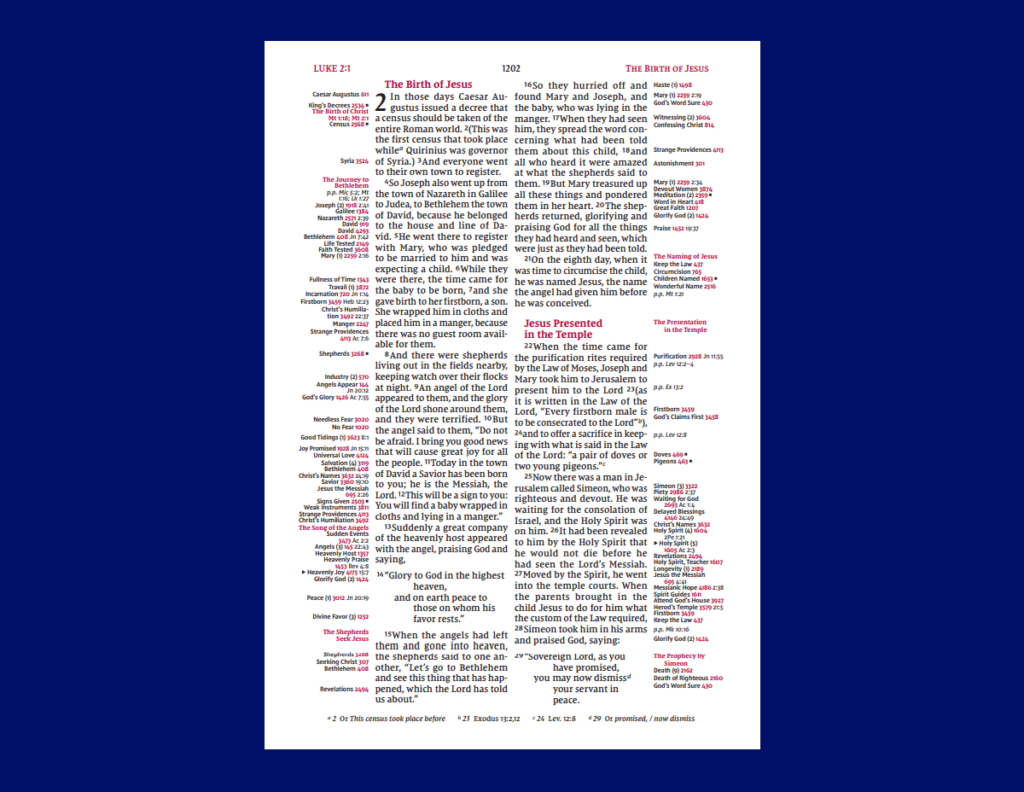
The first thing most readers notice is the layout. The text and study material are presented much differently than most study Bibles, which follow a fairly standard format: the text is placed at the top of the page; commentary is placed at the bottom of the page. They also typically include charts and maps within the text and notes, and many features that break into the flow of the text. But the TCR’s layout is much cleaner and much different.
The TCR features a four-column layout. The text is presented in the two center columns; it flows freely, without any features distracting from the Bible text. The topical references are placed in the outer margins and have been helpfully set next to the verses to which they apply. This makes them easy to see at a glance and improves usability.
The Bible text is presented with the standard format of the translation. It includes the section headings within the text and, if appropriate, footnotes under the text at the bottom of the page. Because the topical references are all in the margins, there are no interruptions within the text.
Topical Chains
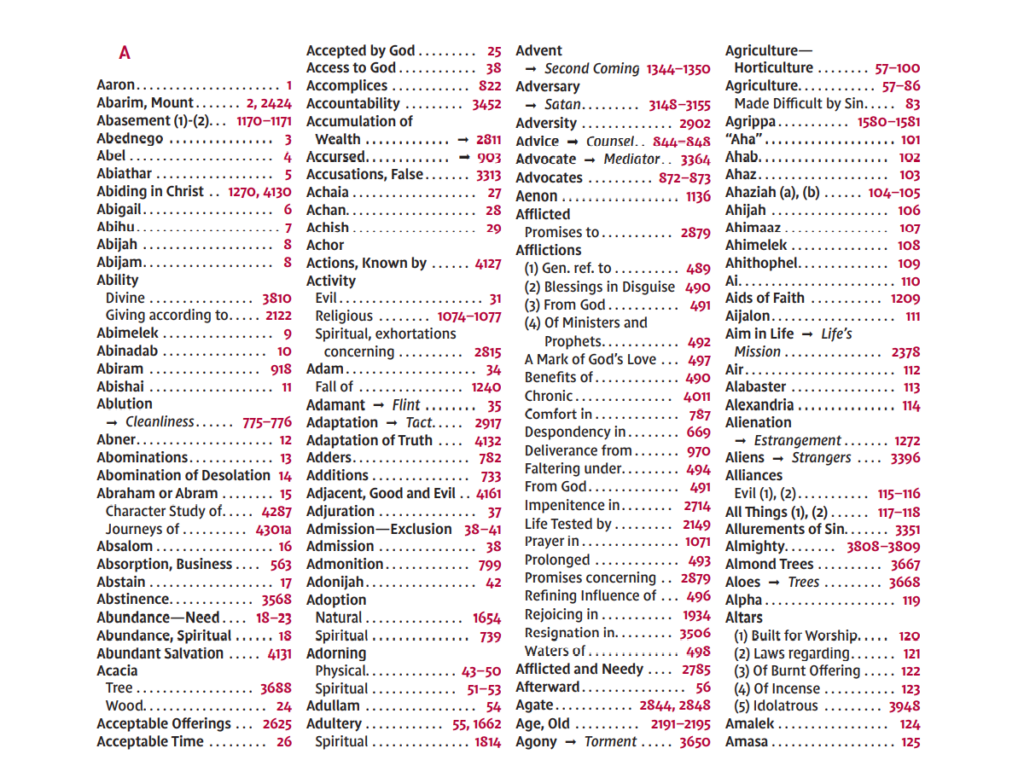
The Alphabetical Index of Topics lists over 8000 topics that include nearly every significant theme, person, place, and event in the Bible. This list gives the reader a quick way to search for and find the topics that they’re interested in studying. Along with the topic’s name, this index also provides the appropriate topic number, making it easy to find the topic in the Numerical Index of Topics. It also links to the other tools found in the TCR.
Numerical Index of Topics
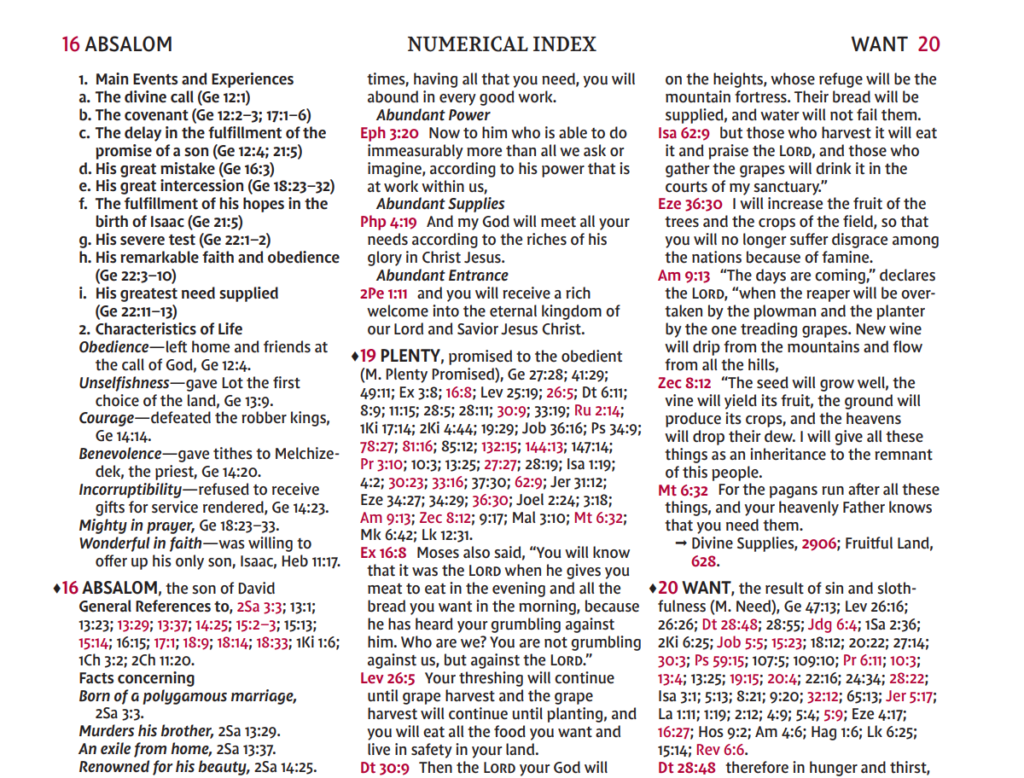
This is the largest index in the Thompson Chain-Reference Bible. It’s a nearly exhaustive index that lists every theme, person, place, and event by their specific topic numbers. Each topic includes a list of Scripture references to review for that topic. The most significant verses that pertain to each topic are printed in full. Many of the topics include names and index numbers of related topics, and many of the topics also include subtopics, which provides a lot of useful material for digging deeply into each subject.
As they study a particular subject, readers can study the verses from the Numerical Index of Topics or turn to any verse in the chain and follow the forward-moving chain references in the margins of the biblical text.
Book Introductions
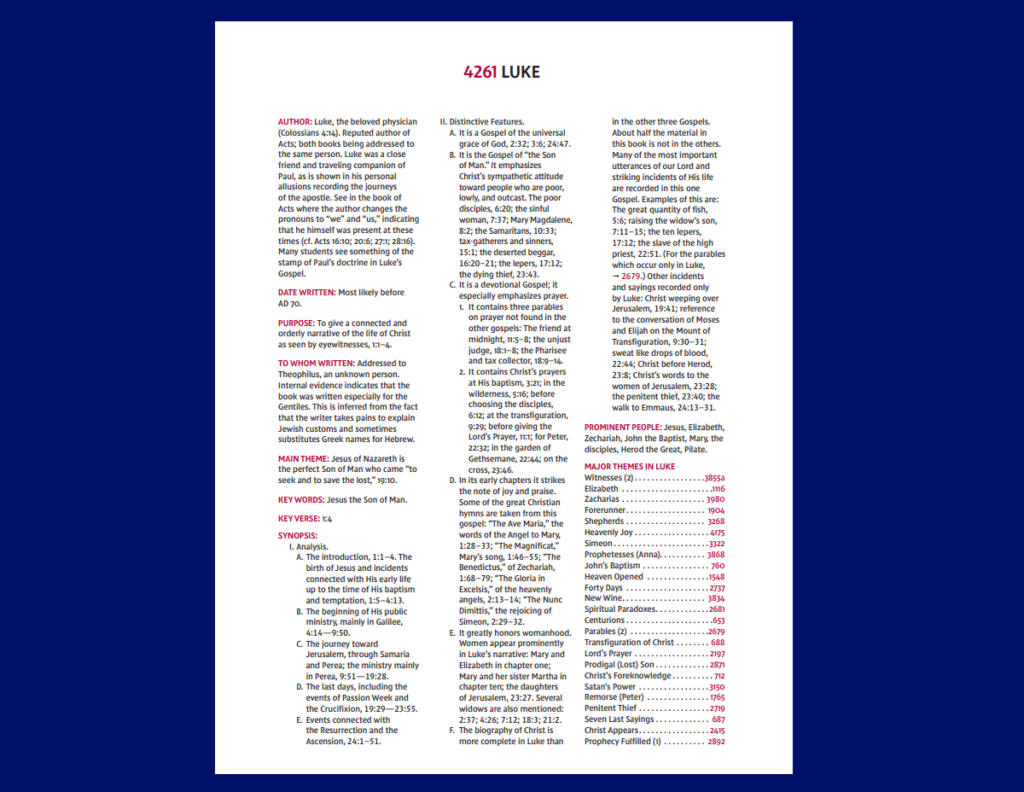
The Analysis of Books feature that was a part of previous iterations of the TCR is now organized into book introductions in the newest editions. Most study Bibles have book introductions, but those in the TCR are unique. They include the basic relevant information such as the author, date, to whom it was written, major themes, key words, an outline, and prominent people.
Most notable in these introductions, however, is the TCR’s outline that breaks each book down with a detailed synopsis. This synopsis includes an analysis of the Bible book and points out the distinctive features of each book. Also included is a new feature called Major Themes, which lists the main topics in the book along with their topic number. These themes are great for reviewing the main points of each book, and provide a helpful starting-off point for study.
Bible Character Studies
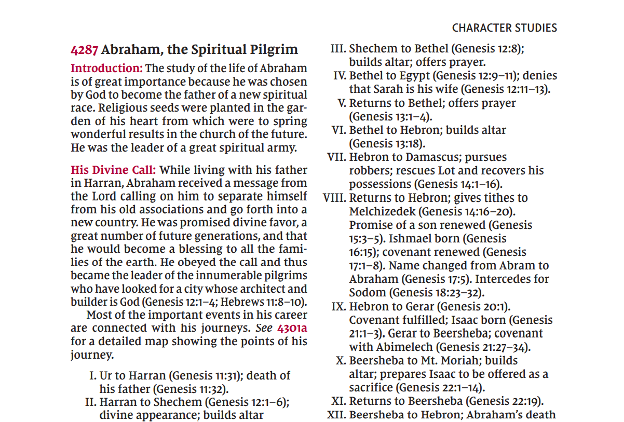
Bible Character Studies is a large section that covers some of the major characters in the Bible. It provides biographic sketches and outline studies of a dozen leading characters, each of which is unique to that particular person. Each study covers the key points in their lives and provides Scripture references for each point.
Bible Harmonies and Illustrated Studies
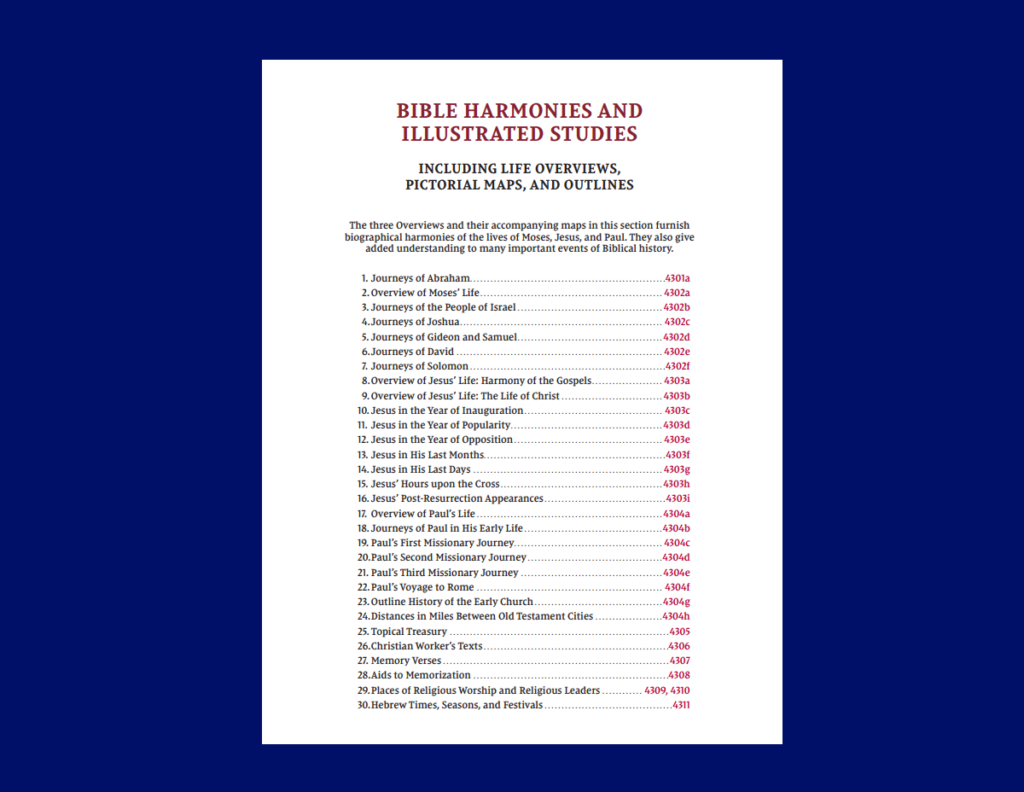
This section includes many helpful charts and maps that relate to several prominent biblical characters; it also includes special in-depth life overviews of Moses, Jesus, and Paul. These overviews include accompanying maps and charts that highlight important events in their lives, as well as other important historical events.
Ending Thoughts
Although the Thompson Chain-Reference Bible features many helpful study tools that might be found in other study Bibles, there are several that stand out as being unique to the TCR. All these features combine to help the reader get the most out of their Bible study. In a future article, we’ll dig a little deeper and demonstrate some of the in-depth features of the TCR that take your studies even further.
The Thompson Chain-Reference Bible is available in several translations, sizes, and cover options. Take a look at the Thompson shop to choose your TCR today.

The NIV Thompson Chain-Reference Bible: A 21st Century Update
March 14, 2022
The NIV Thompson Chain-Reference Bible: A 21st Century Update
The Thompson Chain-Reference Bible has been trusted and used for more than five generations. It is a study and reference work that is unparalleled in its ability to enrich personal devotions, topical study, and sermon preparation.
This unique reference Bible enables you to follow Scripture’s teachings on thousands of topics throughout the entire Bible. Its chain-reference system is an ideal tool for comprehensive topical study, with over 100,000 references that are listed in the Bible’s margins covering over 8,000 topics that span the entire Bible.
This Bible also offers a library of additional study resources that allows readers to interpret the Bible using related scripture passages rather than consulting other works, making this an all-in-one, self-contained study resource.
History: Where It Came From
The Thompson Chain-Reference Bible is a beloved and time-tested reference work that was the lifetime labor of Bible scholar, minister, and teacher Dr. Frank Charles Thompson. Dr. Thompson received his Ph.D. from Boston University and began his ministry in a Methodist church in western New York in the late 1800s.
Early in his ministry, Dr. Thompson realized that the reference Bibles then on the market failed to help students of the Bible organize their study in a clear, scholarly, interesting, and yet simple and compact form. He saw the need for a well-organized reference Bible that both laypersons and ministry professionals could use.
Dr. Thompson began his original research about 1890. He was a deep Hebrew, Aramaic and Greek scholar, and he referred to the original manuscripts for many of the thoughts he placed in the margins of his wide-margin King James Version Bible. After seeing the notations in his Bible, several parishioners inquired about using those notes in their own study, eventually working with Dr. Thompson to publish the first edition of the chain-reference Bible in 1908.
Over time and through four generations of family, the curators of the Thompson Chain-Reference Bible at B.B. Kirkbride and Company worked with other English and global-languages publishers to release the notes and study helps in various Bible editions. Their work included partnering with then family-owned Zondervan Bible Publishers to release the first NIV edition in 1983. In 2020, the Thompson Chain-Reference Bible assets were sold to Zondervan for their ongoing stewardship of this important Bible legacy.
2022: A New NIV Edition
Work began in 2021 to create a brand-new edition of the NIV TCR—the first since the former title went out of print in the early 1990s. With access to the latest technologies, the team that worked on the NIV Thompson Chain-Reference Bible were able to create a new edition that has unparalleled accuracy and that is absolutely complete in its essence. What’s more, the composition team used the NIV Comfort Print® font, specifically created for the NIV translation by a globally renowned team in Denmark. This company, called 2K, used cutting-edge font design practices to produce a font that’s efficient, beautiful, and very easy to read.
When a team begins work on a project such as the TCR, they have to deal first with differences in the technology that defines the current (older) data. As storage and composition methods change quickly, the available databases of notes and indexes can be outmoded in short order, making it challenging for later publishing teams to ensure that they capture the exact detail of the original and faithfully represent that in their updated editions.
The Zondervan team started with data brought over from the original editions. This data had long been built on the foundation of Thompson’s original notes—built by hand and checked by hand. That system had produced the wonderful editions available in the past, but a new system was required to update the Thompson Chain-Reference Bible for additional Bible translations.
Some 15 years later, the team within Zondervan decided to take a different approach. In partnership with various outside organizations that had past experience with integrating the TCR notes and indexes into scholarly electronic products, the team was able to complete a comprehensive review of all of the notes so that the latest edition of the NIV TCR represents the highest order of accuracy. Simply put, of all the editions of the TCR that have come before, the new NIV TCR edition stands as the most complete and accurate edition ever released in print.
From Hand Work to Strategic Data Analysis
As noted above, previous iterations of the TCR were updated and upgraded by hand. Much of this work was done in the middle of the 20th century, and as such the data analysis tools available to publishers today were not available. The faithful scribes who brought the original NIV TCR to the Bible-loving community did their best to create a consistent and accurate product. But humans are…well, human.
The more recent editions were carefully reviewed by a team that tried to bring more consistency to the names of the topics that appear in the margins and in the indexes, upgrading the data that had been used to a very high degree. The team working on the NIV TCR in 2021 was able to take that effort to the next level.
A highly skilled team utilized the latest in computational data analysis techniques to analyze the data on various translations to compare the names of the topics used in the Numerical and Alphabetical Indexes to those that appear in the margins of the various TCR titles. By calculating the percentages of times those topic names are used in multiple translations against the various translations themselves, the team was able to pull together a standardized set of topic names that only varies about ten percent between the different translations. That ten percent variation is mostly comprised of different spellings and word choices between the translations.
The next issue that the team needed to tackle was the gaps that existed between the marginal notes as presented in the most recently published editions, the NKJV and ESV TCR Bibles, and the Numerical Indexes for those titles. After correcting for the topic names in the previous step, the team was able to fortify both data sets so that both the marginal notes and the indexes are absolutely consistent. As the TCR finds its way into different translations, both data sets will be updated for each translation simultaneously.
Indexes and Typesetting
One of the most impactful features of the TCR notes and indexes is the amount of printed Scripture that’s included in the Numerical Index. As readers take advantage of that useful feature, they may wonder how all of that Scripture gets changed from translation to translation. Does an editor or compositor have to go into the file and swap out every one of the thousands of Scripture passages by hand?
60 years ago when updates to the TCR were made, the answer would have been yes. Today, tagged text files of the TCR Numerical Index, along with multiple data analysis chains, make that swap much quicker and more accurate. What would have previously taken weeks is now done in a day with pinpoint accuracy and complete fidelity to the TCR and to the Scripture.
Another wonderful feature of the TCR is that each one of the marginal notes is set next to the word or phrase or verse in Scripture that it points to. Previously, that typesetting task had all been done by hand—in past decades, using mainframe databases to place the different notes at the correct verse and making hand adjustments; in later years, after the advent of desktop publishing, an editor literally sat with the compositor and pointed out where the different topic names and numbers needed to be positioned.
When the Zondervan team in 2021 decided to tackle that note-balancing task this time around, they again turned to the experts in data analysis for help. First of all, each verse’s note set was tagged to its specific verse. Next, each time a topic’s name matched a word in the text exactly, that name was changed to a bright blue color. Further analysis was done to tag words that weren’t exact matches in the text, but were close. For example, the topic “Covenant Breakers” was matched to the phrase “break the covenant” within the text—not an exact match, but close. Those terms were then changed to a muted purple tone.
As the composition team set the marginal notes, they first set the notes in line with their appropriate book, chapter and verse numbers. Then they looked for the bright blue terms and matched them to the exact words in the text, carefully aligning them to those words. Finally, they looked to place the purple terms next to the texts that they related to.
A detailed process, yes, but not exact; this process left tens of thousands of terms that still needed to be placed next to their appropriate term in the Bible text. That’s where the editorial team took it “old school,” checking each of the 78,000+ appearances of the topical names and making sure that each one aligned with the appropriate term or idea in the text. This involved a lot of hand work on actual physical pages, and more than a few red pens.
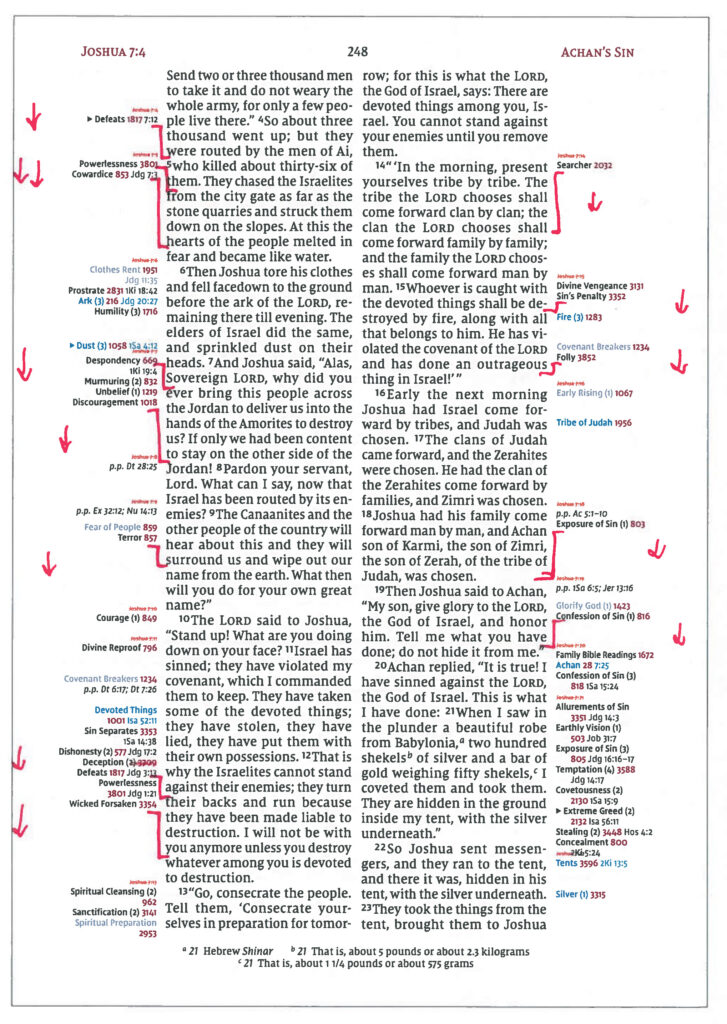
Front Matter and End Matter Changes
The next significant changes to the TCR data occurred in the rest of the Bible—those pages that don’t fall within the span of Genesis to Revelation. While the front matter pages in the new NIV TCR don’t vary much from the earlier editions, the end matter has been significantly changed based on user feedback.
Once again, the NIV TCR represents the latest developments in user experience that only the most current technological advances could provide. Marketers within Zondervan turned to social media to ask the most dedicated, hard-core TCR enthusiasts what they loved most about the front matter and end matter features—including how each feature was used, and how often.
Armed with a wealth of real-time user feedback, the NIV TCR team carefully walked through each of the previously printed end-matter features and made changes based on that feedback. The end result is a streamlined set of indexes, notes, maps, charts, and information that has been specifically crafted to tie into the time-tested content in the chain-reference system. In the same spirit, the editorial team worked carefully to remove those features that users cited as being outdated or not as useful.
One of the most significant changes that long-time users will note in the new NIV TCR edition is the integration of book introductions using what had formerly been an end-matter feature called the “Analysis of Books.” That’s probably the most visible example of the end result of this careful process of reworking the end matter section, which had previously been added to without the advantage of real-time feedback from avid users of the product.
In addition to all this, each map and map set was carefully recreated using a combination of detailed, hand-drawn maps with the latest digital composition programs and placed alongside all the appropriate TCR commentary, to give users clear and accurate study tools for their use.
Where to Next?
All of this work has combined to make the NIV Thompson Chain-Reference Bible the most accurate, complete, and beautiful iteration of the TCR to date.
The aim of the editors and producers of the TCR Bible, from its first release in 1908 until today, has always been to provide the most complete one-volume Biblical topical study tool available: one filled with a vast array of resources designed to enhance the study, teaching, and preaching skills of Bible students of all ages and backgrounds.
Earlier in 2020, previous editions of the TCR were re-released in multiple translations, sizes, and bindings, using updated printing techniques to bring these older editions back to life in vivid detail.
With the 2022 release of the NIV TCR, Zondervan begins a new era in this revision process, while continuing the important legacy of this beloved Bible brand. Each of the new editions of the TCR (beginning with the KJV release in 2023) will employ the same careful data analysis as the newest NIV editions. Zondervan also plans to release additional new editions of the TCR in successive years. And of course, each one of these new translations will also make use of its own translation-specific Comfort Print® typeface, making each one beautiful and readable in its own unique way.
All of these new releases will be available for purchase in a robust selection of sizes and bindings online and at retail stores for current and past users and for new audiences as well.
The Zondervan Bible Group and its editorial staff pray that the latest NIV Thompson Chain-Reference Bible will serve to enhance the study of God’s Word for millions of students, for the glory of Christ and his kingdom.
And as we continue to work to release the new editions in different translations, our prayer remains the same.
The Thompson Chain-Reference Bible is available in many translations in small, regular, and large print. Choose your TCR in the Zondervan shop today.

Who is the Thompson Chain-Reference Bible for?
March 7, 2022
Who is the Thompson Chain-Reference Bible for?
The Thompson Chain-Reference Bible was originally designed with pastors and teachers in mind.
In the late 1880s, Dr. Thompson became dissatisfied with the reference Bibles that were available to pastors and began development of this work to rectify that perceived problem. However, the Thompson Chain-Reference Bible is not just for pastors or others involved in ministry. While it’s true that since its release in 1908, the TCR has been popular with pastors, in this article we’ll explore what kinds of individuals have been using the TCR in the over 100 years since its first release. Hopefully this will help you decide whether the TCR is the right study Bible for you.
Pastors
Pastors find the TCR great for their ministries because its tools are helpful for just about everything they need. The indexes and marginal references help them prepare expository and topical sermons. The indexes are great for counseling and guidance for individuals, families, and leaders. The lists in the back include topics of study and evangelism for all Christian workers, tools that help pastors develop leaders within the church.
Pastors also appreciate the fact that the TCR is a trusted resource that they can comfortably recommend to their congregation. Since its notes and ancillary content are free of any theological or sectarian bias, they can recommend it without having to worry about leading their congregation down a path that doesn’t align with their teaching. Its reference system also promotes pure in-depth Bible study, which is something all pastors want to promote within their congregations.
Preachers
The indexes and marginal topics and references are excellent tools for sermon preparation for those who stand in the pulpit whatever the setting, whether that be before a larger church congregation or a smaller group. The study system is very in-depth, which makes the TCR great for both sermon preparation and sermon delivery. Anyone who has to travel to preach, such as an evangelist, will appreciate having the wealth of these resources available to them in one handy-sized volume; and with the three sizes that are available, preachers can select and carry the size that’s best suited for their travel needs.
Teachers
Those who teach classes and Sunday school typically teach on specific topics, Bible books, events, characters, and the like. The TCR gives teachers easy access to over 8,000 topics; it also provides a detailed analysis of the biblical books and character studies in a way that’s easy to use in the classroom setting. These tools include lists of Scriptures, outlines, charts, and maps, which help make lesson plan preparation simpler.
Teachers can also use the short articles on Bible study and memorization to lead their students into proper study techniques.
Counselors
Pastors, Church leaders, and biblical counselors often need to counsel those in the congregation on topics such as personal growth, healing their relationships, personal loss, finding work, and more. As the study tools allow Scripture to illuminate Scripture, the counselor has a wealth of information available to them as they approach these topics. The TCR’s indexes and character studies are great resource tools for virtually any counseling situations.
Small-Group Leaders
Anyone leading a small-group study, whether in a church group or simply studying with their family can use the TCR’s tools in the same way as preachers and teachers to prepare. Small groups as well can use the TCR’s tools to study together within the context of their meeting without having to prepare anything ahead of time, exploring topics together and discussing them as a group.
Christian Workers’ Resources
The end matter features tools to help the Christian worker. These are helpful to all people who work in Christian ministry regardless of the level or type of ministry they pursue.. These tools can be used by someone witnessing to one person at a time, but they can also be used by someone who may be addressing a crowd.
The Topical Treasury includes lists of topics for prayer and devotional meetings, youth meetings, men’s meetings, women’s and children’s meetings, evangelistic meetings, missionary meetings, temperance meetings, and special days. The lists include topic names with their topic numbers. Some include Scripture references for larger passages. The Christian Worker’s Texts, Memory Verses, and Aids to Memorization will also be useful for those involved in ministry of any kind.
Students
The TCR is great for students who want to trace a topic, person, or place through the Scriptures. As they start their research, they can use the Alphabetical Index of Topics which leads them to the Numerical Index, where they will find a wealth of resources and cross-Scripture connections. Students will also be able to profitably use the Condensed Outline of the Bible, Bible Character Studies, maps, charts, and various other study tools that will help bolster their work. There is also a list of memory verses and tools to help students memorize Scripture.
A section in the back called Bible Harmonies and Illustrated Studies is particularly helpful. Its maps, charts, and tables cover biblical history, an outline history of the apostles, and Messianic prophecies and their fulfillments, and also offer detailed journeys and overviews of key biblical characters. This section even includes a table to show the distance between Old Testament cities.
Families
The Bible says a lot about family relationships; in it families will find guidance for their marriages, parenting, in-laws, and blended family situations. The TCR lists helpful verses within topics that will help guide parents, children, and spouses into deeper scripture study. The Numerical Index of Topics includes a section on Home that includes subtopics such as courtship, marriage, parental duties, prayers, examples, influence, love, weaknesses, gifts, honor, obedience, and many more. The tools are appropriate to be used by students of any age, so parents can allow their children to use the TCR without having any concern about doctrinal influence.
Personal Devotions and Growth
The TCR is also a great resource for devotional reading and personal development. The lists in the back provide readings on many topics such as prayer, attitudes, relationships, leadership, and even business life. The text itself is beautifully rendered and is clear of distractions, making it great for simply reading the Word of God. The Alphabetical Index of Topics makes finding study subjects simple, and the Numerical Index of Topics prints many of the related Scriptures in full, so that in-depth topical Bible study can be easily done right in the end matter itself, without having to hunt for related passages.
Anyone Who Wants to Study the Bible Without Outside Influence
The TCR is ideal for personal study because every single resource in the Bible is designed to allow Scripture to interpret Scripture. The TCR provides topic names and Scripture references that help you find verses in each topic. Study can be completed by verse, passage, chapter, or book. Students can study characters, locations, and events. Chapters and verses feature helpful outlines and topics in the margins. Indexes and tables in the back provide lots of opportunities for in-depth study. All of these tools provide direction and help while allowing Scripture alone to interpret Scripture.
Summary
While no single tool is best for every possible purpose, the Thompson Chain-Reference Bible is an excellent resource for anyone who wants to delve deeply into the topics that can be found in Scripture. Because the TCR doesn’t access information and commentary outside the Bible, students can use these tools to find answers in the Bible itself, allowing the Bible to be its own expositor.
If you want answers to your questions that come directly from Scripture, the Thompson Chain-Reference Bible is the resource that you need.
The Thompson Chain-Reference Bible is available in many translations in small, regular, and large print. Choose your TCR in the Zondervan shop today.
How the Thompson Chain-Reference System Works
February 3, 2022
How the Thompson Chain-Reference System Works
The Thompson Chain-Reference Bible’s study tools have been in constant use since 1908. Millions of readers have benefitted in their personal devotions and in teaching and sermon preparation as they have mined the riches of the topical study resources available within its pages.
But at first glance, the Thompson Chain-Reference Bible can look complicated. Opening the TCR to any page shows four columns of text. The biblical text in the middle two columns looks simple enough to use, but the margins include numbers, words, and references. In the back of the Bible are large indexes that can look somewhat intimidating. How do all of these features relate to one another?
Fortunately, navigating the study system of the TCR it isn’t nearly as complicated as it may first seem. In this article, we’ll look at how the Thompson Chain-Reference Bible works.
Main Elements
The Thompson Chain-Reference Bible has two main elements: the chain references in the margins and the indexes in the back. Both work together, and can also be used independently. Chain references provide forward-moving (from Genesis to Revelation) references to specific topics for each verse. Indexes list all the topics in the Thompson Chain-Reference Bible to make them easy to find and use. All of these tools are interconnected within the TCR.
Let’s take a closer look at both and see how they work. We’ll also explore a specific example of using the Thompson chain-reference system to see how easy it is to study a broad range of Scriptures on a specific topic.
References in the Margins
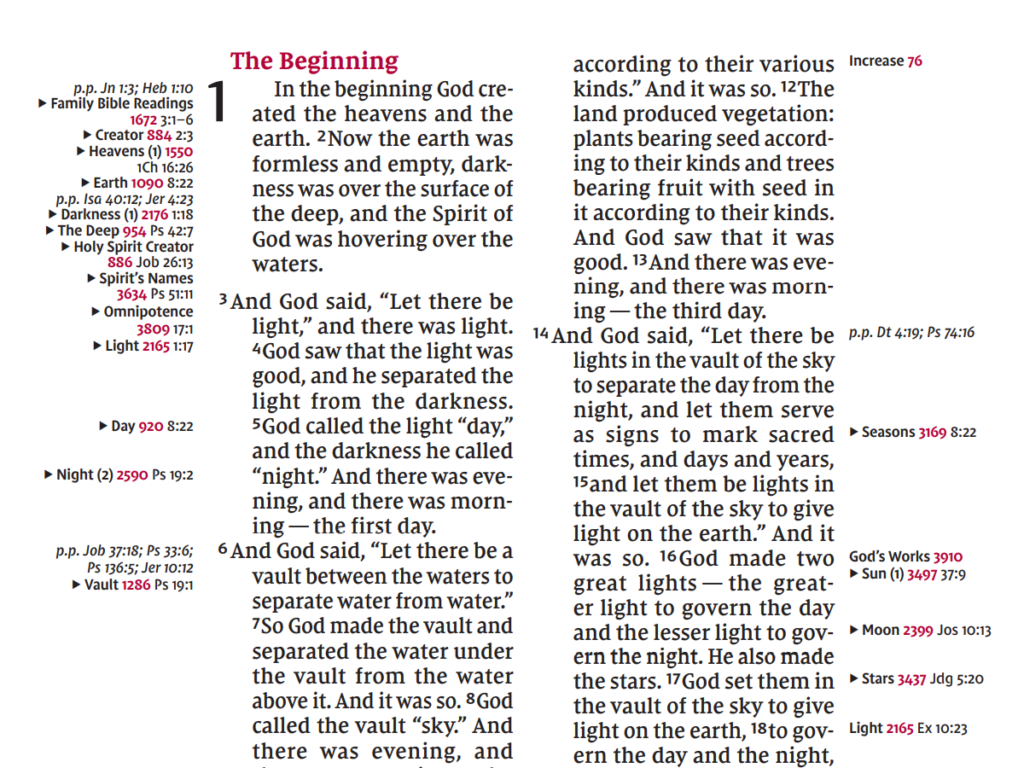
The forward-moving chain references are placed in the margins next to their verses. They contain three parts which include the topic name, topic number, and the next reference in the chain. Most verses include multiple topics to explore, so you’ll see a topic number, topic name, and reference for each topic represented by the verses themselves. These topics were initially categorized by Dr. Frank Thompson and his wife, and the system they created has been added to significantly over the years. These references are the key study system within every TCR.
Topic Names
The topic name identifies the topic of the reference. These can also be profitably used to help you better identify the major themes in the text as you’re reading through the Scripture itself.
Pilot Numbers
Each topic that appears in the margins is numbered consistently. Each topic only has one number, so every time you see a specific topic number, it always references the same topic. These topic numbers correspond to the Numerical Index that’s located in the back of the Bible, where additional study information can be found.
Chain References
The topical chains also include forward references that point readers to the next verse for this topic. The next verse in the chain also shows the topic name and number, along with a reference to the next verse in the chain. At the start of each chain there is a small triangle symbol that indicates the beginning of that chain (see sample in Genesis, above). At the end of each chain, you’ll see a small square, indicating that all of the cross references for that topic chain have been explored. To get an overview of each chain, refer to the Numerical Index topic numbers in the back of the Bible.
Indexes in the Back
There are two comprehensive indexes in the back of each TCR Bible. Both focus on biblical topics, but each one works differently.
Alphabetical Index
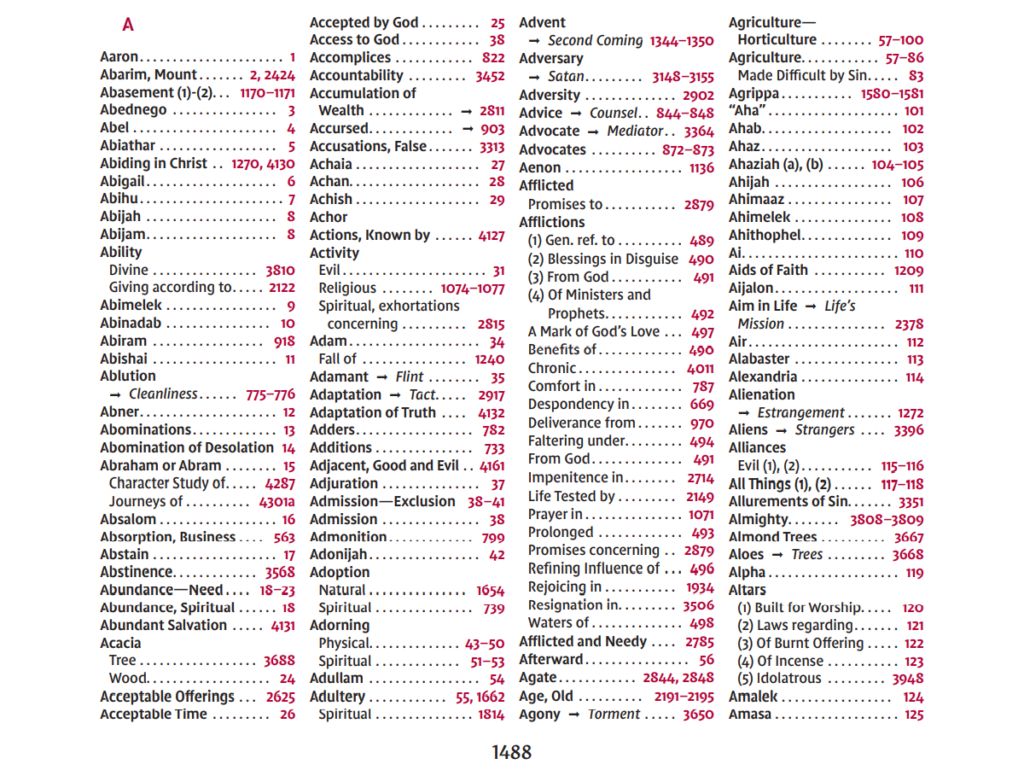
The Alphabetical Index contains all the topics covered in the Thompson Chain-Reference Bible. All of the topics are listed alphabetically and include the topic numbers for each topic and each subtopic under those topics. Subtopics are indented under each primary topic, as can be seen above.
The topics in the Alphabetical Index include subjects and events. The numbers that follow them refer to topics, names, places, and charts that are found in the back matter of the TCR.
When studying a topic, the Alphabetical Index is typically the best place to start your search. To use it, simply look up the name of the topic you’re interested in. Locate the topic number from the listing and turn to the Numerical Index to see the verses that relate to that particular topic.
Numerical Index
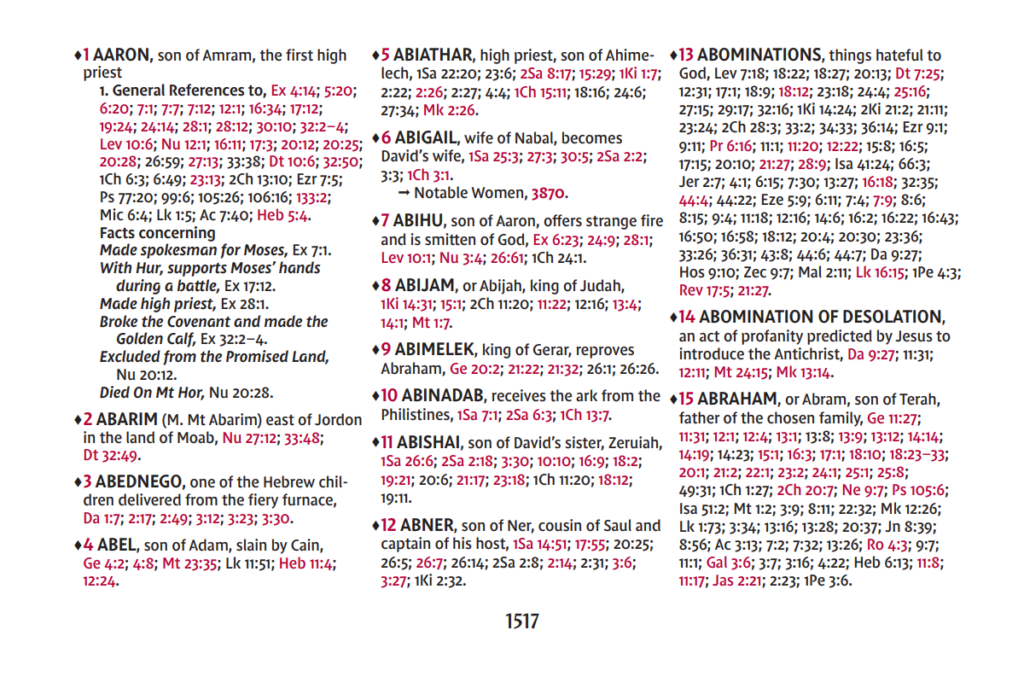
The Numerical Index is an extensive cross-reference study tool that lists all the topics in the TCR by their topic numbers. These numbers match the topic numbers in the margins. They’re generally listed alphabetically, but that is not the goal of the Numerical Index, as many of the topics are grouped under larger topics. So navigating this index requires use of the numbers, which are all in numerical order.
This index lists the topic number and name followed by the list of Scripture references that are also categorized with that topic. Many of the topics include short descriptions, and verses from the more significant chains are printed in full. Many of the topics also include a list that points to similar topics on the same subject.
To use the Numerical Index, search for the topic number either in the margins of the Scripture or in the Alphabetical Index, and then turn to that topic number in this index. Then, you can either read the Scriptures from this index or turn to any of the references in the Bible to follow the chain from there.
Example
Let’s use the tools to study the topic “Word of God.”
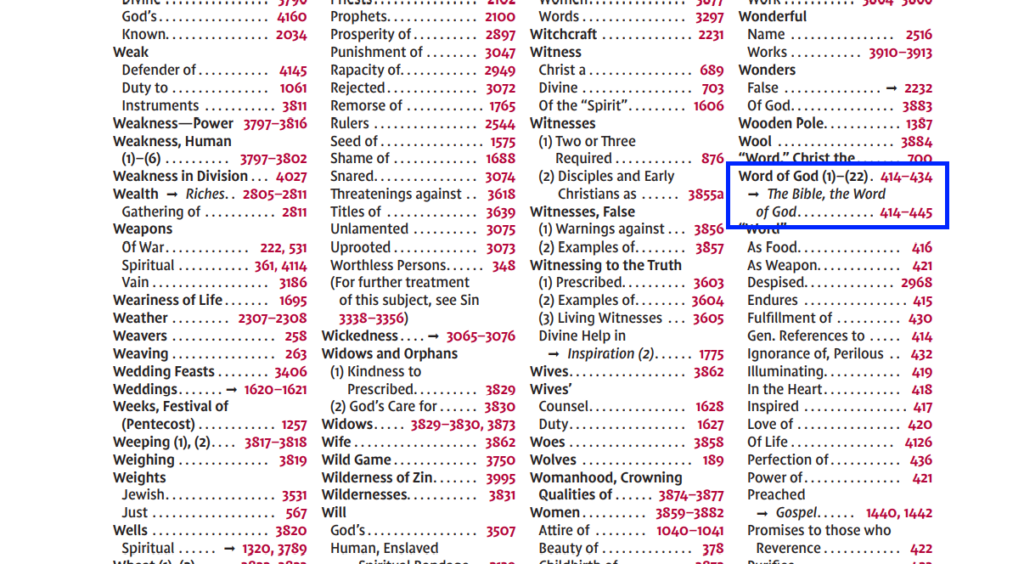
We can start by looking up “Word of God” in the Alphabetical Index. Under that listing in the Alphabetical Index we find a range of topic numbers with lots of subtopics. The first topic number is 414.
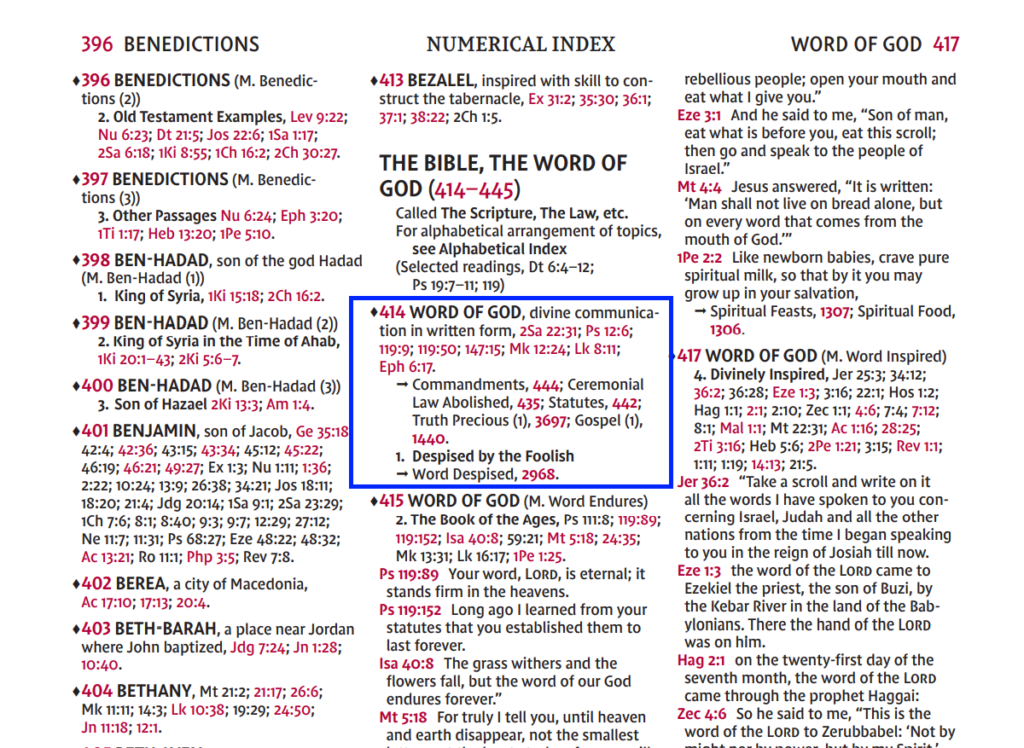
Next, as we turn to the topic number 414 in the Numerical Index, we find the primary topic of “The Bible, The Word of God” in a bold font—that indicates the larger category that includes a range of topics. Under that category title are multiple lists lots of topics and subtopics. The first one provides a description, a list of references, and similar topics we can look up as we continue our study of the larger topic.
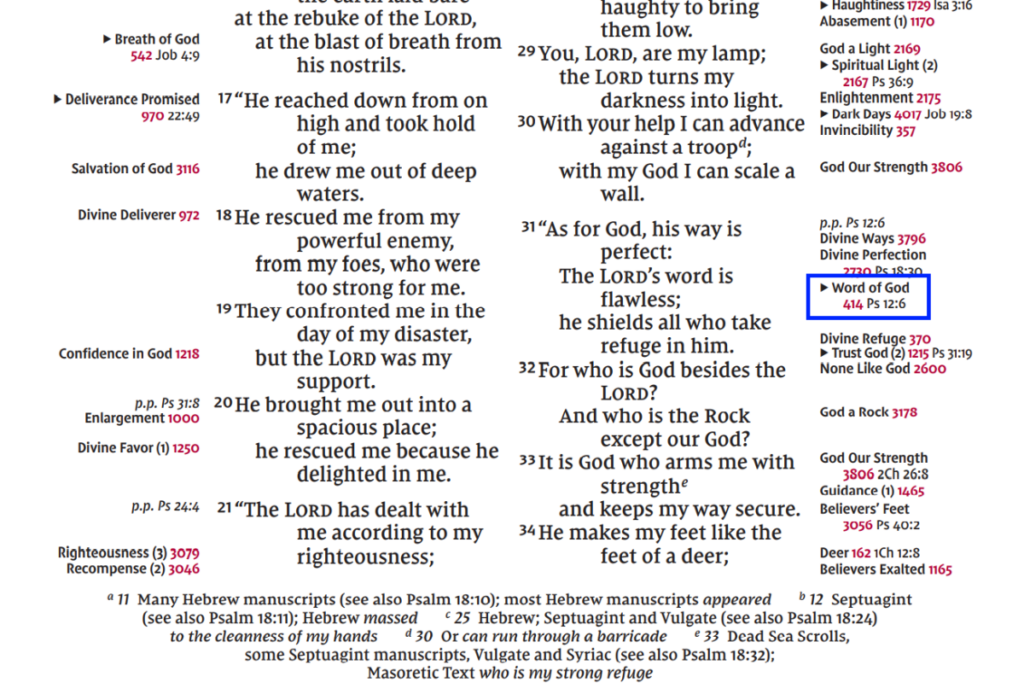
As we begin our study, we can turn to any of the verses we want. We’ll start with the first verse on the list, 2 Samuel 22:31. Notice the small triangle indicating that this is the first reference in the chain. This verse has five topics in the margin, including “Word of God 414.” It shows that the next reference in the chain is Psalm 12:6.
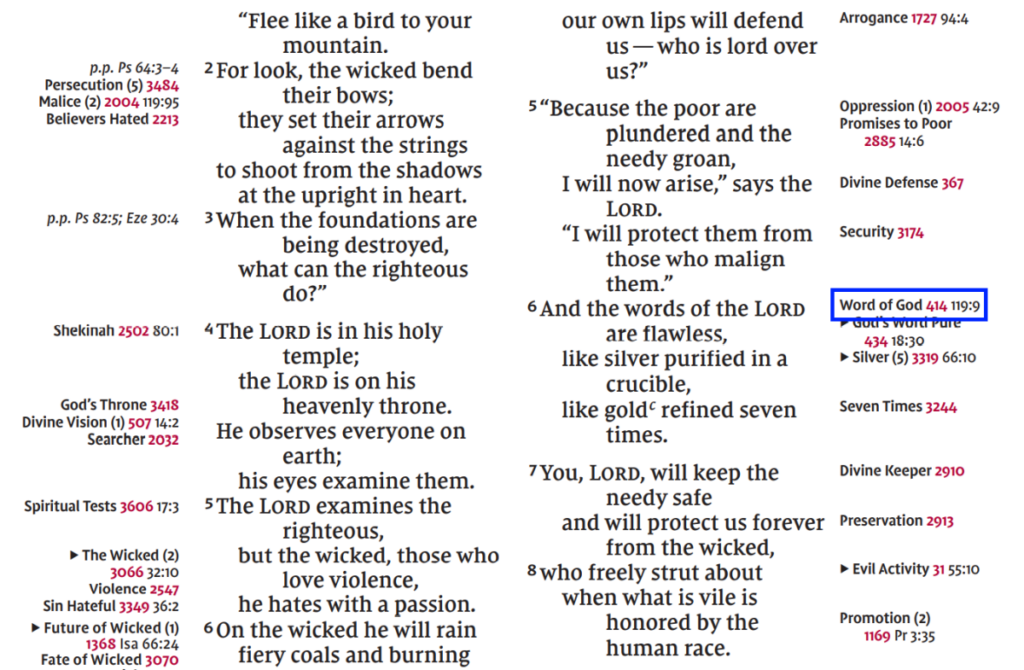
Psalm 12:6 includes four topics in addition to “Word of God 414” and leads us to the next reference in the chain, Psalm 119:9. We can continue this process until we’ve read all the Scriptures in this list. As we study, we’ll want to be sure to read before and after the references to better understand the context of each verse we’re reading.
Once we’ve completed this list, we can turn back to the Numerical Index and see the next set of Scriptures in our topic. This is topic number 415, “The Book of the Ages.” This one includes another list of references, with many of them printed in the index where we can read them.
This process is the same for every topic within the Thompson chain-reference system. Readers will quickly find that the chain references are incredibly productive and insightful for the study of each topic. And notice that besides the brief descriptions, there is no editorial commentary on the Scriptures themselves. This follows Dr. Thompson’s key idea for the study of Scriptures, and the main idea behind the TCR: Scripture itself is the best interpreter of Scripture.
Concluding Thoughts on How to Use the Thompson Chain-Reference Bible
The Thompson Chain Reference Bible may look complex initially, but once the reader understands what the tools are, they’ll see that the study system in the TCR is very easy to use. The references and indexes work well together to help students of the Bible, pastors, and teachers to identify and trace any topic through the Bible.
The Thompson Chain-Reference Bible is available in several translations and in many different beautiful and durable cover options. Find yours today in the Thompson shop.

What Makes the TCR Different from Other Study Bibles?
January 11, 2022
What Makes the TCR Different from Other Study Bibles?
Study Bibles are some of the most popular types of Bibles available. Millions of people every year purchase new study Bibles to delve more deeply into the text of the Scriptures using teachings and observations from a wide range of scholarly author teams.
When most people think of a study Bible, they often think of certain tools and layouts, such as a two-column format with a center-column cross-reference system and verse-by-verse study notes that run along the bottom of the page.
The Thompson Chain Reference doesn’t include those tools and doesn’t look like the typical study Bible, yet it’s been one of the most popular study Bibles for over 100 years. In this article, we’ll discuss what makes the TCR different from other study Bibles. Along the way, we’ll also see how it’s similar to a traditional study Bible.
What is a Study Bible?
First, let’s analyze the question, what is a study Bible? The simplest answer is that it’s a Bible that gives the reader tools to help in studying the Bible in-depth. These tools help explain in detail what scholarly or application-oriented teaching material has been developed to enrich a person’s study of the Bible. While most study Bibles have similar tools, some focus on general survey-oriented study information while others focus on specific topics such as life application, culture, archaeology, literature, and the like.
Those that focus on general information provide as much overview information on a certain passage as they can manage to fit in a small space. Some study Bibles follow one point of view from a specific doctrinal perspective, while others try to include multiple doctrinal points of view. Those that focus on specific topics, such as archaeology or culture, cover those topics in greater detail.
Typical Study Bible Tools and Layouts
Book Introductions
These discuss the themes within the different Bible books, key characters, key verses, and the like. Many include detailed outlines of each book. Most include theological themes from the doctrinal viewpoint of the authors, so there is typically, but not always, some doctrinal bias.
Commentary
Commentary on the text is usually the main focus of a study Bible. This commentary typically covers certain verses or passages and is placed on the bottom of the page on which the Scripture appears. These notes provide explanations and insights into the biblical text, people, places, events, theology, and words of a certain verse or passage. The commentary focuses heavily on the viewpoint of the authors; because different study Bibles have note sets written by individuals and author teams with different theological perspectives, the notes for some Bibles may conflict with notes from others.
Biographies and Character Studies
These are short essays that cover details about certain characters in the biblical narrative. They’re usually placed on the page where an appropriate passage of Scripture is located—some important story about the individual or a reference to his or her life.
Tables and Charts
These reference works are placed within the text of the Bible to summarize or categorize certain types of information within the Scripture text. They often include lists of Scripture references on a certain topic; lists of people such as kings, prophets, or other prominent characters; a Harmony of the Gospels; information on archaeological discoveries; and ancient calendars, traditions, worship practices, and the like. They’re often placed within the text or at the bottom of the page. Many Bibles insert this kind of information between the Old and New Testaments to give readers an idea of what was happening during the transition between the two groups of writings.
Maps
Small maps of the areas discussed in the text are often placed within the text or at the bottom of the page. These are sometimes placed within the text of the Bible in addition to the color maps in the back.
Articles
These discuss specific theological topics from the doctrinal views of the authors.
References
Most study Bibles include an extensive set of cross-references that allow readers to read a passage, then explore other passages related to what they just read based on these additional references.
Concordance
Concordances found in study Bibles are usually more detailed than those used in other Bibles. They often include more entries and more references so the reader can engage in more comprehensive study.
Indexes
These usually cover topics, articles, maps, or subjects within the Bible text.
About the Tools
Not every study Bible will have all these tools. Many of these tools, especially the commentary and articles, focus heavily on the doctrinal perspectives of the authors. They usually do include Scripture references, but they provide information from the author’s point of view. Many of the tools share space on the page with the text, which can be distracting for some individuals when they’re reading the text devotionally.
Thompson Chain Reference Tools
With all of that in mind, is the TCR a study Bible? Yes! But it’s one that has a different focus than most study Bibles. Rather than supplying readers with study materials based on a certain author’s point of view, it provides extensive topically based Scripture references grouped together to allow Scripture to interpret Scripture.
Dr. Thompson, with the aid of his wife, categorized every verse into one or more topics. The TCR identifies some 8000 topics and has more than 100,000 chain references that move forward canonically—from Genesis to Revelation. It presents these categories as topical chains in the margins next to the text of Scripture, each of which points to the extensive indexes in the back, which contain rich and detailed Scripture-based study opportunities. All of the study tools presented in the TCR are tied together with the topical numbers.
While the TCR doesn’t include theological articles, it does have an extensive array of short articles on various subjects in the end matter reference section, including a discussion of the principles and best methods of Bible study, various characters, a Harmony of the Gospels, notes on the life and passion of Christ, and many other study tools. Throughout the TCR, however, the main thrust of the study material focuses on allowing Scripture to illuminate Scripture so that the reader can explore each topic in his or her own way.
Here’s a look at the main tools that are offered in the TCR.
Topical Chain References
Rather than commentary, the TCR has over 100,000 forward-moving topical chain references in the margins next to the verses that they categorize. Each includes the topic name, topic number, and the next reference in the chain for that topic. A person reading on any page will be able to see the topics at a glance, yet the verses of the Bible themselves are clear of distractions.
The true genius of the TCR lies in the topical index to which each of these topical chain references refer. In the back of the Bible are around 800 pages of topical tools that illuminate the intricate interconnectedness of the Scriptures themselves.
Indexes
Two large indexes in the back of the TCR include information relating to each one of the 8,000 topics and subtopics referred to in the marginal notes.
Indexes include:
Alphabetical Index of Topics: This 30-page index includes a complete alphabetical listing of every topic and subtopic that is explored and highlighted in the TCR. It includes each topic name and number. This index has been designed to make it easy to find any topic on any subject based on the description of the topic itself.
Numerical Index of Topics: This 400-page index includes a list of every topic that’s explored in the TCR in its numerical order. This topic is arranged mostly in alphabetical order, but that order is disrupted by the thousands of sub-topics that the TCR also explores. Each entry in this substantial study tool includes the complete list of references that relate to the topic, and many of them have the applicable verses printed in full so readers can study directly from the index.
Condensed Outline of the Bible
This is a short outline with a brief description of every book of the Bible. These are divided into major biblical divisions.
Bible Character Studies
These are brief biographical sketches and outline studies of several prominent biblical characters. They include descriptions of each individual’s life in outline form. Another table shows the prominent characters classified with the meaning of their names.
Bible Harmonies and Illustrated Studies
Charts are found throughout the content in the back, including a large section called Bible Harmonies and Illustrated Studies. This section supplies readers with detailed study information and includes tables, detailed maps with commentary, a Harmony of the Gospels, a timeline of the life of Christ, and more. This section also includes lists of Scriptures for a topical treasury, helps for Christian workers, memory verses, aids to memorization, and descriptions of places of religious worship and ancient Hebrew religious leaders.
Hebrew Times, Seasons, and Festivals
This section provides a short description of the Hebrew Calendar and has a table with the Hebrew month, the modern equivalent of that month, and a description of each of the prescribed Hebrew festivals for each month.
Concordance
Each TCR edition includes its translation’s standard concordance. Each is a large concordance of over 100 pages with thousands of entries that reference words, topics, people, places, and other information.
Map Index and Color Maps
The TCR includes 13 color maps with an index that will direct readers toward the place names on the maps. Each map includes intricate plotting of places, archaeological sites, territories, kingdoms, dates, journeys, elevations, and much more. The index that is tied to these 13 maps is separated into six divisions that make it easy to locate any place in the Bible based on the type of information one is looking for.
About the Tools
The tools in the TCR are topically based. They don’t include commentary from different theological points of view. Instead, they give readers extensive lists of Scriptures based on topics, people, places, events, items, and more. These lists have been carefully curated to open the Scriptures to readers who are studying to find out more information on how the Bible can be thoughtfully applied to life. As individuals study the topics using these extensive study tools, they will find the intricate connections that make in-depth Bible study so fascinating.
The topical chains that are in the margins of the Scripture pages identify the topics within each verse and provide the reference for the next verse in those topics. The indexes that these chains refer to make it easy to find any topic, to see all the verses associated with every topic, and to do extensive research into the books and people in the Bible.
Instead of telling readers how to think or what to believe about the teachings and stories in the Bible, the TCR provides the tools for readers to complete their own studies, making it a great choice for personal study or for Sunday school and sermon preparation for both topical and expository teaching.
Ending Thoughts on What Makes the TCR Different from Other Study Bibles
The main difference between the TCR and other study Bibles is that the TCR doesn’t include commentary or doctrinal articles. The focus is solely on the topical chain references and the indexes to which those references point. These study tools are non-biased and aren’t focused on any specific doctrinal stance. As such, he TCR is a great choice for allowing Scripture to interpret Scripture. Rather than telling readers what to believe or giving them the answers to any questions they might be interested in pursuing, the TCR’s tools work well together to promote and support in-depth, personalized Bible study.
To see more about the Thompson chain reference system and to explore the Bibles that are available for purchase, see the Zondervan TCR shop.

History of the Thompson® Chain-Reference® Bible
December 17, 2021
History of the Thompson Chain-Reference Bible
So many people have grown to love the Thompson Chain-Reference Bible over the years because of the way it helps to focus topical study and the almost limitless way it allows students to examine the connections within the Word of God. But where did it begin? How was it organized and distributed? How did it become the Bible that people know and love today?
The Passion Behind the Chain-Reference System
The Thompson Chain-Reference Bible is one of the oldest study Bibles on the market today. At the time of this writing, it has been in print in some form for nearly 115 years. But rather than featuring commentary on different passages, the Thompson Chain-Reference Bible (TCR) features a chain-reference system that allows users to follow any topic, idea, person, or place from the front to the back of the Bible.
First published in 1908, the TCR began as the work of Dr. Frank Charles Thompson in 1890. Dr. Thompson had been ordained in 1879. During his years of studying the Bible, he had become disappointed with the reference Bibles that were available to preachers at the time. So he began planning to create what he had been looking for: a reference Bible that was both scholarly and simple, with study features to be that would be unbiased and useful to anyone. He wanted it to be well organized, and simple enough to be usable to both novice laypersons and seasoned ministers. Additionally, knowing that it was difficult for evangelists to take commentaries with them, Dr. Thompson wanted it to be portable, so it had to fit within the dimensions of other reference Bibles on the market at that time.
How could he create such an unbiased work? The easiest way to accomplish this was to remove the human element from the equation and allow Scripture to comment on itself.
Beginning His Work
In 1890, Dr. Thompson, with the help of his wife Laura Boughton Thompson, began work on a reference system that would link similar thoughts together within the context of Scripture. They examined every verse of Scripture in multiple translations and categorized the topics found in those verses into different subject areas. They consulted may of the available Bible commentaries and topical helps to aid in this study.
As they worked, Dr. Thompson used their analysis to place “thought suggestions” in the margins of his wide-margin Bible, next to the verses that featured these topics. Each “thought suggestion” included a reference to the next verse that featured that same topic. These notes became the chain links that make up the Thompson chain-reference system.
Several people in his church saw the notations that Dr. Thompson had in the margins of his Bible. They became fascinated with Dr. Thompson’s system of study, and suggested that perhaps they could have one of their own. Recognizing how helpful it was for Bible study and sermon preparation, they encouraged Dr. Thompson to have his Bible published so others could have access to these wonderful study tools.
First Edition of the Thompson Chain-Reference Bible
Methodists Book Concern of Dobbs Ferry, New York published the first edition of the KJV Thompson Chain-Reference Bible in 1908. It quickly became known amongst a small circle of people as the most helpful and trustworthy study Bible available. However, it wasn’t distributed very well at that time, so few people had the opportunity to take advantage of the study system that the Thompsons had developed.
This first edition did not include many of the tools available in the TCR today. For example, it did not include the numbers for the topics that organize the study tools in today’s Bibles, and many of the chains moved both forward and backward, which more modern TCR Bibles don’t do. It did include the subject index, but the number and variety of subjects was far less than what we have available today.
Dr. Thompson wanted to make improvements to this Bible and also make it more widely available. This was difficult to do under Methodists Book Concern of Dobbs Ferry, so Dr. Thompson began to look for other options.
B. B. Kirkbride Bible Company
To increase distribution and have the capability to make constant improvements to the chain-reference system, Dr. Thompson joined with B.B. Kirkbride in 1913 to form the Kirkbride Bible Company in Indianapolis, Indiana. Through this productive partnership, both of Dr. Thompson’s goals were met. The Kirkbride Bible company produced the Thompson Chain-Reference Bible for over 100 years; during that time, they sold over 4 million copies.
TCR Improvements
Over the ensuing years, the Thompson Chain-Reference Bible continued to be improved with new features, topics, references. Newer editions added to the number of topics and references, and a more substantial set of reference tools was added in the end matter. The 2nd edition was published in 1917, and enjoyed much wider distribution.
The 3rd edition was published in 1929. This edition added the topical numbering system to the New Testament. This became a popular addition, and the publishers at B.B. Kirkbride soon learned that readers were responding well to this innovation. They wanted more.
In 1964, the 4th edition was published. This added the numbering system to the Old Testament, so for the first time, the TCR included the popular numbering system in the margins in both testaments. This edition also added pictorial maps and journeys of Abraham, Joshua, Gideon, Samuel, Saul, David, and Solomon. It also featured an archaeological supplement developed by Dr. G. Frederick Owen; this feature was also linked to the numbering system.
The 5th edition of the KJV TCR was published in 1988. It improved the TCR tool set even further and added new features such as a KJV glossary and improved cross-reference chains. Also, the maps, charts, and diagrams featured in the end matter were added to the numbered system and listed in the index.
More Translations and Languages for the TCR
The Thompson Chain-Reference Bible was later published in modern translations including the New International Version (NIV), the New American Standard Bible (NASB), the New King James Version (NKJV), and the English Standard Version (ESV). The TCR was also published in other global languages, including French, German, Portuguese, and Spanish. Each included the same tools and structure, so those familiar with one edition could naturally use the others.
Licensing in various translations and other languages opened several unique opportunities over the years. The TCR was licensed to other publishers such as Thomas Nelson, Zondervan, Eyre & Spottiswoode in the UK (which was then absorbed by Cambridge and produced under their brand), Hodder & Stoughton, and others in various global languages.
Zondervan Obtains the TCR
On December 2, 2020, HarperCollins Christian Publishing (HCCP) announced they had acquired the Thompson Chain-Reference Bible from Kirkbride to be published by Zondervan. The first round of TCRs used the Kirkbride files and were published in the KJV, NKJV, NASB, and ESV translations in multiple sizes and cover options. The Spanish edition also came under the stewardship of HCCP.
The TCR in the 2011 NIV, which Kirkbride had not previously licensed, will be published in the summer of 2022. Typeset by 2K/Denmark in the NIV Comfort Print typeface, it will be available in multiple sizes and covers including a goatskin edition in the Premier Collection.
Ending Thoughts
Thompson’s chain-reference system has been refined for over 100 years into a sophisticated navigational system that’s both intuitive and natural. It not only shows themes in the text, but it makes them easy to navigate. As Dr. Thompson perceived over a century ago, Scripture is its own best commentary. No other study Bible allows Scripture to interpret Scripture to the extent that the Thompson Chain-Reference Bible does.
Choose your own Thompson Chain-Reference Bible on the Zondervan TCR page.