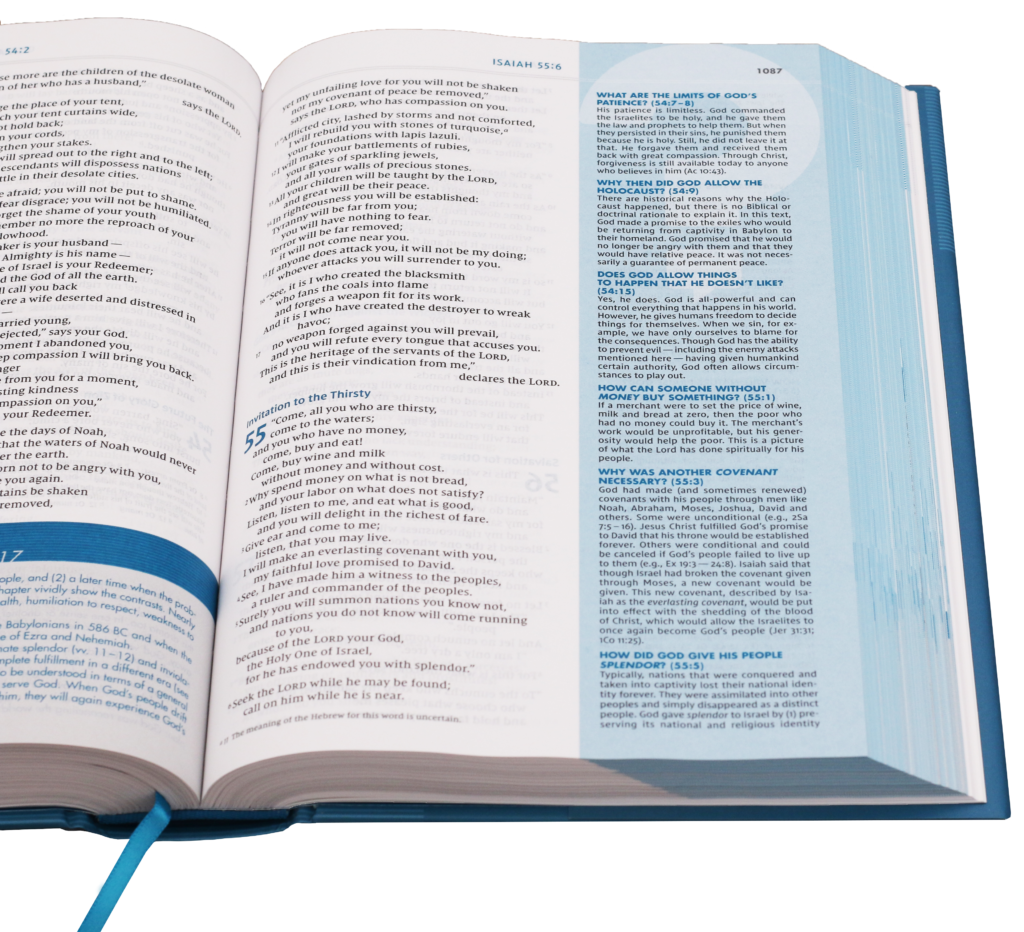
THE NIV QUEST STUDY BIBLE ANSWERS YOUR QUESTIONS
The original NIV Quest Study Bible was conceived in 1989 when two publishing companies, Zondervan and Christianity Today International, worked together to develop a Bible that would answer the challenging questions that arose as people read Scripture.
Focus groups around the United States evaluated the usefulness of potential study Bible features and helped select the features that would be included in this Bible. Then, more than 1,000 people received passages of Scripture and were asked, “What questions do you have about this portion of the Bible?” Their responses helped determine what kinds of questions the notes would answer, helping to create a resource that answers the questions that real people have asked about the Bible. Notes have been updated in subsequent releases to ensure that this Bible stays relevant and current to modern readers.
Selections from the Top 100 Questions People Have About the Bible
(all 100 are answered in the NIV Quest Study Bible!)
The Bible doesn’t explain who God is or try to prove his divine existence. It assumes God is eternally present (Ge 1:1) and depicts creation as a result of his divine thought and action (Ge 1:1 — 2:25). God has, however, offered us a glimpse of who he is through creation (Ps 19:1 – 6), his Word (Ps 18:30 – 31), and especially through the incarnation of his Son, Jesus Christ, who is the radiance of God’s glory and the exact representation of his being (Heb 1:3). Jesus demonstrated God’s compassion, grace and glory in his life, death and resurrection. From this and from the empowering presence of the Holy Spirit at Pentecost (Ac 2:1 – 13), our awareness of God as Trinity (one God in three persons) was formed.
While God’s being is beyond comprehension or perception (Ex 33:20; Jn 1:18), both the physical world and the human conscience clearly attest to his values and purposes. In addition, God revealed what he values through the Sinai covenant (Ex 20:1 — 24:18). The Ten Commandments (Ex 20:2 – 17; Dt 5:6 – 21) were affirmed by Jesus as a faithful summary of God’s moral values (Mt 5:17 – 47), and they continue to shape social values and legal systems today. God also revealed what he values through the dietary regulations (Lev 11:1 – 47) and worship regulations (Lev 1:1 — 9:24; 16:1 – 34; 21:1 — 25:55) that were given to the ancient Israelites. Those regulations emphasized God’s holiness and his desire for his people to be holy (Lev 11:44). When Jesus came to earth, he taught that while actions are important, God is more concerned with the heart (Mt 5:17 – 47; 15:18 – 20). God desires that we love him, trust him, obey him and imitate his character in our interactions with others by being compassionate, loving and forgiving.
So how can we approach such a holy God? Access to God is only through faith in Jesus Christ (Jn 14:6; Ro 5:1 – 2; Eph 2:13 – 18; 3:12). Christ suffered once for sins, the righteous for the unrighteous, to bring [us] to God (1Pe 3:18). Let us then approach God’s throne of grace with confidence, so that we may receive mercy and find grace to help us in our time of need (Heb 4:16).
Scripture teaches that God sometimes adjusts his plans in response to our actions or requests. The Bible contains several examples of this: the Hebrews on the outskirts of Canaan (Nu 14:11 – 23); Hezekiah’s repentance on behalf of Israel (Am 7:1 – 7) and the sparing of Nineveh (Jnh 3:1 – 10).
Experiencing God’s will is dynamic. As with any interpersonal relationship, God’s relationship with humanity involves complex twists and turns. God modifies his responses based on ours, and we adjust our responses to God’s. So, in a sense, it can be said that God sometimes changes his mind in response to our prayers.
At the same time, God’s will is determined. There are decrees and promises he has made that do not change. He kept his covenant with the forefathers of the Israelites (Dt 7:7 – 8), and he keeps his new covenant with those who believe in Jesus (Jn 6:37 – 40,44). God wants us to live out his will obediently. He has predetermined ways he expects us to respond, but he has made us capable of resisting him (Ps 143:10; 1Th 5:16 – 18; Heb 10:35 – 39; 2Pe 3:9).
These aspects of God’s will work together. While it is not possible for us to fully understand how they work together, we know that God is ultimately in control.
Abraham was an immigrant, so this issue is evident in Jewish and Christian history. God’s original commitments to Abraham included promises that all nations of the earth would be blessed through him and his descendants (Ge 12:1 – 9). This proved true when Israel’s borders were opened to anyone who wished to become part of the covenant community. Many people, such as Rahab (Jos 2:1 – 21; 6:23 – 25), the Gibeonites (Jos 9:1 – 27) and Ruth (Ru 1:16; 4:11 – 13), found a home and identity among God’s people.
Psalm 87 and similar passages in the prophetic writings indicate that all nations are part of God’s large family. Jesus was born into a family that included both Hebrews and immigrants (Mt 1:1 – 16); Jesus himself was an immigrant from heaven to earth (Jn 1:14). Hospitality was a key theme of Jesus’ teachings (Mt 10:40 – 42) and was echoed by his disciples (Ac 10:1 — 11:30; Gal 3:26 – 29) as the international and multicultural character of the family of God became more apparent (Rev 7:9 – 17).
In current political discussions regarding immigration, a number of factors have to be considered: economic needs, criminal and safety concerns, compassion for the poor and refugees, labor justice, and security. But Jesus’ followers would be wise to keep hospitality and justice high on the list of values that inform their opinions in conversations regarding immigration.
No one knows the mind of God, except for God himself. He is infinite; we are finite. We are not entirely clueless about his character, however, because God speaks to us through his Word. According to the Bible, one reason bad things happen is because the whole world is under the control of the evil one (1Jn 5:19). That’s why Jesus taught us to ask God to deliver us from the evil one when we pray (Mt 6:13). Even in the Garden of Eden — in paradise, before Adam and Eve partook of the forbidden fruit — Satan was already there, waiting to tempt them to disobey God (Ge 3:1 – 6).
Another reason bad things happen is because people sin. The reason why God allows people to sin and be tempted to sin is not for us to know — at least for now (Dt 29:29). What we do know is that when bad things happen, we should not rage against God. To revolt against God is to fall prey to the devil. The devil is a liar (Jn 8:44) and wants us to believe that God is blameworthy. But the Bible says that God is light; in him there is no darkness at all (1Jn 1:5). God is not the enemy; Satan is the enemy. Through his Spirit God empowers us to war against the enemy by following Jesus Christ, our Lord and Savior — during good times and bad times.
A Christian is someone who knows there is nothing they can do to deserve God’s love but who gratefully accepts and trusts in what God has done through the sacrifice of his Son, Jesus Christ. This faith translates into a life lived in love, gratitude and service. A Christian family, then, reflects these same values. While the members of a Christian family are not perfect people and are not without problems, they do believe that God has their best interests at heart. The Bible and the commandments from God found in it serve as their rules for living. They strive to live according to God’s Word and make God the foundation of their beliefs as a family unit.
However, the modern family unit has changed over the years. Whether comprised of a husband and wife with no children, a husband and wife with children, a single parent raising a child or children alone, or any number of other scenarios — the goal of a Christian family is to love God and love people.
With that in mind, the definition of “family” can extend beyond blood relatives and those related by marriage. One Biblical illustration of what a Christian family can look like may be found in Matthew 12:48 – 50, where Jesus said that his “family” is comprised of those who do the will of his Father in heaven. Jesus’ answer emphasizes the great importance of our spiritual family — those with whom we may not share blood but with whom we share a common and strong faith in God and his Son, Jesus Christ.
It should be noted, however, that being a Christian doesn’t necessarily mean that every member of one’s family will also be a Christian. It’s possible that only one spouse may believe (1Co 7:12 – 14; 1Pe 3:1) or that some children won’t believe. After all, even Satan rebelled against the perfect Father.
When Jesus introduced prayer by saying, Our Father (Mt 6:9), he reminded us that prayer is more personal than prescriptive. Prayer is a “divine dialogue” between God and those who have a relationship with him. Therefore, we are welcome to come to God anytime and anywhere.
Like Jesus, we may pray early in the morning (Mk 1:35) or in the evening (Mk 14:32). We may pray when we are afraid (Ps 119:145 – 146), when we are in need (Mt 7:7 – 12) or when we lack wisdom (Jas 1:5). We may also pray to express the joy (Php 1:4) and the gratitude (1Th 5:16 – 18) we feel when we see God at work around us. And while many of our prayers include requests for our personal needs, it is right to pray for others (1Th 5:25), including those in authority (1Ti 2:1 – 2) and even our enemies (Mt 5:44). We should pray on all occasions with all kinds of prayers and requests (Eph 6:18).
Our prayers at any timemay also be offered in any place. Hannah’s prayer in the temple (1Sa 1:9 – 11) was no more spiritual than Moses’ prayer in the desert (Ex 32:11 – 14). Jesus prayed in a garden (Mk 14:32 – 42). Jonah prayed in the belly of a fish (Jnh 2:1 – 10). Paul prayed in prison (Ac 16:22 – 25). Nehemiah prayed in the king’s court (Ne 2:4). No matter where we are, we can always be assured of reception with God when we pray.
In a word, yes. When Solomon said the people were as numerous as the dust of the earth (v. 9), he didn’t have an exact figure in mind. Solomon was using a figure of speech called hyperbole — an exaggeration not meant to be interpreted literally. He simply meant that he ruled over a lot of people.
The writers of the Bible’s 66 books used all the richness and variety of human language to communicate God’s message. To understand the Bible accurately, its various literary devices and figures of speech must be seen for what they are. If we interpret them at face value, the intended meaning may be missed completely.
The Chronicler reports in verse 15 that Solomon made silver and gold as common . . . as stones, and cedar[a rare and costly wood] as plentiful as sycamore-fig trees [a commonplace tree]. His point was not to be exact but to indicate great wealth — numbers that would boggle the mind.
There are many passages — especially in 1 and 2 Chronicles — in which the Bible offers precise information. But when God promised Abraham that his children would be as numerous as the stars (Ge 15:5), when Mark said that all the people of Jerusalem went out to see John the Baptist (Mk 1:5), or when Paul claimed to be the worst of sinners (1Ti 1:15), the context and language indicate a meaning beneath the surface rather than a literal meaning. Instead of being frustrated by the lack of precision in such statements, we should be thankful that God reveals himself in the richness of human language.
As every psychiatrist knows, unresolved guilt and brooding regret are significant blocks to healthy living. The Bible emphasizes self-analysis and awareness (Ps 139:1 – 24), confession and repentance (Ps 32:1 – 11; 51:1 – 19; Jas 5:16), and forgiveness (Mt 6:14) as elements of a sound spiritual lifestyle.
But the past cannot be altered. Therefore it is also important to accept what has happened and learn how to live with the consequences of our choices and decisions. Once the consequences are acknowledged and dealt with (Ps 51:1 – 19), and the lessons are learned (Ps 107:1 – 43), we must be able to forgive ourselves because God forgives us. We need to forgive ourselves so that we can move ahead with hope into the future.
Forgiving ourselves is not always easy, nor is it a matter only of individual concern. The teachings of the Bible indicate that self-forgiveness is a spiritual journey that takes place best in community. It is often within the faith community that we come to understand that there is no condemnation for those who are in Christ Jesus (Ro 8:1). It is there that we find the grace, forgiveness and comfort of both God and others (2Co 1:3 – 7; 2:7). It is there that we can confess our sins to God and others and be healed (Jas 5:16; 1Jn 1:9). And “community” isn’t limited to church congregations. There are many communities of faith working to help people heal from the consequences of their past choices. The “Twelve Steps” of Alcoholics Anonymous were formed on the basis of Biblical teachings and spiritual insights; as such, they often help people respond constructively to the tortures of an imperfect past.
It sometimes seems that people are caught in events beyond their control, events manipulated by God or Satan. They may feel forced into situations they would not choose if they were given a choice. While this seems unfair, there is another way — a higher way — to interpret the circumstances of life. We can see them as God-given opportunities to cooperate with God’s purposes and plans that allow us to participate in something far more significant than our own schemes. We are more than pawns in a chess game. We can honor Almighty God by the way we live and die.
Still, many unanswered questions remain. Only God knows why dozens of bystanders had to die in this unfolding drama between Satan and God. We struggle with the fact that some who are righteous have short, tragic lives, while others who are wicked enjoy wealth and long life. There is one thing we can affirm, however: what seems unfair in this life will be made right in eternity. Our problems will be resolved and many of our questions answered.
God has permitted Satan certain freedoms. Satan is called the prince of this world (Jn 14:30) and the ruler of the kingdom of the air (Eph 2:2), for he sometimes uses sicknesses, plagues, wicked people and the forces of nature. Though God dealt a fatal blow to Satan through Jesus’ death and resurrection, Satan continues to struggle against God and will do so until the end (Ro 16:20).
There are two sides to the suffering of the righteous: the earthly and the heavenly. The apostle Paul understood the tension of living in a corrupt world. He placed his trust in God and things eternal — God’s justice, mercy and love — not in the temporary things of this world — success, wealth and fame. Paul recognized that our struggle is not against flesh and blood (Eph 6:12) and took courage in knowing that our citizenship is in heaven (Php 3:20).
One of the differences between the personal God of the Bible and all other so-called gods is that the Lord is near us whenever we pray to him (Dt 4:7). However, anyone who has ever prayed has surely experienced a time when their prayers didn’t seem to make it higher than the ceiling.
Sometimes God is silent when we harbor sin in our lives. The psalmist understood that the Lord would not listen to his prayers if he cherished sin in [his] heart (Ps 66:18). Indeed, if Jesus experienced separation from the Father when he took our sin on himself at the cross (Mt 27:46), we should not be surprised to experience a sense of distance from God when we have unconfessed sin in our lives. When we rebel against God, he does not listen to our prayers (Isa 1:2,15; 1Pe 3:7; cf. Heb 5:7).
Similarly, our prayers may go unanswered if we ask with self-centered intentions (see Simon’s story in Ac 8:9 – 25). Jesus’ model of prayer, the Lord’s Prayer (Mt 6:9 – 13), included not only personal requests but also praise, thanksgiving and intercession. Selfish requests made with insincere motives will fall on deaf ears (Jas 4:3).
At other times, our prayers may seem ineffective when, in fact, the silence of God is intended to bolster our faith. In Luke 18:1 – 8, Jesus told a parable about a woman who sought help from a judge who initially refused her request but eventually gave her what she asked for because of her persistence. The lesson of the story is that God — a just judge who cares for us — will see to it that our needs are met, but we must exercise faith in his sovereign goodness (Lk 18:8). And while our praying may not produce immediate results, praying with persistence changes us and moves us toward greater dependence on God.
Although the Bible is not an ancient history textbook, it does report events that have been confirmed by other historical works. Consider the following examples:
- Archeological digs and ancient Assyrian records confirm the Bible’s portrayal of King Sennacherib’s invasion of Judah (2Ki 18:13 — 19:37).
- Until recent excavations at Tell Mardikh uncovered tablets mentioning Sodom and Gomorrah (Ge 19:1 – 29), scholars dismissed the existence of both cities as a Biblical legend.
- The Hittites were also considered a Biblical legend until their capital and records were discovered in modern-day Turkey.
- The palace of King Sargon, an Assyrian ruler mentioned in Isaiah, was uncovered in Iraq. The events recorded in Isaiah 20 were even recorded on the palace walls.
- In 1947, the discovery of the Dead Sea Scrolls (which are copies of almost the entire Old Testament) confirmed how accurately the Bible was copied from 200 BC to AD 1200.
- Greek and Jewish writers (e.g., Pliny, Tacitus and Josephus) supported the Bible’s claims that Jesus really lived, that he was executed between AD 26 and AD 36 and that he was worshiped as God.
- Many of the details of the New Testament — including facts about Pontius Pilate, the census recorded in Luke 2, the death of Agrippa I, the execution of Ananias the high priest and the crucifixion of Jesus are also mentioned in other historical works.
The Old Testament seems to say yes. The New Testament seems to say the opposite. This apparent contradiction must be understood within its historical context.
Old Testament Israel conquered the sinful Canaanites as part of God’s judgment. Israel was a theocracy — a nation-state in which God was King. But New Testament followers of Jesus Christ knew only the oppressive rule of the Roman state. Jesus introduced a whole new paradigm concerning violence, resistance and peace in his teachings regarding the kingdom of God. In fact, some early Christians did experience tension between loving one’s enemy and serving in the military, while others such as the Roman centurion in Matthew 8:5 – 13 were encouraged by Jesus for their faith and their witness to those around them. At the end of the second century, soldiers began converting to Christianity, and by the time of Augustine (fourth century), Christians in the military were recognized as an essential component to carrying out warfare in a just manner.
In Romans 13:1 – 7, we read that God gives governments the right to bear the sword — the power of retributive justice to punish evildoers. Any nation has a God-given responsibility to exercise just and appropriate force to protect its citizens from evil. The Bible does not detail how this is to be carried out, but the principles of punishing wrongdoers and protecting the innocent are the basis of our system of law enforcement today, on both a national level (police, FBI, etc.) and an international level (the military).
This does not mean that God approves of everything that is done in the name of law enforcement or war (e.g., torture, wars of conquest, use of nuclear weapons). But the basic principles of punishing wrongdoers and protecting the innocent are in keeping with the character of God.
There is an old saying that ships were meant for the sea, not for the harbor. While the harbor is safe, the ship never fulfills its purpose until it is tested in deep waters. We face a similar dilemma in overseeing the lives of our children. Our natural instinct and primary duty while they are young is to protect them. But just as important, we must prepare them to face the risky, even dangerous, situations that life inevitably presents.
Parents can find a healthy balance by working to develop three interrelated qualities in their children that will bear much fruit when their children grow to be adults. First, parents should raise their children to desire wisdom. What parent would not desire for his or her child to follow Solomon’s example and ask God for wisdom above wealth and honor (1Ki 3:6 – 9)? The pursuit of wisdom will help children stay out of harm’s way and equip them with the skills needed for effective leadership in any calling.
Second, parents need to teach their children how to distinguish between right and wrong. Moral discernment and wisdom complement each other. Solomon, in fact, joined them together in his prayer for wisdom: So give your servant a discerning heart to govern your people and to distinguish between right and wrong. For who is able to govern this great people of yours? (1Ki 3:9).
Finally, parents should look for opportunities to vest maturing children with significant responsibilities that impact other people. This is one way to put into practice the stewardship principle found in Matthew 25:23: You have been faithful with a few things; I will put you in charge of many things.
The Bible has a lot to say about sex. In fact, God’s creation of sex is recorded at the very beginning of his written Word, and God’s first instruction to humankind was to have sex: Be fruitful and increase in number; fill the earth and subdue it (Ge 1:28). No one who studies the Bible can say that it is prudish about sexuality. Song of Songs is such a steamy account of sexual love that Jewish boys were forbidden to read it until they were 14 years old!
However, as our creator, God knew that people needed committed love to protect them. He knew that outside of a God-ordained marriage, sex can cause many emotional, physical and spiritual problems. The Bible says: Can a man scoop fire into his lap without his clothes being burned? Can a man walk on hot coals without his feet being scorched? So is he who sleeps with another man’s wife; no one who touches her will go unpunished (Pr 6:27 – 29).
This instruction isn’t just for adultery. In fact, any sexual relationship outside of marriage is outside of God’s good plan for us. Sex was meant to be the intimate bond that holds a marriage together, as Jesus noted in Mark 10: For this reason a man will leave his father and mother and be united to his wife, and the two will become one flesh (vv. 7 – 8). Paul said that we are to honor God with our bodies (1Co 6:20). That means sex is essential between a husband and wife (1Co 7:3 – 5) but prohibited under any other circumstance. All people should flee from sexual immorality (1Co 6:18).
When God created human beings in his image, he gave them a privileged position above all other creatures (Ps 8:5). This position also carried the responsibility of caring for their environment. God’s first mandates to his people were to fill the earth and cultivate the land (Ge 1:28 – 30). Therefore, human beings are stewards (managers) of all the good things God has made. We are accountable to God to care for his world.
Another reason that Christians should be concerned for the environment is because creation is intended to reflect the glory of God (Ps 19:1 – 2). The beauty of leaves turning color in the fall, the power of Niagara Falls and the majesty of Mount Everest all point people to the beauty, power and majesty of their Creator. For this reason, we care for the world as an act of worship — preserving our environment to bring greater praise to God.
Finally, we care for the earth because as we do, we join God in his kingdom agenda. Sin did more than contaminate human hearts; it also threw physical creation into chaos (Ge 3:17 – 18; Ro 8:22). Since that time, God has been reclaiming, redeeming and renovating the world. One day, Jesus Christ will return and make all things new (Isa 65:17; Rev 21:5). Until then, we cooperate with God’s great goal of restoration when we protect, preserve and cultivate the world around us.
No matter how much we desire to know God’s will, he reveals his plans regarding the future of the world and the future of our lives on a selective basis. Consequently, some people strain to find clues or signs of God’s will — as if they are mysteriously encoded in ways that only super spiritual people can decipher. Such a process is both frustrating and subjective.
The Bible does, however, tell us that we can be sure of several things that fit within God’s purpose for each of us. While our plans may be upset, his purpose will prevail (Pr 19:21). We were put here to worship God (Jn 4:23), become part of his family (Ro 8:14 – 16), grow in spiritual maturity (Eph 4:14 – 15), serve others in the church (Eph 4:16) and bear witness to the world of God’s love and grace in Jesus (Ac 1:8). In addition, it is God’s expressed will that we serve those who are less fortunate than we are. Jesus put it this way:
Then the King will say to those on his right, “Come, you who are blessed by my Father; take your inheritance, the kingdom prepared for you since the creation of the world. For I was hungry and you gave me something to eat, I was thirsty and you gave me something to drink, I was a stranger and you invited me in, I needed clothes and you clothed me, I was sick and you looked after me, I was in prison and you came to visit me . . . Truly I tell you, whatever you did for one of the least of these brothers and sisters of mine, you did for me” (Mt 25:34 – 36,40).
Finally, while God created each of us with our own personality, he wants us to be conformed to the likeness of his Son, Jesus Christ (Ro 8:29). He does not want anyone to perish, but instead desires everyone to repent — to have a change of mind that leads to a changed life (2Pe 3:9).
There is no easy answer to this question. Perhaps the most straightforward reply is that it depends. It depends mostly on what you mean by the church’s involvement. When we speak of the “church,” if we are thinking of each individual believer bearing witness to God’s truth in public debates on critical political and moral issues, then it seems clear that the level of involvement should be high, as God’s people should give . . . to God what is God’s (Mt 22:21). This often takes the form of checking the state’s messianic ambition. But if we understand church involvement in politics to be formal representatives of a denomination taking official stances on political issues, then the line becomes quite a bit more obscured for two important reasons.
First, Scripture teaches that we are to maintain a clear conscience toward God (1Pe 3:21), which implies that each individual believer is responsible for his or her actions, political affiliations and beliefs. Aside from the obvious issue in this country of a church’s tax-exempt status being jeopardized by engaging in party politics, the more important matter relates to the binding of consciences that can take place when church officials take positions on behalf of their members. Second, a great many stances on political issues fall into the category of prudential judgment, and this is an area in which God’s people are to free to lovingly disagree while they give back to Caesar what is Caesar’s, and to God what is God’s (Mt 22:21). The question is not how muchpolitical involvement is appropriate, but which kind of political involvement is appropriate.
So how involved should Christians become in the politics of our nation and culture? There is no set answer, but we are to observe at least two principles. First, we must show respect for our political leaders (Ro 13:1 – 7) and work together with them in caring for our society. Second, we must remind the state to not play God and resist any messianic ambitions that politicians announce (Ac 5:29).
The church is a spiritual organism and, at the same time, a human organization. We become members of the organism by new birth and baptism (1Co 12:13) and members of the organization by covenant. Most of the controversy about the church becoming what Jesus intended is focused on this organizational form. The real issue, however, is not with organization, but with people who occupy it (both leaders and members).
On the one hand, we Christians still live with our own version of the flesh, not realizing that we are angry, envious, competitive and self-righteous, which are all barriers to communication. On the other hand, we tend to see the sin of others so much more clearly than our own. We each have our own set of expectations as to what the church should be. We go from church to church in search of this ideal, which gets in the way of living dynamic, loving lives in the imperfect church we are in. In Life Together, Dietrich Bonhoeffer writes, “He who loves his dream of community more than the Christian community itself becomes a destroyer of the latter.” We all have our own dream of what the church should be like, and when we cannot find it, we grow disillusioned. However, true fellowship is based on faith and not dreams — on truth and not emotions. Bonhoeffer boldly suggests that the sooner disillusionment comes, the better: “Therefore the very hour of disillusionment is instructive because it teaches me that neither I nor my brother can live to ourselves, but only through the grace and forgiveness of Jesus Christ.”
In other words, the church will become what Jesus intended it to be when we receive one another with grace and forgiveness instead of measuring one another by our own faulty expectations.
Your kingdom come, your will be done, on earth as it is in heaven (Mt 6:10). This is the essence of our purpose. We are to honor God and advance his kingdom through who we are and in everything we do.
Through our cooperation with God’s Spirit who is at work within us, we can grow to the point that what we want aligns with what God wants — our passions and purposes are his passions and purposes; we think, speak, act and relate in a Christlike way. We will never be perfect or without struggle in this life, but we can be inwardly connected to Jesus (Jn 15:1 – 8). We listen for the Spirit’s guidance. We cultivate our gifts. We live our lives pursuing God’s kingdom interests (1Co 10:31 — 11:1).
But often this isn’t enough for us. We want to know our specific, individual purpose with certainty. We want the mystery solved. We want to find a unique purpose that focuses our energies and convinces us that our life counts.
Perhaps our feverish search for the specific is misguided. Maybe our need for certainty reflects our addiction to control and what Eugene Peterson calls “insiders’ pride.” God wants us to trust him, and sometimes knowing too much leads to trusting too little. Maybe letting go of the pressure to find our purpose — and instead following hard after God each new day — will center us squarely in the target.
The question of whether or not Christians should do good works can be answered with an enthusiastic “Yes!” Jesus said that his disciples are the light of the world (Mt 5:14). He then said, Let your light shine before others, that they may see your good deeds and glorify your Father in heaven (Mt 5:16). Jesus calls us to stand out from the rest of the world by the good deeds we perform. Paul also characterized redeemed believers as those who are eager to do what is good (Titus 2:14).
Still, there is often confusion about how good works are related to salvation. The Scriptures teach that good works are not the cause of our salvation but the result. We cannot earn our salvation with good works. Paul said,For it is by grace you have been saved, through faith — and this is not from yourselves, it is the gift of God — not by works, so that no one can boast (Eph 2:8 – 9). After reading Paul’s statement, it’s natural to wonder if good works have any place in our lives. But in the next breath, Paul said, For we are God’s handiwork, created in Christ Jesus to do good works, which God prepared in advance for us to do (Eph 2:10).
Imagine the goodness of a God who not only offers salvation as a gift but also makes us new creatures in Christ who are able to perform good works that he himself has orchestrated beforehand!
The Bible isn’t saying that husbands have license to be domineering, abusive, controlling, tyrannical or dictatorial. It doesn’t mean that wives shouldn’t be allowed to express themselves, think independently or cooperate in decision making that affects the couple and the family. Ephesians 5:22 – 24 teaches mutual submission: husbands and wives are to live in an attitude of humility and service to one another, and together, as well as individually, they are to be in submission to Christ.
The word submission takes on a positive meaning as we understand the loving God who becomes the source for all authority. When a husband willingly submits to the loving authority of Jesus Christ, he treats his wife with the same sacrificial love that Christ displayed to his bride, the church. When mutual submission is practiced, husbands and wives embody the humble servanthood that epitomized Christ’s earthly obedience, even to the point of death (Eph 5:25 – 33).
We see an example of submission at work in the Trinity. Jesus the Son willingly submitted to the Father, because Jesus knew the Father loved him (Jn 15:10). Similarly, the Holy Spirit willingly submits to Jesus and exalts Jesus in everything he does (Jn 16:13 – 15).
While Jesus and the Holy Spirit willingly exercise submission in their relationship with the triune God, they also act as co-equal members of the Godhead. Their willing submission doesn’t mean one person in the relationship is less important than the other. The same is true in a marriage relationship.
Matthew Henry wrote: “The woman was made out of Adam’s side. She was not made out of his head to rule over him, nor out of his feet to be trampled upon by him, but out of his side to be equal with him, under his arm to be protected, and near his heart to be loved.”
First and foremost, the church is to preach the gospel — to make known to sinners the free offer of salvation through Jesus Christ. This was Jesus’ great commission to the church: Go and make disciples of all nations (Mt 28:19). The gospel is preached not only when someone stands in front of an audience but also when Christians live out their faith (especially in times of trouble) and tell others the reason for the hope that [they] have (1Pe 3:15).
Christians also serve the world by loving one another and the Lord (Jn 17:23). The church is the body of Christ in this world. When unbelievers witness church members serving one another and the community as a healthy, Spirit-filled body, they see Jesus for themselves and are drawn to him (Mt 5:16; 1Pe 2:12).
Being agents of grace and compassion in the world is another sphere of the church’s service (1Pe 3:8 – 9). “This is a dog-eat-dog world,” people often say. But Christians are to reverse that by giving generously of their resources, by advocating justice for those who cannot speak for themselves and by befriending those who are friendless.
Finally, Christians can pray. We can ask the Judge of all the earth [to] do right (Ge 18:25). We can ask God for wisdom when it comes to helping people. We can ask for God’s resources when it’s unclear how the need will be met. And we can ask for the love of Christ to be vividly expressed to those who have no one to care for them.
When children are born, they are helpless and incapable of survival without the care and protection of their parents or guardians. In addition, children are sponge-like learners who are talked into talking, walked into walking, loved into loving and socialized into relational skills. It is no wonder God places huge responsibilities on parents for their children’s faith development (Dt 4:9 – 11; Pr 22:6; Eph 6:4).
A significant portion of this development should happen in the home (Dt 6:1 – 25; 2Ti 1:5), where loving parents model faith and commitment (Pr 1:1 – 9:18). This often involves the creation of intentional teaching moments based on a society’s cultural heritage (Ex 12:26 – 27; 13:14; 16:32 – 33; Dt 6:20 – 25; Jos 4:21 – 23). Indeed, the church and overall faith community is always responsible for nurturing a broad range of religious education and guidance (Joel 1:3; 2:16; Ac 2:39).
For this reason, the church has always promoted organized methods of training, including larger systems of community and social education. At the very least, faith communities should promote healthy marriages and homes (where children receive their first and most influential spiritual nurturing), provide good training classes and youth groups, and encourage positive investment in local educational systems.
According to the Bible, all Scripture is God-breathed (2Ti 3:16). Peter confirmed this when he said that those who wrote the Bible were not speaking on their own but spoke from God as they were carried along by the Holy Spirit (2Pe 1:21). Many parts of Scripture are directly attributed to God through use of phrases like This is what the Lord says (e.g., Ex 4:22). Finally, Jesus often quoted from the Old Testament and affirmed it as being God’s Word.
Prophecies that were later fulfilled are corroboration of the accuracy of the Bible’s claim to be God’s Word. For example, the vision recorded in Daniel 7 correctly predicted the rise of the Medo-Persian Empire, the Greek Empire under Alexander the Great, and the Roman Empire.
Archaeological discoveries are also important evidence of the Bible’s accuracy. For example, for many years King David was believed by some to be a fictional character. But recently a composition from a king of Syria referring to the “house of David” was discovered at Tel Dan. This writing provides tangible evidence that ancient rulers indeed recognized the dynasty of David in Judah.
Another reason for confidence in the Bible’s authenticity is its internal consistency. The Bible is actually a compilation of 66 books written over a period of 2,000 years by more than 40 different authors, and yet there is a unified message and a striking theological coherence — something that clearly speaks of God’s guidance throughout the process of writing, transmitting and assembling the Biblical texts.
It is important to remember that the original Biblical documents no longer exist. We are dependent on copies, and copyists can make mistakes. However, scholars have carefully tracked the accuracy of ancient manuscripts from different centuries, and their consistency gives us good reason to be confident in the Bibles we read today. Furthermore, rigorous standards were applied to determine the canon — both by the Jews, who determined the collection of books that make up the Old Testament Scriptures, and by the early church, which decided the books to be included in the New Testament.
In the Bible, faith is always tied to an active trust in God and his Word. For the believer, there is no such thing as “blind faith.” Faith is the sensible response to the revealed will of God and the privileges he has promised his people. Biblical faith does not mean that people can believe in any unlikely thing and God, in response, must bring it to pass. In other words, faith that is not directly attached to God’s Word is merely positive thinking.
At its core, faith — trusting God — is how people access the salvation God has provided in Christ Jesus. Abraham, the father of all who have saving faith (Ro 4:16), believed God, and it was credited to him as righteousness (Jas 2:23). Faith is not righteousness, but it is how we access Jesus’ saving righteousness — something we could never access on our own (Eph 2:8).
Faith, God’s gift to his followers (Eph 2:8), is fortified by paying careful attention to the Bible and practicing the spiritual disciplines. Romans 10:17 says, Faith comes from hearing the message, and the message is heard through the word about Christ. Throughout the Christian life, faith continues to be how believers receive the privileges and necessities for serving Christ. We trust God to give what he has promised — whether it is gifts and abilities to do the work of Jesus in the world and in our own hearts (Jn 14:12 – 13) or whether it is carrying us through our spiritual journey and into our eternal home in heaven.