

What If We Became Friends?
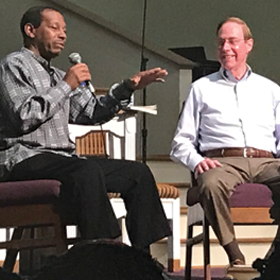 By Gary Chapman & Clarence Shuler
During the summer of 2020, racial tensions in American culture once again made headlines. Images of White policemen killing unarmed African Americans stirred emotions. Our screens were filled with images of individuals breaking windows and looting stores in many of our major cities. On both sides, anger led to overreactions. Some labeled all policemen as racist and called for the abolition of the police.
We believe that most citizens were bewildered that such things could be happening. Many thought that as a nation we were further along than that in understanding racial differences and learning to live as fellow citizens with respect for all races and cultures. Many were tired and dejected that such things continue to happen to them. The August 2019 Walmart shooting in El Paso, Texas, in which twenty-two people were killed, was aimed at Hispanics. During the first quarter of 2021, attacks on Asian Americans spiked by 164 percent, according to police data. And Native Americans experienced the violation of more than eight hundred treaties with the United States government, resulting in massive loss of life, land theft, and the subjection of Native Americans to the power of American law.
Many of us have lived long enough to remember the racial tensions that accompanied the integration of schools, restaurants, and other public facilities in the 1960s and ’70s. Most Americans saw these changes as a giant step forward in racial relations. Yet here we are, half a century later, appearing to have made little progress in racial understanding.
The obvious question is why. Why have we made so little progress in living together in the United States of America? Where is our unity? And why does it seem so tenuous? We believe it is because we have failed on the interpersonal level in relating to those of a different race or culture. Most Americans do not have a close personal friend of another race. We may have casual acquaintances, but not close friendships.
Some social structural changes, such as school integration, can be legislated. Many of our national and local leaders are seeking to make such changes. But loving relationships cannot be legislated. They must be developed by individuals of different races and cultures. Without deep cross-cultural friendships, we will never understand each other, and our relationships will always be tenuous in America.
We believe everyone can help heal racial divides one relationship at a time. Cross-cultural friendships become life-changing when we learn from each other, and result in mutually beneficial, intimate, long-lasting relationships while lessening racial tension.
Cross-cultural is not simply a Black-White issue. America is composed of numerous cultures, all of which deserve to be treated with dignity and respect. We need to develop loving friendships in which we learn from each other and seek to enrich each other’s lives. True friends may disagree on many things, but they will not allow disagreements to divide them. They will each seek the well-being of the other. Imagine a nation, and a world, where cross-cultural friendships are a way of life.
In a world often divided by race, it is important to realize that none of us chose our parents, our color, and the place and time of our birth. We were born into a culture which already existed. Some were born into affluent families. Some were born into poverty. Some were born to single moms and never knew their fathers, while others grew up with both a mom and a dad. Some saw their parents divorce, often after experiencing verbal or physical abuse. All of these factors made an impact on our lives.
Racial Versus Cultural Identity
We acknowledge that there is considerable confusion even in the terms we use when we refer to someone of a different race. For example, would you call me (Gary) White, Caucasian, or Irish American? Would you call me (Clarence) Black, African American, a person of color, or just an American who happens to have black skin? If a person born in Jamaica immigrated to the United States, would we call him or her Black, Jamaican American, African American, or a Black from Jamaica? If you have a friend who is from China or whose parents or ancestors came from China, do you speak of them as your Chinese friend? Or just “my friend Jung”? It is not our purpose to promote a particular term. In building friendships, especially cross-cultural ones, we believe it is essential to use the term that the other person prefers. We also know that derogatory names are sometimes used of various races. These are never appropriate.
When it comes to racial and cultural differences, racial differences have to do with physical distinctives—primarily skin color and facial characteristics. Cultural differences refer to patterned ways of life. For example, Chinese culture is distinct from Indian culture. Culture includes language, family structure, economic system, musical forms, and religion. Of course, within every major culture there are subcultures. For example, we speak of American culture, but we have many subcultures within America. These are ways of life that were brought to America by people from many different cultures. These subcultures operate within the larger framework of American culture. Sometimes we use the words race and culture interchangeably, but often people of the same race are of different cultures.
According to the latest research, 75 percent of Whites do not have any friends of color, and this percentage is even higher in the evangelical church. If this is your experience, the racial violence and tension in recent years may be new to you. It is, of course, not new to people of color who continue to experience racial violence. But regardless of your racial and cultural experience, one vital message must be shared: building friendships across racial and cultural lines will change individual lives and our country for the better forever.
Interracial contact is inevitable in America, because we are a multicultural country. How we relate to those of another race is a choice. Some choose to largely ignore those who do not look like them. Others choose to acknowledge each other only with a nod and perhaps a “hi.” Some, particularly in school and vocational settings, choose to have conversations about work, sports, and the weather. But few have deep and abiding cross-cultural friendships.
Seeking a Biblical Solution to the Racial Divide
I (Clarence) have many friends who don’t look like me. I feel that I am rich with friends. Some of my close friends who don’t resemble me initially said things that offended me. Some of these friends and I disagree politically. Yet I have found these cross-cultural friendships to be beneficial and life changing. They are valuable and continue to force me to look at situations from a different perspective. They help me process my emotions and reach healthy conclusions. My cross-cultural friends say our relationship does the same for them.
I (Gary) fully agree with Clarence. We don’t have to agree on everything to be friends. What is important is that we value each other as persons and desire to understand, encourage, and enrich each other. Clarence and I have had this kind of friendship over many years. We have each experienced the benefits of our friendship. That is why we are so motivated to help others build such relationships.
We wrote Life-Changing Cross-Cultural Friendships together because in the providence of God, our paths crossed and neither of us has ever been the same. We have experienced a deep friendship for more than fifty years. In this book, we share our journey and how our lives have affected each other.
We believe that if every Christian had at least one friend of a different culture or race, it would radically change race relations in our country. Many are asking, “What can I do? I am only one person.” An ancient Chinese proverb says, “The journey of a thousand miles begins with one step.” We believe that building cross-cultural friendships is that first step. We encourage you to join us in promoting such friendships by putting into practice the biblical principles you’ll discover in Life-Changing Cross-Cultural Friendships.
It is our deep desire that others might experience friendships across racial and ethnic barriers like we have. We see this as the only hope for eliminating racism from our culture.
________
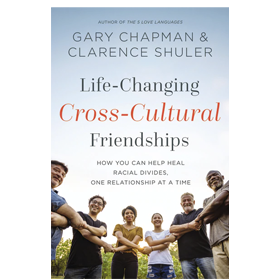 Adapted from Life-Changing Cross-Cultural Friendships: How You Can Help Heal Racial Divides, One Relationship at a Time by Gary Chapman and Clarence Shuler. Click here to learn more about this book.
We can heal our communities—one friendship at a time.
Many of us want to do something to improve race relations, but we don't know where to start or even if we can make a difference. In Life-Changing Cross-Cultural Friendships, beloved authors and good friends Gary Chapman and Clarence Shuler answer those questions and more by recounting their own story together.
Long before Gary was the bestselling author of The 5 Love Languages and Clarence was the president and CEO of Building Lasting Relationships, they were just an associate pastor and a young high school student, bonded by a love of Christ and learning how to navigate their newly desegregated community. Decades of friendship later, they are sharing the important lessons they learned that will enable you to experience enriching friendships across racial and ethnic barriers.
Each chapter of this inspiring and practical book will guide you into a deeper level of understanding about what friendship is and about the benefits of cross-cultural friendships on an individual and national level. These powerful lessons will include:
- The importance of choosing the right words
- How to differentiate true friends from mere acquaintances
- How Jesus initiated a cross-cultural relationship
- The first two steps to your own cross-cultural friendship
- Three ways to resolve conflict in a cross-cultural friendship
- How to make friendships last through life's many seasons
Breaking down the walls of division might not be easy, but the simple act of building friendships tears down walls of racism and fear. Will you accept the cross-cultural friendship challenge?
Gary Chapman—author, speaker, counselor—has a passion for people and for helping them form lasting relationships. He is the #1 bestselling author of The 5 Love Languages series and director of Marriage and Family Life Consultants, Inc. Gary travels the world presenting seminars, and his radio programs air on more than four hundred stations.
Clarence Shuler is the President/CEO of BLR: Building Lasting Relationships. He's authored ten books. He and his wife, Brenda, conduct marriage, men's, women’s, and singles seminars internationally. Clarence speaks to youth, college students, and singles about friendships, dating, biblical sex, pornography, and sexting. He and Dr. Gary Chapman speak together at The Five Love Languages, Date Night, and Life-Changing Cross-Cultural Friendship events. For more information, visit clarenceshuler.com.

